Hi everyone! Welcome back to my website! This Thursday, I
don't have a whole lot of updates, but updates are updates. Let's get started!
First of all, I haven't done a whole lot in concerning the
next episode of my stop-motion series called Planet of the Dinosaurs,
but I am still working on it. I'm hoping this episode (which will be the third
episode of the series) will be released in either late August or September at
the latest. Right now, it stands at 55% in completion, so I'll keep you posted.
In the past week or two, there have been no updates dealing
with several of the movies I've been posting updates on: process on movies such
as Walking with Dinosaurs 3D, Jurassic Park IV, The Good
Dinosaur have been rather hush, hush. However, I recently was surfing the
internet when I found out about another movie soon to be released! If you're a
fan of the Alcon Entertainmnt movie Dolphin Tale, which was
released in 2011, you'll be pleased to know that the creators of that movie
have decided to go ahead with (you guessed it!) a sequel! I for one think
that's an awesome idea because I totally love the movie Dolphin Tale!
The theatrical poster for the first film, released in 2011.
But for those of you who might have never seen Dolphin
Tale, it's based on the true story of a young female dolphin, later named
Winter, who washed up on a beach in Florida with her tail caught in a crab
trap. In the film, a boy named Sawyer Nelson (Nathan Gambles) quickly develops
a relationship with the dolphin who is taken to the Clearwater Marine Hospital.
The dolphin's tail unfortunately is too infected to remain on poor Winter and
it's amputated off. But the heroes of the movie have a plan: give her a
prosthetic tail!
This is Winter without her prosthetic tail
Dolphin Tale was a box office success, so it makes
since that Alcon Entertainment would want to go ahead with a sequel. I
know many times, sequels to movies often stink in comparison to the original,
but Dolphin Tale 2 might be different. Why? Well, it's also based on a
true story; while Winter will probably make an appearance in this film, the
film's going to be inspired by another dolphin's true story: the rescue of a
dolphin named Hope, who was rescued in 2010 and still lives at the Clearwater
Marine Hospital alongside Winter (by the way, Winter played herself in Dolphin
Tale). And alongside these marine mammal stars, the original cast from the
first film, including Nathan Gamble as Sawyer Nelson, Harry Connick Jr. as Dr.
Clay Haskett, Hazel's dad and Reed's son, Ashley Judd as Lorraine Nelson,
Sawyer's mom, Kris Kristofferson as Reed Haskett, Hazel's grandfather and Dr.
Clay's father, Morgan Freeman as Dr. Cameron McCarthy, Austin Stowell as Kyle
Connellan, Sawyer's cousin and Cozi Zuehlsdorff as Hazel Hasket, Dr. Clay's
daughter and Reed's granddaughter.
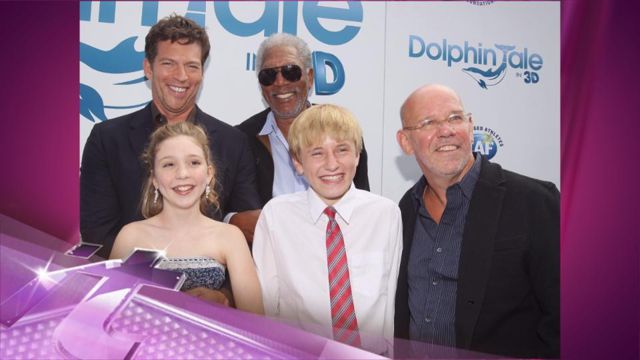
This photo includes some of the movie's cast: Harry Connick Jr. (rear left), Morgan Freeman (rear center), Cozi Zuehlsdorff (front left) and Nathan Gambles (front center).
Dolphin Tale 2 will be released on September 9, 2014,
so let's hear it for Winter!
I love it when I'm outside at night and the fireflies start coming out. I always try to catch a few of them and then watched as they flew away, off my hand. Fireflies are so much fun and just beautiful in the dark. They light up the night and are enjoyed by pretty much everyone.
This is a Japanese Firefly showing off its glowing tail.
Fireflies also known as lightening bugs light up because of a chemical reaction called bioluminescence. As a larvae however, the light is used to mostly warn enemies. Some people believe that the light is also used during mating season. Female fireflies tend to use the light for attracting males. However there are some fireflies that don't glow. Those lightening bugs have large antennas and small eyes.
The top photo was taken with the flash on, and the bottom picture was taken with it off to show the firefly's glow.
Night time is full of life but either we're too busy or already asleep to see it happen. There is practically a whole new world outside when the sun goes down and the moon and stars come up. You will see raccoons and owls, fireflies and Mosquitos, but most importantly, you will always see light at night and in the daytime. How much have you taken light and electricity for granted?
This is a beautiful picture of fireflies shining away in a pine forest.
Thanks for stopping by today! Next week, we'll learn about the ancient fauna that used to exist on Antarctica before it turned to the desolate and freezing cold continent of today! Until next time, goodbye!
PS: To post a comment (this is highly encouraged), please
simply click the post you wish to comment on, scroll to the bottom of the page
and put what you wish to say or ask in the comment box. Then in the box below
the comment box choose who you’re going to comment as. And then click preview or publish. If you aren’t signed into Google, you’ll be asked to type
in a word and a number in the space provided. Type the word, put a space and
then put the number. Then your comment is on the blog!
PS 2: Have a puzzling question about animals (including
dinosaurs), myself, my latest book, my stop-motion movies, Creation or etc?
Please post your question as a comment or send me an email at animaladventures@aol.com.
PS 3: What’s the latest scoop? Check it out at SMILEY’S NEWS.
PS 4: Be sure to comment on the latest stop-motion movies
too, this will help me improve them.
Welcome back to my blog everyone! Like last week, I don't have many
updates today, but we'll go through the few I do have and we'll get
to today's non-fiction article.
If you read last week's post, you'll recall that my latest
stop-motion series episode from the I'm working on (called Planet
of the Dinosaurs), The Tropical Poles was just released.
Remember that this is only the second episode, so we still have a lot
to cover in this series as there are four more episodes. The third
episode of the series, called Back to the Jurassic, is roughly
55% complete. I'll let you know how progress is going as the weeks
pass.
This week, Joy was not able to write an article, so that's why I
wrote one for today. I hope you like it:
In the Bible, there is a book appropriately named Job, after the man who the account focuses on. And if you know the story of Job, you'll recall that Job went through a time of severe testing and trials that would cause many to be angry with God. During this time, God came to Job to remind him just how great God is as Creator. During this conversation, God brought up many different species of animals, most of which are identifiable without question, but there are two in particular that cause trouble for many, one of which we're going to look at today – it's called Leviathan. As it's described in the 41st chapter of Job, we learn that this creature was an awe-inspiring beast that was massive and terrifying, even to the brave and mighty. In Job 41, God is describing Leviathan to Job as an example of something He created that is beyond mankind's ability to compete with.
For a long time, people have wondered what kind of animal Leviathan was and they've come up with many possible candidates. Today, we'll look into this matter and see which candidate best fits Leviathan!
First of course, we must see exactly what scripture has to say about Leviathan. Job 41:8-34 says:
“If you lay a hand on it, you will remember the struggle and never do it again! Any hope of subduing it is false; the mere sight of it is overpowering. No one is fierce enough to rouse it . . . I will not fail to speak of Leviathan’s limbs, its strength and its graceful form. Who can strip off its outer coat? Who can penetrate its double coat of armor? Who dares open the doors of its mouth, ringed about with fearsome teeth? Its back has rows of shields tightly sealed together; each is so close to the net that no air can pass between. They are joined fast to one another; they cling together and cannot be parted. Its snorting throws out flashes of light; its eyes are like the rays of the dawn. Flames stream from its mouth; sparks of fire shoot out. Smoke pours from its nostrils as from a boiling pot over burning reeds. Its breath sets coals ablaze, and flames dart from its mouth. Strength resides in its neck; dismay goes before it. The folds of its flesh are tightly joined; they are firm and immovable. Its chest is hard as rock, hard as a lower millstone. When it rises up, the mighty are terrified; they retreat before its thrashing. The sword that reaches it has no effect, nor does the speak or the dart or the javelin. Iron he treats like straw and bronze like rotten wood. Arrows do not make it flee; slingstones a like chaff to it. A club seems to it but a piece of straw; it laughs at the rattling of the lance. Its undersides are jagged potsherds, leaving a trail in the mud like a threshing sledge. It makes the depths churn like a boiling caldron and stirs up the sea like a pot of ointment. It leaves glistening wake behind it; one would think the deep had white hair. Nothing on earth is its equal– a creature without fear. It looks down on all that are haughty; it is king over all that are proud.”
So, what characteristics of this creature do we get from these passages? Here's a list:
It was an immensely strong beast (Job 41:12, 25-24)
Leviathan was mostly an aquatic creature, but it did come to land (Job 41:30-32)
It couldn't be captured due to its strength and ferocity (Job 41:3-6,9)
No one wanted to fight this beast more than once (Job 41: 8-10)
It had a huge jaw with sharp teeth (Job 41:14)
Leviathan could literally breathe fire and smoke (Job 41:18-21)
This creature had strong armor in the form of an impenetrable coat, or “rows of shields” as Job puts it (Job 41:13, 15-17)
Human weapons were useless when confronting this beast (Job 41:1-2, 7, 26-29)
Many Bible versions have attempted to identify Leviathan as some sort of crocodile. In fact, if you look at the footnotes in many Bibles referencing Job 41:1, they will say something like: “Probably a crocodile.” Many people think Leviathan was indeed a crocodile, but let's explore this. While it is true that crocodiles are strong, semi-aquatic beasts, have a fierce set of jaws and have tough armor, crocodiles normally live in rivers and lakes (one exception would be the Saltwater Crocodile, which often ventures out to sea), while Leviathan is said to have spent time in the sea. Also, the scales on a crocodile's back, while tough, can be penetrated by relatively “simple” human weapons, contrary to Leviathan’s armor, which is described more as shields than scales. Do you remember when the Bible described Leviathan as being so ferocious that no one would do battle with it more than once? Well, if the modern crocodile was the Leviathan described in the Bible, Steve Irwin, better known as “The Crocodile Hunter”, would have been out of a job! People can catch AND kill crocodiles with relative ease. And as if all this evidence wasn't enough, the Bible describes Leviathan as being able to actually breathe fire! What croc do you know that fits that description? Leviathan was not the modern crocodile!
Contrary to what many think, the modern crocodile is not the Leviathan of the Bible.
No other living animal fits the description of Leviathan, so we're forced to look at extinct animals instead to find Leviathan’s probable identity (much to the displeasure of Long-Age-believers). Some have suggested that Leviathan was one of the greatest predators ever to walk the face of the earth – Tyrannosaurus rex! After all, even the mighty would probably scared if they came across this beast! But there are some major problems with this theory as well. Dinosaurs were terrestrial creatures, while Job 41:30-32 clearly demonstrates that Leviathan was largely aquatic. T. rex stuck with hunting land-based prey. So we know that T. rex was not the Leviathan God described in Job.
Tyrannosaurus rex weighed 7 tons and was over 42 feet in length. Did you know T. rex had the strongest bite force of any animal ever measured?
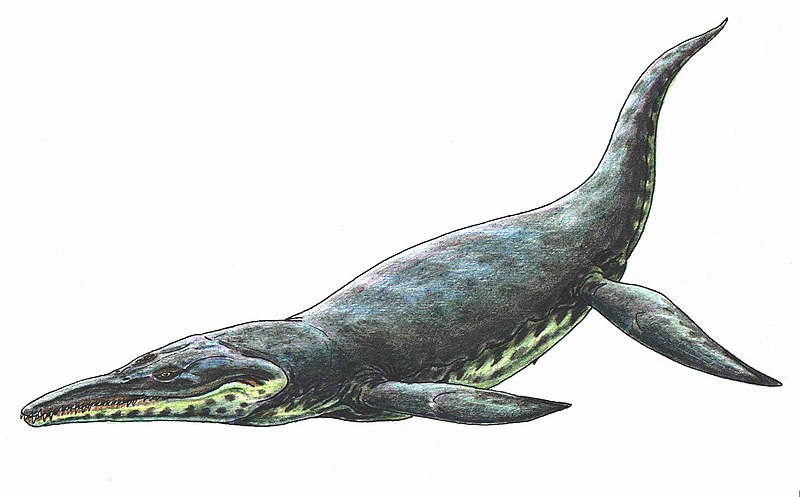
Some have attempted to assign Leviathan to other extinct marine creatures, such as the ferocious pliosaurs and mosasaurs. Pliosaurs were short-necked members of the order Plesiosauria and depending on the species, ranged from smaller individuals, such as the 15-foot Macroplata, to enormous monsters such as the 21-foot Liopleurodon, the 30-foot Kronosaurus and the 40+-foot long Pliosaurus. Many species of pliosaurs had jaws that were over 10 feet in length, and had pearly whites that could grow about a foot in length! Mosasaurs were marine lizards ranging from the meter-long Dallasaurus, to giant marine assassins such as Tylosaurus and Mosasaurus, each measuring over 50 feet in length. Both pliosaurs and mosasaurs were ferocious predators and seem to fit the description of Leviathan perfectly . . . except for one tiny detail: mosasaurs and pliosaurs were 100% aquatic, while Leviathan was semi-aquatic. The Bible explains how, “Its undersides are jagged potsherds, leaving a trail in the mud like a threshing sledge.” This creature was able to come on land. Pliosaurs and mosasaurs would probably be in the same state as a beached whale if they tried to come on land. In fact, God made pliosaurs and mosasaurs so at home in the water, that they even gave birth there.
Liopleurodon was a ferocious marine reptile!
Kronosaurus was originally estimated to be over 65 feet long! But recent research has proven that it was only around 30 feet -- still big enough to be a killer!
Mosasaurs were a lot like the monitor lizards we have today, but larger and they had flippers. They also ate anything that moved, sharks, turtles, fish, birds and even other mosasaurs!
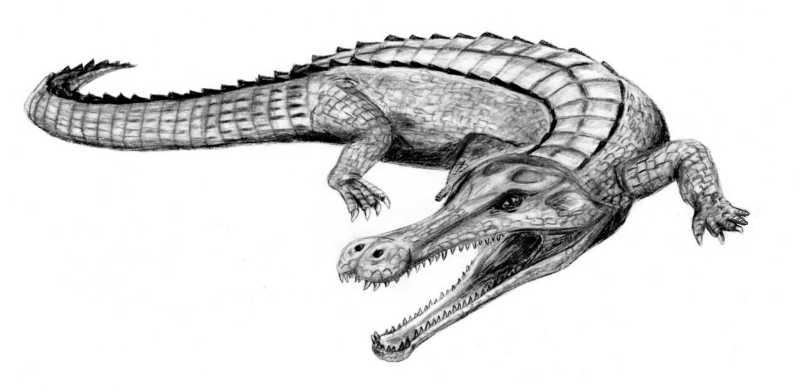
There are a number of possible candidates for Leviathan, but none of the ones we went through fit the description given in the Bible. All of the creatures mentioned fit only a few of the qualifications. But there is an extinct animal that fits very well. For a while, the case of Leviathan's identity remained cold . . . until the 1960's, when out of the sands of Northern Africa, scientists uncovered the fossils of a large reptilian creature. But it wasn't until 1997 and 2000 when scientists really started to learn about the anatomy of this beast. They named this creature Sarcosuchus imperator, meaning “flesh crocodile emperor”, but it is also commonly referred to as “Super Croc”. And “super” it was!
The skull of Super Croc is almost six feet in length and had dozens of sharp teeth.
At over 40 feet in length, it was one of the largest crocodilians that ever existed. It weighed at least 10 tons and the largest known skulls of Sarcosuchus were five feet long! Another amazing feature of this croc was the rows of osteoderms, or scutes along its neck, back and tail. Each bony scute was a foot long and many scientists describe it as looking like roofing tiles. This provided Super Croc impenetrable protection (sounding familiar?).
Sarcosuchus had foot-long scutes running down its neck, back and tail, making it almost impenetrable.
But perhaps the most unusual feature of Sarcosuchus is the large bulge on its snout, called a bulla. The male individuals of a modern crocodilian known as the gharial also have a bulla on the end of their snouts, and they use it for display. What did Sarcosuchus use its bulla for? Well, in addition for display, scientists have guessed that perhaps it was used to produce sounds or to improve its sense of smell. Creationists don't know either, but we do have some idea on a possible use.
What was the bulla of Sarcosuchus used for?
In the Bible, Leviathan is described as having the ability to breathe fire. Perhaps the bulla of Sarcosuchus was used to help it accomplish this feat! We don't know for sure, but this isn't out of the realms of scientific possibilities. Some people might believe that this sounds a bit far fetched, but let's explore this a little further.
There's a modern beetle known as the bombardier beetle, and believe it or not, God has designed a special feature for this critter to help it escape danger. When a predator such as a spider or carnivorous ant approaches the beetle, hoping to have it as a next meal, the beetle points its tail in the direction of the attacker and it shoots out spurts of hot chemicals that send an attacker packing! If a little beetle can do something like this, what about a 10-ton Sarcosuchus? And after all, it wouldn't be hard for God Almighty to create a fire-breathing creature anyway, I mean, He did create everything after all!
The bombardier beetle is able to fire noxious chemicals at its enemies through its tail (it's a wonder they didn't name it the "fire-blasting beetle").
We can't say for sure if the mighty Leviathan described in the Bible was a Sarcosuchus, but we can definitely say with certainty that it's a great candidate! And Sarcosuchus was a force to be reckoned with, either way. It was so large, that it was probably able to take down medium-sized dinosaurs! Leviathan was definitely an amazing creature God has created to exist on the planet, and it's a sad thing that this creature went extinct. Or perhaps, considering those fierce jaws and fire-breath, maybe it's just as well!
Here's a video clip of Sarcosuchus in action, this one isn't breathing fire, but it's still on the hunt . . . looking for prey:
I hope you enjoyed this week's article and I hope you'll stop by next
week to learn more about the wonderful world of nature. Bye!
PS: To post a comment (this is highly
encouraged), please simply click the post you wish to comment on,
scroll to the bottom of the page and put what you wish to say or ask
in the comment box. Then in the box below the comment box choose who
you’re going to comment as. And then click preview or
publish. If you aren’t signed into Google, you’ll be asked
to type in a word and a number in the space provided. Type the word,
put a space and then put the number. Then your comment is on the
blog!
PS 2: Have a puzzling question about
animals (including dinosaurs), myself, my latest book, my stop-motion
movies, Creation or etc? Please post your question as a comment or
send me an email at animaladventures@aol.com.
PS 3: What’s the latest scoop? Check
it out at SMILEY’S
NEWS.
PS 4: Be sure to comment on the latest
stop-motion movies too, this will help me improve them
The weeks pass by quickly don't they? Wow! We're already
passed the middle of the year and soon, Christmas songs will be ringing in our
heads. So before time slips away, let's get to updates, and then to this week's non-fiction article.
First of all, I have big news from my stop-motion series Planet
of the Dinosaurs that I have been working on for the past several weeks:
THE SECOND EPISODE IS FINISHED!!! That's right! I have successfully finished
the second episode, The Tropical Poles. So today, I have posted the
episode for your viewing enjoyment. You can either, watch the episode first and
then read the article, or you can read the article and then watch the episode.
Of course, you can also watch it later too. But what ever you decide to do I
really hope you like it as much as I did making it. So get ready to travel back
in time – 4,900 years into the past – to learn all about the amazing dinosaurs
that lived in The Tropical Poles:
Now it's time for this week's non-fiction article:
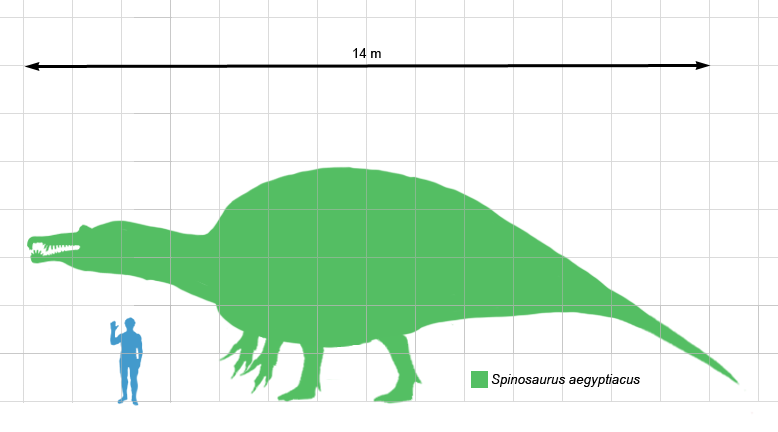
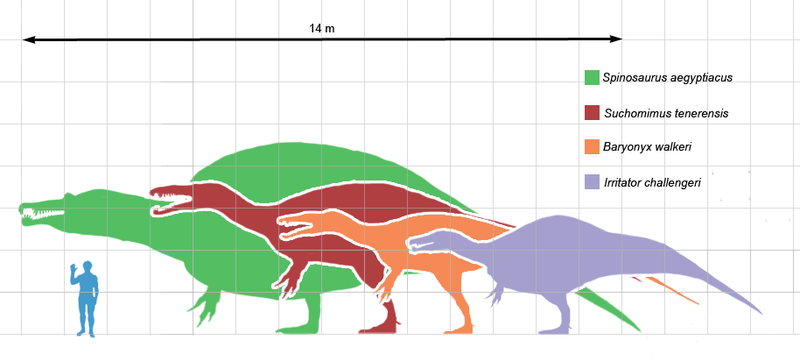
A size comparison of different members of the spinosaurid group.
Over the past few weeks, we've been learning about the largest carnivorous dinosaur ever to walk the earth: Spinosaurus egyptiacus. And it was a very awesome predator: it had a crocodilian-like jaw, eight-foot arms and nine-inch claws and perhaps its most obvious feature, a seven-foot tall sail on its back. But did you know that Spinosaurus wasn't the only spinosaur in the family. The spinosaur family is home to a host of remarkable dinosaurs, dinosaurs that tried really hard to be crocodiles! Today, we'll wrap up this series on spinosaurs by looking at the different species that are in this family:
Spinosaurus aegyptiacus is the largest carnivore ever to walk the earth.
Spinosaurus: (Since we've already been looking at this monster in great depth over the past several weeks, I'll just run through the basics) Spinosaurus was the largest carnivore ever to walk the earth. At 60 feet from nose to tail and weighing 10 tons, it was a force to be reckoned with. It had sharp nine-inch claws and sharp teeth. The most obvious feature on this dinosaur is the seven-foot tall sail on its back. Scientists are unsure of its use, but it was probably used for display, temperature regulation, fishing apparatus (fish would be attracted to the dark shadow the sail cast on the water), or all three. Despite its large size and awesome strength, Spinosaurus mainly ate fish, such as the 20-foot Onchopristis. Every other animal living in Norther Africa wanted to steer clear of Spinosaurus.
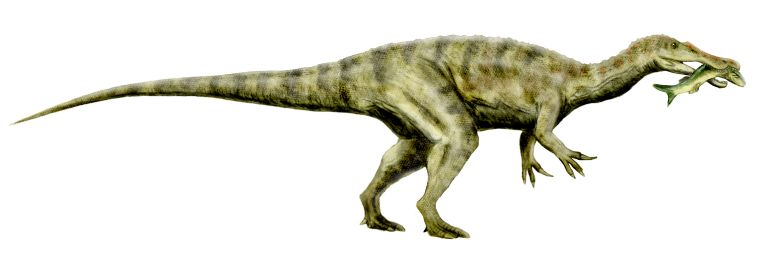
Baryonyx, like its larger cousin, Spinosaurus, mainly ate fish.
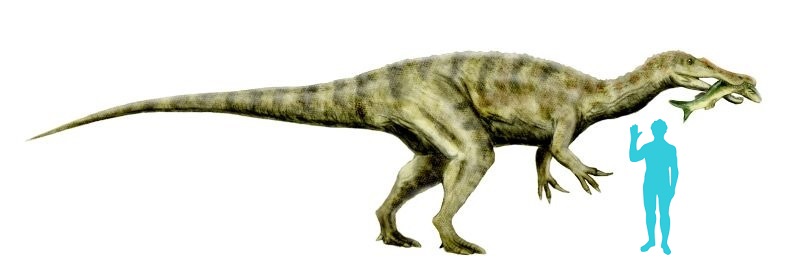
Humans are a bit puny compared to Baryonyx!
Baryonyx: This dinosaur is known from almost complete skeletons and is closely related to Spinosaurus; but at 30 feet long, it was about half the size of its larger cousin. Like Spinosaurus, we know Baryonyx mainly ate fish because fish scales were found in a specimen's stomach cavity. Many scientists believe Baryonyx hunted like a grizzly bear, waiting at the riverbank for fish to come close enough before it would sweep the fish from the water with its powerful claws. But this dinosaur might have eaten more than just fish: bones from an ornithopod called Iguanodon have also been discovered within the stomach of Baryonyx, so perhaps other spinosaurs also ate a variety of things besides fish.
Suchomimus is often described as the dinosaur that was "trying hard to be a crocodile".
Suchomimus: Meaning “crocodile mimic”, Suchomimus was definitely crocodile-like in many ways, as was the rest of the spinosaur family. It was a bit larger than its cousin, Baryonyx at around 36 feet long, but it was still no where near the size of Spinosaurus. Unlike Spinosaurus, Suchomimus didn't have a large sail on its back. It was more like a low ridge. As in other members of its family, Suchomimus had a wicked sharp thumb-claw that was probably used to snag slippery fish from the water. It lived in North Africa.
Irritator closely resembled the other members of the spinosaurid group.
Irritator: This dinosaur was officially described in 1996 and is only known from one part of its body – the skull. Its fossils were illegally sold by fossil-poachers in Brazil. The buyers of the Irritator fossils were unaware of the dinosaur's origins in the hands of fossil-poachers. When they received the dinosaur's skull, they realized that the poachers had covered it in plaster to make it look more complete and valuable. The scientists spent a great deal of time trying to restore the skull to its original features and they got so irritated, that they decided to name the dinosaur, Irritator. Since we only have the skull of this creature, scientists have used other spinosaurs as examples to help us figure out what this dinosaur probably looked like. They estimate it to have been 26 feet in length and weighing 2-3 tons.
Oxalaia: This is the last spinosaur that we're going to look at today. This dinosaur was discovered in Brazil and grew 39-46 feet in length and weighed 5-7 tons, making it the largest theropod ever found in Brazil. It was described in 2011.
Spinosaurus was an amazing dinosaur and as we just learned, it had some amazing cousins! It probably hunted on both land and water and used its sail as a temperature regulator, mating display, fishing apparatus or all three. It was the largest predator ever to walk the earth. Yet, while learning more about this amazing beast, we shouldn't loose focus on the fact that even this mighty beast and its relatives were regally designed by a loving and intelligent Creator who made this animal in such a way to thrive in the environment in which it lived.
"Spinosaurus is and was, the biggest meat-eating dinosaur that ever lived." Jack Horner
I hope you have thoroughly enjoyed these past few weeks
learning about spinosaurs. I know I have enjoyed writing it. Please be sure to
comment on my latest stop-motion movie and the article I wrote! See you next
week!
PS: To post a comment (this is highly encouraged), please
simply click the post you wish to comment on, scroll to the bottom of the page
and put what you wish to say or ask in the comment box. Then in the box below
the comment box choose who you’re going to comment as. And then click preview or publish. If you aren’t signed into Google, you’ll be asked to type
in a word and a number in the space provided. Type the word, put a space and
then put the number. Then your comment is on the blog!
PS 2: Have a puzzling question about animals (including
dinosaurs), myself, my latest book, my stop-motion movies, Creation or etc?
Please post your question as a comment or send me an email at animaladventures@aol.com.
PS 3: What’s the latest scoop? Check it out at SMILEY’S NEWS.
PS 4: Be sure to comment on the latest stop-motion movies
too, this will help me improve them.
Welcome back to my website everyone. I only have update for today, so we'll go through that before moving on to my other writer -- Joy's -- latest article.
The second episode of my upcoming stop-motion series (Planet of the Dinosaurs) called The Tropical Poles, is about 80% complete. I am pretty sure that (Lord-willing) it will be finished and ready for viewing by the 11th of this month. So I'll keep you posted.
Now, my friends, it is time for Joy's non-fiction article. Let's read:
Squirrel! The word most frequently said in one of Disney's movies, Up! There was also a showing of evil flying squirrels riding in little airplanes to catch Dorothy, aka Candace Flynn, in an episode of Phineas and Ferb. These fury creatures have been frequently known as the animals that can't make up their mind when crossing the road (maybe they should have a crossing guard with them, like a chicken). You see these creatures dead and squashed on roads, quite frequently. Their fluffy tails are almost to irresistible to touch. Our guest star today is (yes, you've guessed it right) the squirrel!
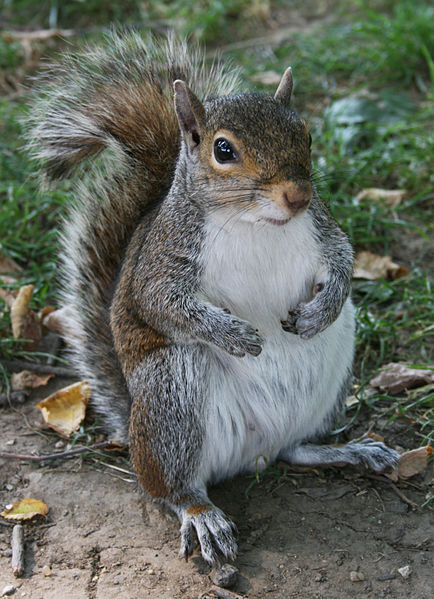
This cute little guy is an Eastern Grey Squirrel.
The "normal" squirrels (the ones you see in your backyard) can be as long as 10-73 cm! They have thumbs and sturdy claws to climb trees. They have large eyes which means they have really great sight. One fact about the urban squirrels is that they hardly ever live to their first birthday, but fortunate squirrels (such as the ever popular grey squirrel) has a life span of six years! This is mostly because of the high probability of being hit and killed by an automobile.
This grey squirrel may be relaxing, but I think we all know what's on his mind: nuts!
Just like us, they are consumers and rely on the plants to provide food for them. You've seen the squirrels gather food, mostly nuts, in the fall and then see them in the spring awake from hibernation. You probably have no idea of their struggles in the spring when they wake up, struggles to survive during starvation. As many of you know, plants come from seed that are buried in the ground. Most seeds start to grow in the spring and become inedible for the squirrels.
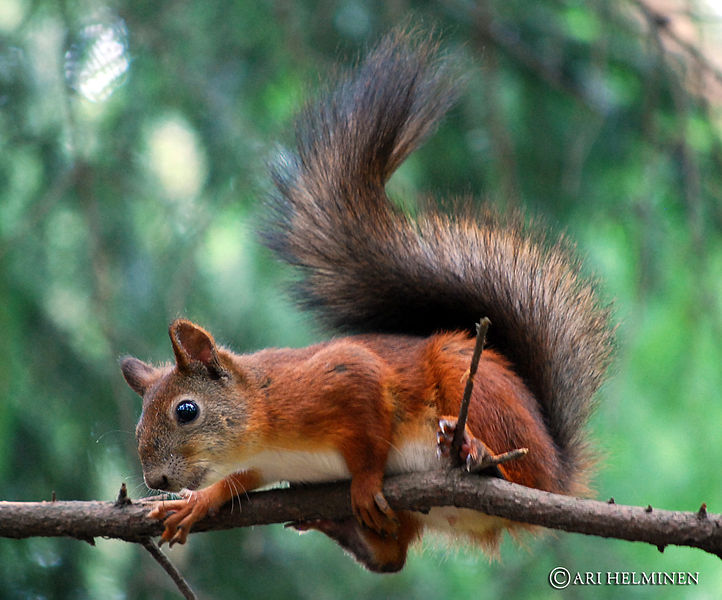
Eurasian red squirrels differ from both American grey squirrels and American red squirrels, due to the tufts on their ears. All three species can be red, brown, black or even albino!
The squirrels have known to change their eating habitats. Squirrels' have been known to eat nuts, seeds, conifer cones, fruits, fungi, and other green vegetation. In order to survive from starvation, squirrels have taken drastic measure. Some have taken up the liberty to eat meat, such as insects, eggs, small birds, young snakes and smaller rodents. I some tropical species have changed almost entirely to a diet of insects!
This American red squirrel looks as if he's bitten off more than he can chew, but his sharp teeth can gobble up this peanut in no time at all!
Yes just like humans, squirrels will risk their lives to survive. Just think about it, has it ever occurred to you that's all of God's nature has a way of taking care of itself without us, humans, telling them what to do and how. Do you ever think about how awesome nature is if you look around and ask yourself, how did this all happen? How or who made the plants able to take in our carbon dioxide (or not needed gas) and recycle into their excess gas called oxygen for us to breath? How did this planet come to meet all our needs? Who created this beautiful place we call home?
Did you like the article? Please be sure to express your opinions through comments.
Normally, this is where I'd end this week's post. But this Thursday is different. Why? Well, it's the Fourth of July of course! Today is the 4th of July, aka, Independence Day. We remember this glorious day because this was the day when America adopted the ever popular Declaration of Independence.
Miami celebrates the Fourth of July, BIG time! Just look at those fireworks!
So let us all take a moment and remember this day and all that it stands for. Spend some time with your family and friends, thanking God that we have this nice, free country to live in. We can not only worship God freely, but we can freely express our opinions (for the most part), attend church, vote and other things we do that many can't do in other countries. What an amazing country we live in!
So today, I've decided to put a video on here of the National Anthem: "The Star-Spangled Banner". It is said that the writer of this song was inspired to write it when he saw our flag, the American Flag, still standing tall and strong! Here's a rendition of "The Star-Spangled Banner" sung by the 14-year old actress (famous for the movie Dolphin Tale), Cozi Zuehlsdorff:
Thanks for stopping by, please be sure to come back next week when we will wrap up our series on the largest carnivorous dinosaurs - the spinosaurs! Bye for now!
PS: To post a comment (this is highly encouraged), please simply click the post you wish to comment on, scroll to the bottom of the page and put what you wish to say or ask in the comment box. Then in the box below the comment box choose who you’re going to comment as. And then click preview or publish. If you aren’t signed into Google, you’ll be asked to type in a word and a number in the space provided. Type the word, put a space and then put the number. Then your comment is on the blog!
PS 2: Have a puzzling question about animals (including dinosaurs), myself, my latest book, my stop-motion movies, Creation or etc? Please post your question as a comment or send me an email at animaladventures@aol.com.
PS 3: What’s the latest scoop? Check it out at SMILEY’S NEWS.
PS 4: Be sure to comment on the latest stop-motion movies too, this will help me improve them.
Welcome back folks! As usual, I'll presume with updates before getting to today's non-fiction article, written by yours truly!
Howdy folks! Welcome back to my website. I've got a lot of cool updates before we get to the main article, so let's get started!
The second episode of my stop-motion series Planet of the Dinosaurs, called The Tropical Poles, is coming along greatly so far! It has reached 75%! I'm not sure it will be finished by the end of this month, but hopefully by the end of the first week next month. Lord willing!
As many of you might already know, the latest Pixar release, Monsters University, just went into theaters on the 21st of this month. I haven't had the opportunity to see it yet, but I'll probably be able to when it comes out on DVD or on Netflix. I can't wait!
Here's a clip from the movie:
So what is Pixar working on next? Well, their next movie, coming out next summer is called The Good Dinosaur. They haven't released much on an actual plot, but here's a basic overview of the project:
They are kind of cartoony but they are dinosaurs; they are not walking around with clothes on or anything like that, they still are kind of dinosaurs. We focused on mostly the plant-eaters, not the carnivores… Their society becomes more of an agrarian society, meaning farmers. They become farmers. It’s a very funny story about a certain way of life that a young dinosaur has trouble fitting into and he ends up going on this quest. He kind of messes up and he has to put everything right by going on this quest and on that quest he meets this our character that is an outcast from his society too and so the two of them form this bond and it becomes this unique kind of story…
Last week, I mentioned that another movie I'm looking forward is the release of the movie known as Jurassic Park IV. If you've read last week's article, you'll remember that this movie's new release date appears to be 2015 based on a teaser banner at the Licensing Expo 2013. This past week, I've literally crisscrossed the internet to see if this date is correct, and it seems valid, so we'll assume this is the new date. That's not the only piece of news everyone has been talking about concerning this film! We even have a potential plot! (SPOILER ALERT: this “spoiler” you're about to read would reveal about as much information if you were watching a trailer, but if you don't want to know anything about the movie yet, please skip this update) Jobio.com has apparently learned the plot of JPIV through an unknown source. This could be exactly what we fans have been waiting for! Here's what Jobio.com had to say about the possible plot for the upcoming movie:
JURASSIC PARK 4, set in present day Isla Nublar, is now an actual theme park, as originally intended by John Hammond in the first film. It garners 10 million visitors per year and is completely safe - until it's not. The park itself is described as very Sea World-esque and includes an area called the Isla Nublar Lagoon. That means underwater dino's for the first time. No indication of what kind, but there's concept art showing one of the aquatic dino's, as part of a show, jumping out of the lagoon and eating a strung up great white shark like it was a fish for a dolphin at sea world.
As part of a show, you ask? That's right, folks, this will feature "tamed" dino's. In fact, our source indicated that the usually menacing Velociraptors (which will finally be muzzled, along with the T-Rex - until they're not) will actually be used to help fight the threat, which begins in the form of a new dinosaur, not seen in any of the previous films (and not disclosed to us) shows to be much smarter than originally thought and is the main cause of havoc breaking out at the park.
So, to sum it all up, JURASSIC PARK 4 will take place back on Isla Nublar with a fully operational dinosaur theme park (I'm sure no expense was spared) that's both prosperous and safe, until a new dinosaur figures out a way to wreak havoc, causing the use of the now tamed Velociraptors (and T-Rex? Unclear) as a means to fighting the threat.
Well, if you ask me, this plot is a great idea! However, we must keep in mind that this rumor may or may not have any fact behind it. It is believed by some that this plot description appears to be from the script before the “major changes” were made. So perhaps this plot is inaccurate, but we don't know for sure yet. We also don't know what people or dinosaurs will be appearing in the movie for sure, yet (although Velociraptors and T. rex have a 99.99% chance of being present regardless of whether this plot is the real thing). But if the plot Jobio.com has is accurate, we should be seeing, not only raptors, but also the longed for marine reptiles (maybe a gnarly Tylosaurus mosasaur will make an appearence) as well, AND also the “new scary dinosaur” that's been talked about for a long time can be seen coming into play. For now, this assumed plot is all we know, as Universal hasn't told us their plot yet. But I think it's time to officially say, “The exploration back to Isla Nublar is about to begin!”
Now to get to today's non-fiction article:
As you might recall from my post two weeks ago, we looked at the history of the discovery of the largest carnivorous dinosaur to ever walk the earth: the 60-foot long, ten-ton Spinosaurus. Last time, we learned that the first Spinosaurus remains ever found were uncovered in Northern Africa and were accidentally destroyed in World War II. A few other Spinosaurus fossils have been found since they were destroyed, but they're far from completion. So paleontologists look to Spinosaurus' relatives – other members of the spinosaur family and modern-day animals for clues. First, let's look at one of the most obvious questions: what did Spinosaurus prey on?
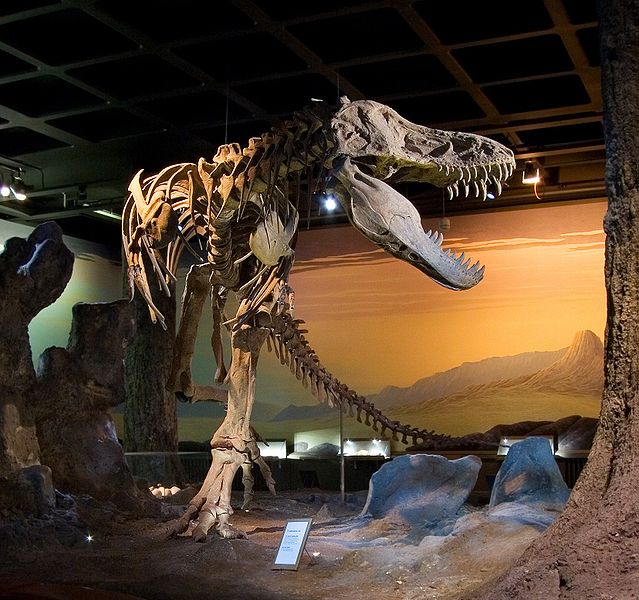
The skeleton of Spinosaurus
We humans are puny compared to this beast!
While we know Spinosaurus ate plants in the world before Man's rebellion against God, which brought death and sin into the world. But what about its diet after the Fall of Man? Well, to find an animal's diet, we must obviously start looking at the mouth and at the teeth. An animal's teeth alone doesn't actually tell you how it behaved or what it ate, but it can give us clues and starting points. The teeth of Spinosaurus are conical-shaped and sharp, somewhat different from your typical theropod dinosaur, which have sharp and serrated teeth. The teeth of spinosaursresembles not any other dinosaur, but of a different reptile, one still patrolling the waterways of the 21st century: crocodiles! Crocodiles also have sharp and conical-shaped teeth, so by learning how and what crocs mainly eat can give us insight into what dinosaurs, such as Spinosaurus ate. Crocodiles, while antelope and zebra are popular choices, often eat fish, and their conical-shaped teeth are perfect for gripping onto these slippery meals. Does this suggest Spinosaurus ate . . . fish?!? Believe it or not, the 10-ton predator actually probably hunted fish. We have more evidence to back this up. When looking at the teeth of modern-day animals that have similar teeth to prehistoric, we learn that we can guess what prehistoric animals ate. The same often applies with features God “installed” into this creature. The six-foot skull of Spinosaurus is shaped like a crocodile's skull. Perhaps the skull of Spinosaurus is crocodile-like for the exact same reason crocodile skulls are crocodile-like. Like modern crocodiles, Spinosaurus has its eyes and nostrils higher up on the skull. This would help when it was fishing because it could have its jaws half-submerged in the water and still breathe at the same time.
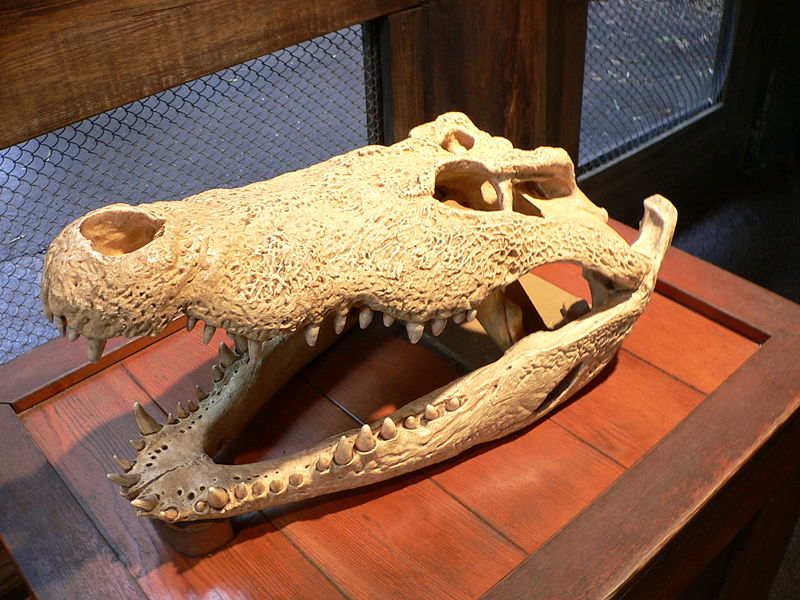
The skull of a crocodile
The skull of Spinosaurus bears great resemblance to that of a crocodile's
When scientists took a close look at the skull of Spinosaurus, they realized that there were a bunch of little pits and holes on the end of the snout. Once again, scientists compared the skull of Spinosaurus with the skull of a modern crocodile and bingo! Crocodiles also have pits and little holes on their snouts. What are they used for? Well, in crocodiles, the pits are attached to sensitive nerve endings. These nerve endings can detect movement in the water so even if a crocodile can't see its prey, it can feel the disturbance in the water and know where the prey is. Perhaps Spinosaurus could stick its snout into the water and feel the water movements of fish below the surface. Does the notion of the 60-foot long Spinosaurus eating mainly fish seem a bit strange to you? After all, how could this huge hyper-carnivore sustain itself on fish? The answer is that many of the fish in pre-Flood Northern Africa (which was much wetter and swampy than today) were huge! Some fish, such as the a type of giant sawfish called Onchopristis, grew over 24 feet in length! That's what I call “catch of the day”! We even have evidence that Spinosaurus hunted Onchopristis in particular: an Onchopristis fossil has been found with Spinosaurus teeth embedded in it.
Onchopristis looked just like this modern sawfish, just a lot bigger!
And Spinosaurus also had a weapon that no crocodile has: arms that were probably over eight-feet in length and ended in nine-inch dagger-like claws! These claws would be useful in helping haul the mighty fish out of the water so Spinosaurus could chow down.
To help you visualize a fishing Spinosaurus, take a look at this clip from the BBC television series called Planet Dinosaur, in which a Spinosaurus catches the big whopper in the river – Onchopristis!
This series is one of my favorites, I hope you enjoy it:
Did you know that Spinosaurus' diet wasn't restricted to giant fish? Fossil remains of the closely related Baryonyx found in Europe, contains the bones of an herbivorous dinosaur called Iguanodon, and a fossil pterosaur, or flying reptile bone in Brazil contains the tooth of a spinosaur. Judging by the position of the tooth, we can tell that the pterosaur was probably attacked by the spinosaur. So spinosaurs including Spinosaurus not only were hunters of water, but they were also ferocious predators on land as well. Scientists estimate that Spinosaurus could run over 20 mph, and that's faster than most of us can run! So if Spinosaurus is coming for you and unless you're an Olympic sprinter, you'd better learn how to hide!
Spinosaurus was a ferocious predator on land AND in the water!
Now it's time to examine the most obvious mystery of Spinosaurus: what exactly put the spine in Spinosaurus? Actually, perhaps I'd better reword that to: what exactly did that sail of Spinosaurus do in life? Unfortunately for us, no animal alive today has a sail quite like Spinosaurus, so we can't really make a comparison. The sail on Spinosaurus' back was about six to seven feet tall and was made up of the creature's backbone. What was it for? Well, many scientists believe that the sail was littered with blood vessels, kind of like the ears of an elephant or a hare. The blood flowing through the sail would have had temperature changes much faster than the rest of the body. If Spinosaurus needed to cool down, cool air would cool the blood in the sail and then this now-cool blood would flow through the rest of the dinosaur's body. Therefore it would cool down the Spinosaurus. The same would work, if the animal wanted to warm up, but instead of air, it would use the heat of the sun. Even if Spinosaurus was a warm-blooded creature, the ability to cool itself down rapidly would have been helpful for the creature. Isn't God ingenious?
Some scientists believe that, instead of trying to stay cool, the sail of Spinosaurus was a way for males to look cool. Perhaps, like many other animals, Spinosaurus had wacky body equipment for display purposes. Many modern insects, mammals, birds and reptiles use weird and wonderful displays to impress potential mates.
Another theory is that Spinosaurus used the sail during fishing. How did it do that? Some species of herons today use their wings to create an umbrella-like shape, casting a shadow on the water. Fish are attracted to the shadow, but little do they know that they're swimming right into range of the heron's beak and SNAP! The heron gulps down a fish. Perhaps the sail of Spinosaurus also attracted fish and could help this dinosaur catch its prey. And who knows? Considering no one around today has seen a living Spinosaurus, who's to say it didn't use its sail in all the ways mentioned? We may never know, but it's a possibility!
What do you think Spinosaurus used its sail for?
Alas, it is time to end our time together for this week. Be sure to come back next week and you can read Joy's latest article. The week after that is when we can delve into the conclusion of my series on spinosaurs, some of the weirdest dinosaurs that ever lived! Hope to see you next week, bye for now and God bless you!
PS: To post a comment (this is highly encouraged), please simply click the post you wish to comment on, scroll to the bottom of the page and put what you wish to say or ask in the comment box. Then in the box below the comment box choose who you’re going to comment as. And then click preview or publish. If you aren’t signed into Google, you’ll be asked to type in a word and a number in the space provided. Type the word, put a space and then put the number. Then your comment is on the blog!
PS 2: Have a puzzling question about animals (including dinosaurs), myself, my latest book, my stop-motion movies, Creation or etc? Please post your question as a comment or send me an email at animaladventures@aol.com.
PS 3: What’s the latest scoop? Check it out at SMILEY’S NEWS.
PS 4: Be sure to comment on the latest stop-motion movies too, this will help me improve them.













.jpg/600px-Gilles_Gonthier_-_%C3%89cureuil_roux_--_Red_Squirrel_(by).jpg)