Happy Independence Day everyone! Summer's fun and all, but have you noticed there aren't many holidays in summer? I mean, winter, spring and fall all are filled with wonderful holidays, but summer . . . not so much. One reason why I like Independence Day is because it is one of the few holidays we celebrate in summer. Of course, it's also cool that we have a day dedicated to fireworks and the celebration of the day the Declaration of Independence -- that makes us a free country -- was officially signed. It's also a day to thank God and praise Him for our independence.
Days Till
It is: Independence Day!
It is: 58 days till Labor Day
It is: 290 days till Patriot's Day
In the Spotlight
Once again, Jurassic World (aka Jurassic Park 4) makes headlines. In a recent interview with Movies with Butter, actor Brian Tee informs us about the character he's portraying, named Hamada. As many of you might recall, a leaked page of the script featured some lines from Hamada. Here's what he had to say:
“I get to play with dinosaurs here
and there. I think Jurassic World is going to be bigger, badder, better
than any other Jurassic Park that you’ve seen.”
“I’m Hamada. I’m the head of security at Jurassic World. Just in case
something happens, because what could go wrong? There are many giant
dinosaurs. They’re probably really tame in their own environment and
stuff like that, so I’m just a precaution, that’s all.”
“Come on,
it’s Jurassic World. You can’t have a Jurassic
World and not have cool security.”
“For what we shot, it was I think the best of
both worlds. It was definitely very measured, but when you’re in the
world itself, you’ve got to represent that particular aesthetic. So he
was definitely in the trenches with us. We’re rolling through mud and
dirt and trees and bushes and swamp and all this other stuff, and he was
in there getting dirty. Absolutely.”
He didn't really tell us much about the plot, but at least we know what role Brian will play: the park's game warden. Jurassic World needs someone to keep the raptors and Diabolus rex in line!
Topic of the Week by Joy Hammond
July 4th is an excellent
time to not only celebrate American Independence but also to hang
with family and friends. Here's a quick recipe that you can whip up
for everyone in a couple of hours, Patriotic Trifle.
1 carton (8 ounce) frozen whipped topping, thawed and
divided
1 pint fresh blueberries
1 quart fresh strawberries,
quartered
1 prepared angel food cake (8 to 10) ounces and cut
into 1-inch cubes.
Now for the first step: have two
small bowls. Combine each gelatin flavor with 1 cup of boiling. Stir
½ cups of cold water into each bowl. Pour each bowl into an not
greased 9-inch square pan. Then refrigerate it for 1 hour until set.
Second, Put in a large bowl, milk and
the pudding mixes and whisk them for 2 minutes. Let it stand for 2
minutes or until it is soft- set then fold in the 2 cups of whipped
cream toppings. Set aside ¼ cups of blueberries and ½ cups of
strawberries for garnish. Then cut the gelatin into 1-inch cubes. In
a 3-qt. Trifle bowl or serving dish and layer the strawberry gelatin,
half of the cake cubes, the remaining blueberries, and half the
pudding mix.
Last, Top the blue gelatin and the
remaining cake cubes, strawberries and pudding mixture. Add the
reserved berries and remaining whip cream topping. Now you can eat it
up and enjoy!
The Patriotic Trifle serves up to 16 to 20 people.
Well, that wraps up this blog post! Tonight, my family is going to see some fireworks! If you're going to see some fireworks, please describe your experience in the comments below and I'll see you all next week. Have a happy 4th of July everyone!
P.S. 1: Have a puzzling
question about animals (including dinosaurs), myself, my latest book,
my stop-motion movies, Creation or etc? Please post your question as
a comment or send me an email at animaladventures@aol.com.
PS. and/or at animaladventures1314.blogspot.com, as
sometimes messages don't come in via my AOL account.
P.S. 2: Many (or in some
cases all) of the photographs and images above are not mine. If you
own one or more of them and would like them to be removed, politely
let me know via one or both of the email addresses above.
P.S. 3: What’s the new in
the news? Check it out at SMILEY’S
NEWS.
Sorry that I'm late again guys! The last couple of weeks have been extremely busy for me! But this article is finally ready for your viewing pleasure. I was looking through the blog articles I've written and realized that there was an entire 3-part series I'd wanted to do last year that never got done, so you'll be able to read it today
Days Till
It is: 3 days till Independence Day
It is: 62 days till Labor Day
It is: 72 days till Patriot's Day
In the Spotlight
Last week, we didn't just get some photograph-related updates on the upcoming Jurassic Park sequel, Jurassic World (which I covered in my last blog post), but finally some video-related updates that appeared on the Today Show! No dinosaurs from Jurassic World were seen, and not many spoilers are revealed, but it nonetheless makes me very stoked about the new movie that's in the making! Check out the videos below:
I was really excited to see a lot of the sets from the movie and can't wait for Jurassic World to "open its doors to the public" on June 12, 2015!
Another Jurassic World update: filming is now taking place in the abandoned Six Flags amusement park in Louisiana.
Topic of the Week by Christian Ryan
Last year, I wrote a three part summary of the
first season of Primeval – I talked about each of the main characters,
episodes and the creatures that make an appearance. Well, that's not where the
story ends, so let's take this time to delve into my review of Primeval
Season 2! Like last time, it's going to be made up of three parts – basic
overview, characters, and last but not least, the creatures themselves. Let's
get started! (By the way, you might want to read my other articles about Season
1 or you might get very confused! Here's the link to Part 1, Part2, and Part 3).
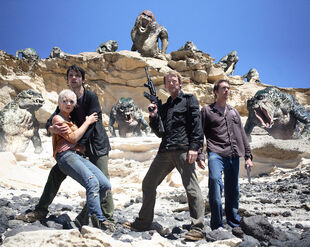
Here is a photo from Primeval Season 2 consisting of (left to right): Connor Temple, Abby Maitland, Nick Cutter and Stephen Hart
Season 2 of Primeval takes place right after the
cliffhanger at the end of Season 1 when Prof. Nick Cutter, a paleozoologist at
Central Metropolitan University, exits the Permian-habitat anomaly I mentioned
in Episode 1.6 and comes to the shocking realization that the woman he loved,
Home Officeofficial Claudia Brown, has
disappeared from history as if she were never born and no one knows who she is;
he believes something they did in the pasthas changed the present. When he tries to go back through the anomaly to
past, Stephen Hart, another team member (the other main team members being Abby
Maitland, Connor Temple and James Lester), stops him and the anomaly closes.
Nick is now forced with having to cope with this change. Though he soon finds
out that that's not the only change that's taken place in this “alternate
time-line”: Nick's team was transferred to a brand new building known as the
ARC (Anomaly Research Center), which is devoted to further
studying the anomalies, hence its name.
I couldn't help but notice how the ARC is shaped sort of like the actual proportions of Noah's Ark
Nick also finds it shocking that no one else is aware of the
change except his ex-wife, Helen Cutter. Nick soon finds out that. Upon
arriving to the ARC though, things are not as they seem at first; as the series
presses on, it seems as if someone on the team is a traitor and Nick and the
others are determined to find out who the traitor is and why he/she is so
interested in the anomalies in the first place.
In Episode 2.1, it is revealed that because of Claudia
Brown's absence, her position as Lester's assistant is instead the
responsibility of Oliver Leek, a man Nick never even knew before the whole
incident. But just when Nick starts adjusting to the changes at the end of
Episode 2.1, James Lester introduces everyone to the newly hired Public
Relations manager, Jennifer “Jenny” Lewis. Nick's astounded to find that she's
practically identical to Claudia Brown and this only confuses things more as
the series plays out for its second season.
My only main objections I must mention in Season 2 are almost
exactly the same as Season 1 (see Season 1 for details), but
otherwise, I not only LOVED this series, but also found it filled with
much more action, more creatures and an even deeper plot than Season 1 that
makes you want to continue watching episode after episode.
The episode summaries given below are filled with the least amount of spoilers
as possible, but there are a few (I will indicate when they're about to
appear). If you want to watch the series completely oblivious to any I might
mention, please skip. Without further ado, here is a basic summary of each
episode in Primeval Season 2:
Episode 2.1:
Connor and Abby face off with dangerous Cretaceous raptors in Episode 2.1.
Right after Nick's bone-shaking revelation that Claudia
Brown's disappearance from history is one of the many changes (including the
appearance of Oliver Leek) that have taken place in the alternate time-line, he
goes with the rest of the team back to the ARC until another anomaly is
reported . . . and reported it is! In a local shopping mall, two security
guards mysteriously disappeared, killed by some unknown assassin (don't worry,
we don't see any of the squeamish bits). So Nick Cutter, along with team
members Stephen Hart, Connor Temple and Abby Maitland go to the mall to track
down the killer and the anomaly that let them escape into the mall. The
culprit? How about a trio of ferocious Cretaceous Raptors on the loose? While
Nick and Stephen attempt to locate the anomaly, Connor and Abby are assigned
the duty of escorting a mall cleaner out of the mall. But after getting
attacked by a baby raptor, the cleaner mysteriously vanishes. Soon though, Nick
and Connor make an amazing discovery they can use radio signals to know exactly
when a new anomaly opens, just like finding a pirate radio station! Also in
this episode, the ARC team is introduced to the ARC's new PR officer, Jenny
Lewis, whom Nick is convinced is actually a doppelganger of Claudia Brown.
Episode 2.2:
The Fog Worm of Episode 2.2 can only breathe in a special type of fog from its home period.
A normal day in an office building . . . but nothing is
“normal” in Primeval! Soon, a strange, eerie, wreaking fog exits an
anomaly that has appeared in the office building, followed by droves of strange
creatures. Nick and the team (who are joined for the first time by the feisty
Jenny Lewis) goes to the office building to deal with the strange creatures and
soon learn that the creatures they're dealing with are giant carnivorous worms
that won't hesitate (and do) take down humans. The team learns that the worms
can't breathe outside the fog and so must find a way to open the building's
windows so it will release the fog. But the windows are all automatically
temperature controlled and the only place to turn up the heat of the building
is on the 15th floor, where the fog is very thick and very
“wormy”. So guess where they're going next! During this episode, Nick attempts
to convince Jenny that she really is Claudia Brown and at a local video store,
Connor meets the attractive Caroline Steel and they become acquainted, Connor
believing she actually “like-likes” him. Also, Helen meets up with Stephen
again, who himself is doubting whether the ARC's method of dealing with the
anomalies is the best way. It's anyone's guess what Helen's up to this time . .
.
Episode 2.3:
Nick Cutter and the rest of the ARC team are about to find out how dangerous a saber-toothed cat on the loose can be . . .
Connor successfully is able to create an anomaly detector
that he believes has the ability to give the precise locations of anomalies as
soon as they appear. That way, they'll be able to hopefully reach them before
animals from the past and future wreak havoc on the present (their only way of
knowing about anomaly appearances before was either sightings of the creatures
or when people were mysteriously attacked or both!). However, Connor's
invention isn't as widely received as he hoped because a creature attack is
reported without the detector giving them any clue of a new anomaly. The team
leaves the ARC to go to the attack site at Blue Sky Park and after much
investigation, they learn that the creature, whatever it was, came through an
anomaly before the detector went online, rendering Connor's device “off
the hook” as he says. The killer turns out to be a ferocious saber-toothed cat
that roams around the park looking for its next meal. Worst of all, someone
seems to be covering up for the creature's attacks, as Nick's about to learn
the hard way . . .
Episode 2.4:
Strange aquatic primates are the main danger to the group in Episode 2.4.
Connor's anomaly detector alerts the ARC team to an anomaly
in the Thames River, but the anomaly disappears before they can get an
appropriate reading and a teenage boy disappears. So the team dispatches to
find the culprit and soon find, not the culprit, but what age the creature
comes from thanks to a shark that almost attacked Jenny before Nick rescued her
and Stephen gunned the predator which is revealed to be a species of shark,
down. Upon bringing it back to the ARC, Nick believes the shark to be
futuristic (see this article concerning my view on Primeval's futuristic
creatures) – once again they're dealing with predators from the future.
After a bit of a disagreement on where to find the creature's lair, the group
splits up and Abby is captured by the aquatic monster and is brought back
through the anomaly. Soon, the team is trying to track Abby down and Nick
becomes suspicious after (SPOILER ALERT!!!) spying the same cleaner they
saw in the shopping mall dressed as one of Lester's soldiers.
Episode 2.5:
Troops of Silurian scorpions are going to make getting home interesting to Nick and Stephen in Episode 2.5!
Connor begins to feel that his relationship with Caroline
isn't working out, so he “dumps her” in his own words, by text. Meanwhile, a
young girl and her dog become trapped on the other side of a Silurian-habitat
anomaly, so Nick and Stephen mount a mission to rescue her. However, it becomes
clear to both Stephen, who (SPOILER ALERT!!!) believes Lester is their
traitor (END OF SPOILER ALERT!!!), and Nick that someone on the team is
in fact trying to sabotage their work. While trying to rescue the girl, the
anomaly closes leaving the three of them trapped. Worst of all, this habitat is
lacking its predators – troops of giant Silurian Scorpions haunt the land and
can track down potential prey by listening for their vibrations underneath the
sand. Any hope of getting home safely is in question. Lester for one isn't
happy about them being trapped in the Silurian because this leaves, in his own
words, “Daphne (Abby) and Scruffy (Connor) in charge of the anomaly operation.”
At the end of the episode, Connor (who is still staying at Abby's
apartment) and Abby return to her apartment to find it a mess and Rex, her pet Coelurosauravus
from Season 1, missing . . .
Episode 2.6:
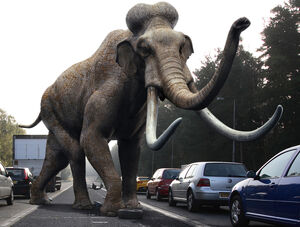
A Colombian mammoth causes "mammoth" chaos (pun intended) on M25 in Episode 2.6.
The busy M25 isn't a great place for an anomaly to open and
release a giant Pleistocene mammal, but that's what happens and a Colombian
mammoth, ironically one of the largest elephants ever to exist, wreaks havoc,
crashing cars and lorries in its rampage. Nick and the team go out to stop the
mighty mammoth and prevent people from knowing about the anomalies (Jenny's
really got her work cut out for her! It's just a good thing Colombian mammoths
look sort of like elephants . . . sort of). Meanwhile, Stephen learns that
Helen has returned to him with plans of her own, when she suggests to him that
(SPOILER ALERT!!!) Lester is in fact their traitor. But when Nick, Abby,
Connor, Jenny and Lester's soldiers go off on another mission due to the
anomaly detector's alert, it is revealed Lester's not the culprit when a
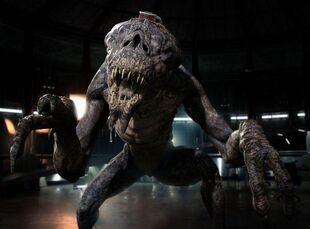
mind-controlled Future is let loose in the ARC by Leek and almost kills him.
The Future Predator is being controlled by neural clamp on his head, and Nick
doesn't think Leek has the intelligence to pull it off . . . suggesting someone
else could be involved other than Leek . . . (END OF SPOILER ALERT!!!)
Episode 2.7: (This whole summary is SPOILER!!!)
Dangerous mind-controlled Future Predators are at risk of getting loose in Episode 2.7 if Nick and the others can't stop them!
Nick, Jenny, Connor, Abby and Caroline walked into the trap
Leek set in Episode 2.6 they become kidnapped. Nick and the others soon learn
that Leek AND Helen have been hoarding an army of animals from the past and
deadly Future Predators . . . but for two different reasons; Leek intends to
use the creatures to make him the most powerful man on the planet, while
Helen's nefarious scheme is to experiment the effects of changing the future by
letting the animals they've collected loose in the present. Can Nick and the
others stop Leek and Helen from letting the animals wreak havoc on the present,
or is the planet's destiny in the hands of slimy and uncaring Leek?
I hope you've enjoyed this brief summary of Primeval
Season 2. See you next time for Joy's article and, in two weeks, the next part
of my Primeval Season 2 review!
P.S. 1: Have a puzzling
question about animals (including dinosaurs), myself, my latest book,
my stop-motion movies, Creation or etc? Please post your question as
a comment or send me an email at animaladventures@aol.com.
PS. and/or at animaladventures1314.blogspot.com, as
sometimes messages don't come in via my AOL account.
P.S. 2: Many (or in some
cases all) of the photographs and images above are not mine. If you
own one or more of them and would like them to be removed, politely
let me know via one or both of the email addresses above.
P.S. 3: What’s the new in
the news? Check it out at SMILEY’S
NEWS.
Sorry I'm late this week, everyone! Due to my schedule, I am going to be changing the date I publish a new article to Friday instead of Thursday. I can't believe the month of June is almost over! Tomorrow is Summer Solstice, the first day of summer (in the northern hemisphere)! For those of you who don't know, Summer Solstice is the longest day of the year! How exciting! To celebrate, before we get to our "usuals" for the week, take a moment to look at some music videos for one of the latest Phineas and Ferb episodes: "Phineas and Ferb Save Summer".
Days Till
It is: 1 day till Summer Solstice and the first day of summer!
It is: 14 days till Independence Day
In the Spotlight
OK, there's a lot of news about Jurassic World for this week. As you might recall, Jurassic World is the fourth Jurassic Park movie to be made, and based on what I know about it so far, I'm going to LOVE it! Lots of pictures from the sets and promotional posters and etc have been posted on the internet. Let's look at several of them now.
The pictures below are of Chris Pratt's character, Owen's, shack where he lives. Apparently, he prefers this to any of the hotels or staff accommodations the park has to offer:
Based on what we know about Owen, it appears that his role will be similar to that of Robert Muldoon from the first film and novel. Robert Muldoon was Jurassic Park's game warden, who was described by the park's owner, John Parker Hammond, as "a bit of an alarmist, I'm afraid, but he knows more about raptors than anyone." Robert Muldoon definitely did know a lot about raptors! As you might recall, Owen will also be dealing with raptors in Jurassic World, to study their behavior. In the first film, Muldoon meets a gristly end when he's outwitted by a pack of Velociraptors just after he uttered his famous final words: "Clever girl."
Below are some promotional photos from this year's Licensing Expo and they portray a 3D Tyrannosaurus rex above the film title. This is appropriate, the film will not only be released into theaters in 2D, but 3D as well:
This set of photos are also from this year's Licensing Expo. They actually show us many of the extinct creatures that will be appearing in the movie!!! That in and of itself is really exciting for me! Here they are:
According to these images, a large number of prehistoric creatures will call Jurassic World their home when the park "opens" on June 12, 2015. The creatures depicted are: Tyrannosaurus, Velociraptor, Pteranodon (not actually a dinosaur), Triceratops, Gallimimus, Stegosaurus, an unidentified species of macronaria sauropod (it looks a little like a Camarasaurus or Brachiosaurus to me), possibly some sharks and a mosasaur (possibly Tylosaurus or Mosasaurus and also not a dinosaur). You might have also noticed Mr. DNA's picture in the top left corner of the second photo. Of course, more dinosaurs might be appearing in the film that aren't on these posters, so be sure to stay tuned as we learn more and Jurassic World!
The final photo I'm showing today was taken by Colin Trevorrow, the director. The photo portrays a shadow from a carnivorous set of jaws in the movie:
Is this Diabolus rex?
We can't say exactly what this creature is, but based on skull shape and tooth configuration, it appears that it is not a carnivore that's yet appeared in the Jurassic Park movies. Perhaps this is the infamous Diabolusrex?
Also, the movie Dolphin Tale 2's release date has been moved sooner: to September 13th! I can't wait to see Winter, Hope, Morgan Freeman, Bethany Hamilton, Cozi Zuehlsdorff, Nathan Gambles and everybody else in the film. Here is the second trailer for the movie:
Topic of the Week by Joy Hammond
So
Summer has begun, time we make a cool snack to go with it: popsicle sticks! Here's an
easy recipe that anyone can try. You will need: 2 ½ cups of seeded
watermelon, cantaloup, or honeydew melon, ½ cup fresh or frozen
raspberries, thawed. ¼ cup sugar, 1 Tablespoon of lemon juice and popsicle sticks.
First
put the melon,sugar, and lemon juice in the blender.
Cover blender
with the lids on and blend it into a high speed until it is all
smooth.
Then,
pour the blend into cups or pop molds.
Put the cups in baking pan.
Cover each cup or mold with foil.
Use the knife to make a small hole
in the center.
Slide the wooden popsicle stick through the hole.
Third,
put the baking pan or pop mold in the freezer for several hours or
over night until the pops are firm.
Remove from the freezer and
remove the foil.
Tear the plastic cups away and remove the pops.
Then
have a good time enjoying your pop.
From Joy and I to all of you readers, have a happy Summer Solstice!
P.S. 1: Have a puzzling
question about animals (including dinosaurs), myself, my latest book,
my stop-motion movies, Creation or etc? Please post your question as
a comment or send me an email at animaladventures@aol.com.
PS. and/or at animaladventures1314.blogspot.com, as
sometimes messages don't come in via my AOL account.
P.S. 2: Many (or in some
cases all) of the photographs and images above are not mine. If you
own one or more of them and would like them to be removed, politely
let me know via one or both of the email addresses above.
P.S. 3: What’s the new in
the news? Check it out at SMILEY’S
NEWS.
Author's Note: This is my 100th blog post!!! A special thanks to all of you devoted readers out there!
Yes, Father's Day will be here
once again! Just like what we did with Mother's Day this and last
year, we're going to devote this blog post to father's all over the
world! That's not the only thing we're celebrating: tomorrow marks my blog's 2nd year anniversary! I'm so excited! Two years of writing this blog . . . where has the time gone? Perhaps this makes today the perfect day to talk about some really cool news concerning, you guessed it, Jurassic World, the upcoming movie. Let's get started.
Days Till
It is: 3 days till Father's Day
It is: 9 days till Summer Solstice and the first day of summer
It is: 22 days till Independence Day
In the Spotlight
A couple of months ago, some official images from Jurassic World were released. We now have three more to add to the collection:
Chris
Pratt's character, Owen, appears to use a motercycle to get around the
park. If the raptors escape, this vehicle will come in handy!
Bryce Dallas Howard's character appears to be having a conversation with Owen in this photo, the topic is unknown.
I
don't know about you, but this picture appears to be from a scene in
which Ty Simpkin's (right) and Nick Robinson's character (left) appear
to have come across a dangerous situation!
Of course, exactly what's happening in the scenes these photographs come from is unknown, but I can't wait to see when the movie finally roars into theaters exactly one year from now, on June 12, 2015!!! Only 365 days to go . . . just don't count down for me!
Topic of the Week by
Christian Ryan
Mother's often get a lot of credit, both human mothers and mothers of
the natural world. Not that they're not due the credit! I mean,
without mothers, the world would be a very different place, as
mothers do a lot of things in our lives that no one else could do
(giving us life is one example). So the purpose of this article is
not to bash the attention mother's get. However, father's are also
important in the role of any animal or person's life. Without them,
we still wouldn't be born.
Scripture
perfectly illustrates the importance of father's in the human
household. In Ephesians 6:2, the writer Paul says, “Fathers,...bring
them (their children)
up in training and instruction of the Lord.”
Another verse says that father's should “Train
up a child in the way he shall go, so that when he is old, he shall
not depart from it,” Proverbs 22:6.
Perhaps father's in nature don't get a lot of credit of child-rearing
sometimes because, frankly, most male animals simply mate with a
female and move on to find another mate. But there are a few animal
father's that not only stick around after mating, but they also help
take care of their offspring. So today, let's look at some of the top
animal dads!
Ostrich
A father ostrich feeds with one of his chicks.
Something special happens when an ostrich gets between 2-4 years of
age: they're ready to mate! At that age, most humans are only just
learning to walk and talk! When it comes time to find a mate, the
male ostrich performs a special mating dance with his wings – by
creating alternating wing beats, he hopes that a female will find him
attractive enough to be his mate. Once mating is done, it becomes
time for egg-laying. Unlike many species of birds, ostriches make
communal nests, meaning more than one female ostrich will lay their
eggs in a single nest. The nest is dug out by the male and is 1-2
feet deep and almost ten feet wide! The dominant female gets the
first dibs on laying eggs and it is only after she's finished that
other subordinate female ostriches will lay their eggs. When the
other females are finished laying, the dominant female often kicks
out some of the eggs of other females, leaving about 20 eggs in the
nest, including her own. Then it's time for the incubating process.
For the next 35 to 45 days, the parents alternate incubating the nest
of eggs. Typically, the dad will incubate the eggs at night because
his black-colored feathers make him harder to see in the dark; the
mother on the other hand incubates normally in the daytime because
her feathers are a lighter color and blend in with sand and savanna,
scrub, and/or desert foliage. Even after the eggs hatch, the male
continues to stick around. Though the mother helps out, it is mostly
the father's responsibility for defending the young and teaching them
to feed. A close relative of the ostrich, the male rhea, rears its young in almost the same way, but with pretty much no help from the female.
Lion
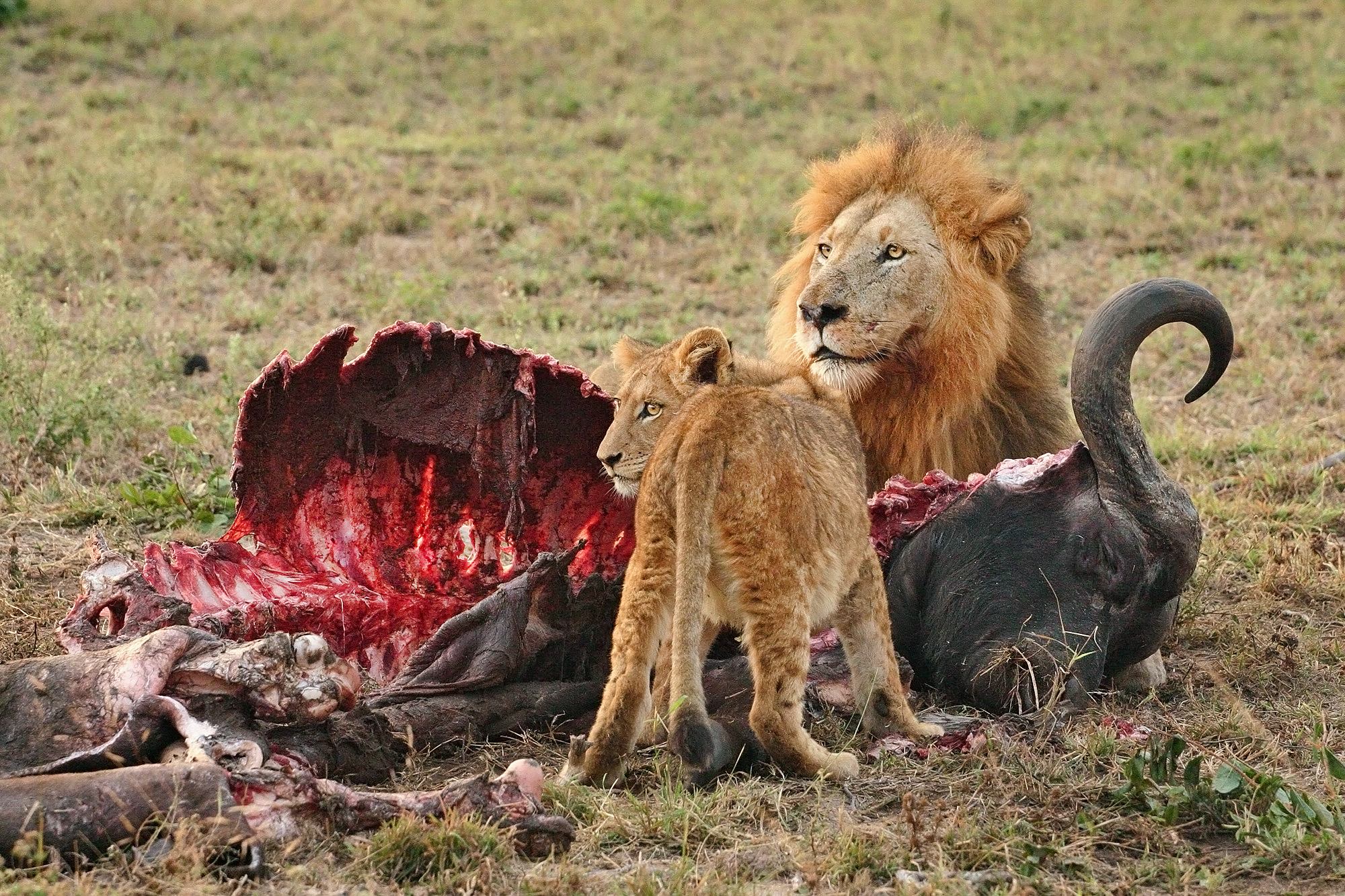
Male lions will ferociously protect their families from all intruders.
The male lion may look majestic and is often referred to as “The
King of the Beasts”. However, it turns out that they don't do too
much in life. Once taking over a pride, they metaphorically hit the
couch; though they do sometimes help the rest of the pride hunt, they
mostly let the lionesses do the work. Then, as if that wasn't bad
enough, he claims first dibs to the kill! So how on earth did the
lion get onto our list of “best animal dads”? Perhaps an even
better question is why on earth the lionesses even need him around?
Well, as you may or may not already know, male lions are responsible
for protecting the pride from other male lions. Sometimes, other
males will attempt to take over the pride; this is when the male lion
really shows why he's “King of the Beasts” (though
technically, I maintain this title belongs to the elephant since
they're much larger and stronger)! A pride leader knows that if
another male takes over the pride, he will kill all the cubs under
the age of two; this enables the lionesses to come into heat again.
The pride leader uses all his muscle and strength to make sure that
he remains leader of the pride. Despite their apparent laziness, it's
never wise to underestimate the power of a male lion! Though a fierce
fighter and often somewhat rough on lionesses (especially during
mating), lion dads can be quite tolerant of their kids. Often times,
they will allow them to play with their father's tail or his majestic
mane. Now you know why the male lion rightly deserves a spot on our
list!
Gorilla
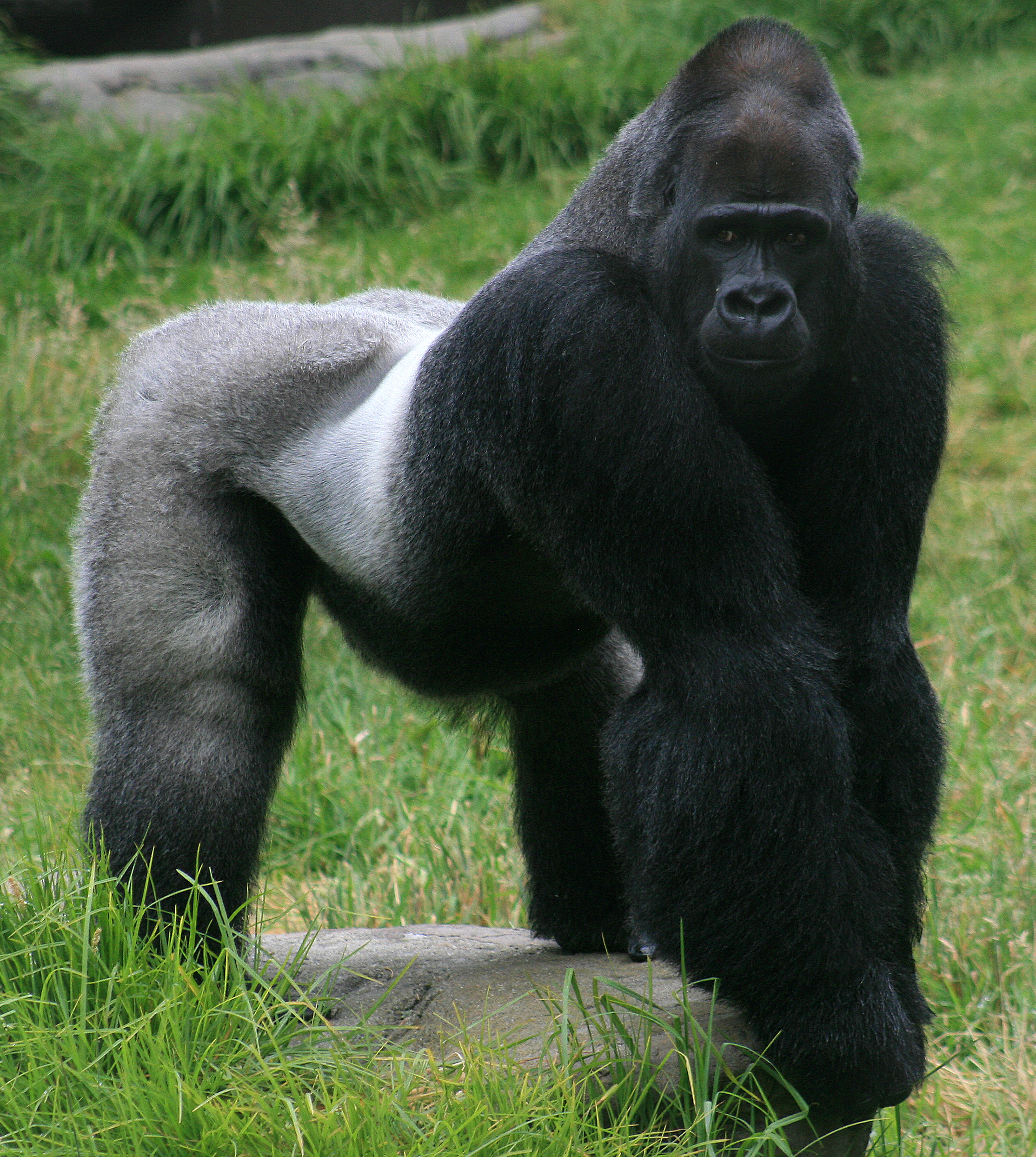
The dominant silverback gorilla is one of the most protective dads in the animal kingdom!
There are four subspecies of gorilla within the two species of this
ape: the Western lowland gorilla (with the easy-to-pronounce
scientific name of Gorilla gorilla gorilla), the Cross River
gorilla, the Mountain gorilla and the Eastern lowland gorilla.
Gorillas live in groups known as troops, normally consisting of an
alpha male – adult male gorillas are called silverbacks due to the
silver-colored fur on their backs – adult females and their young,
though sometimes other adult males may be present in the group.
Gorilla troops center around the silverback alpha. He gets all the
mating rights to the females in his troop if other males are present
in the troop and he's responsible for leading the group to feeding
sites, choosing where they'll go, making all the decisions and
stopping conflicts between other members of the troop. Another job of
the alpha silverback gorilla is to keep the troop safe from predators
and rival silverbacks. The silverback gorilla is one of the best
dad's in the animal kingdom because they will fight with their lives
at stake in order to protect their families. Predators such as
leopards are a potential threat to a troop of gorillas. When
threatened with rivals, gorillas will often do the characteristic
chest-pounding behavior in an attempt to drive them off. Despite
being a strong and powerful creature, silverbacks are pretty laid
back animals and prefer to live peaceful lives in the Africa
rainforests they call home.
Phalarope
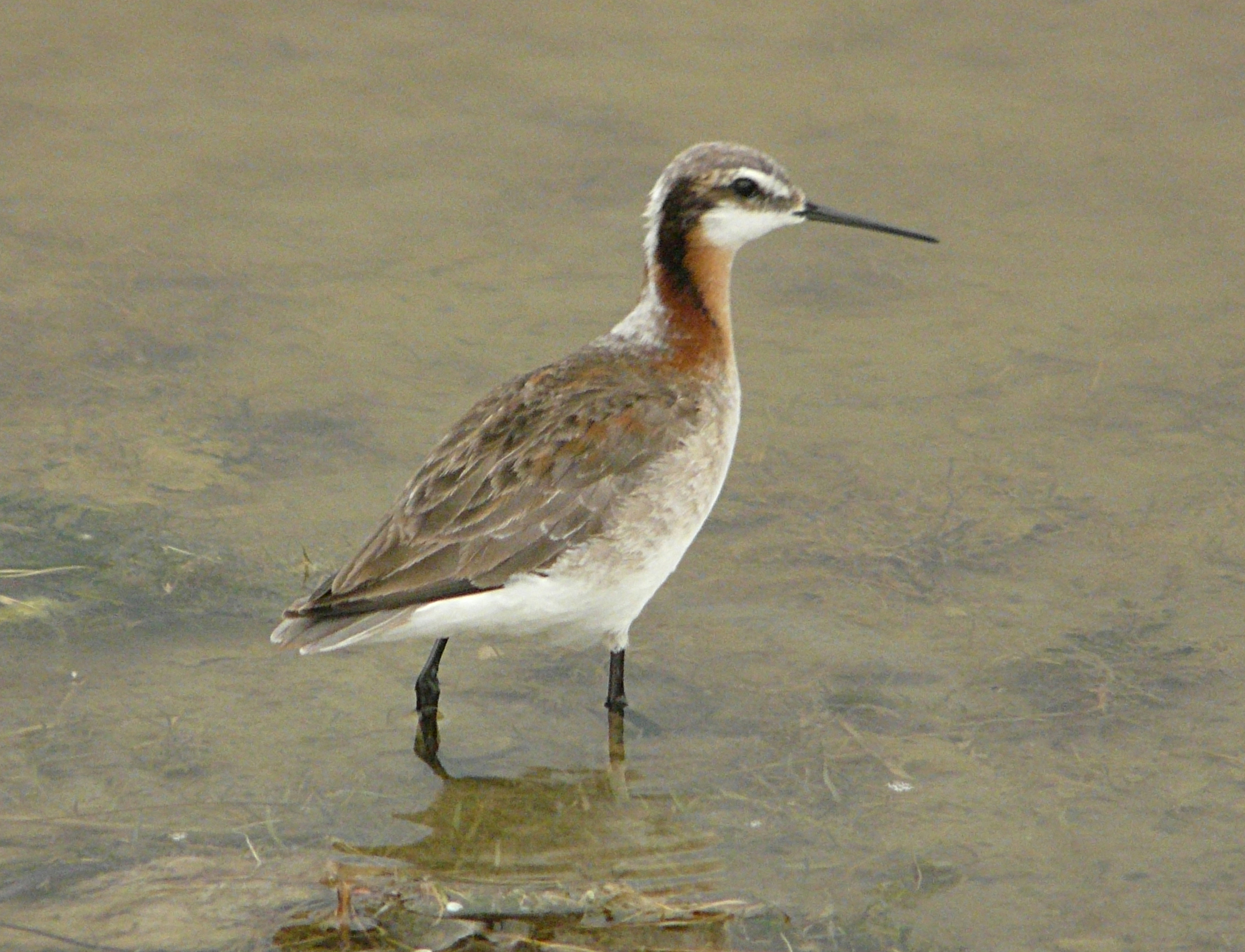
The phalarope is one of the few bird species in the animal kingdom in which the dads have duller plumage than females and presume the role of raising the children solo.
Also known as the wadepiper, this bird is a shorebird with a slender
neck that often feeds in multitudes in areas such as the Great Salt
Lake in Utah and the Mono Lake in California. In most animal species,
the male is more brilliantly colored than the female and it's the
female's job to care for the young. But no one told that to the
phalarope! Not only are females more colorful than potential mates,
but they are also one of the few animal species in which the females
try to search out and fight over males! In fact, the phalarope sexes
basically have switched roles when it comes to reproduction. During
the mating season, female phalarope will mate with a number of
different males before laying their eggs and leaving the area to
migrate south, freeing themselves of child-rearing responsibilities.
The job of incubating the eggs and caring for the young belongs
completely to the dads! This Father's Day, spare a thought for the
hard-working phalarope, because these dads definitely have their
hands (er, wings?) full!
Great
Hornbill
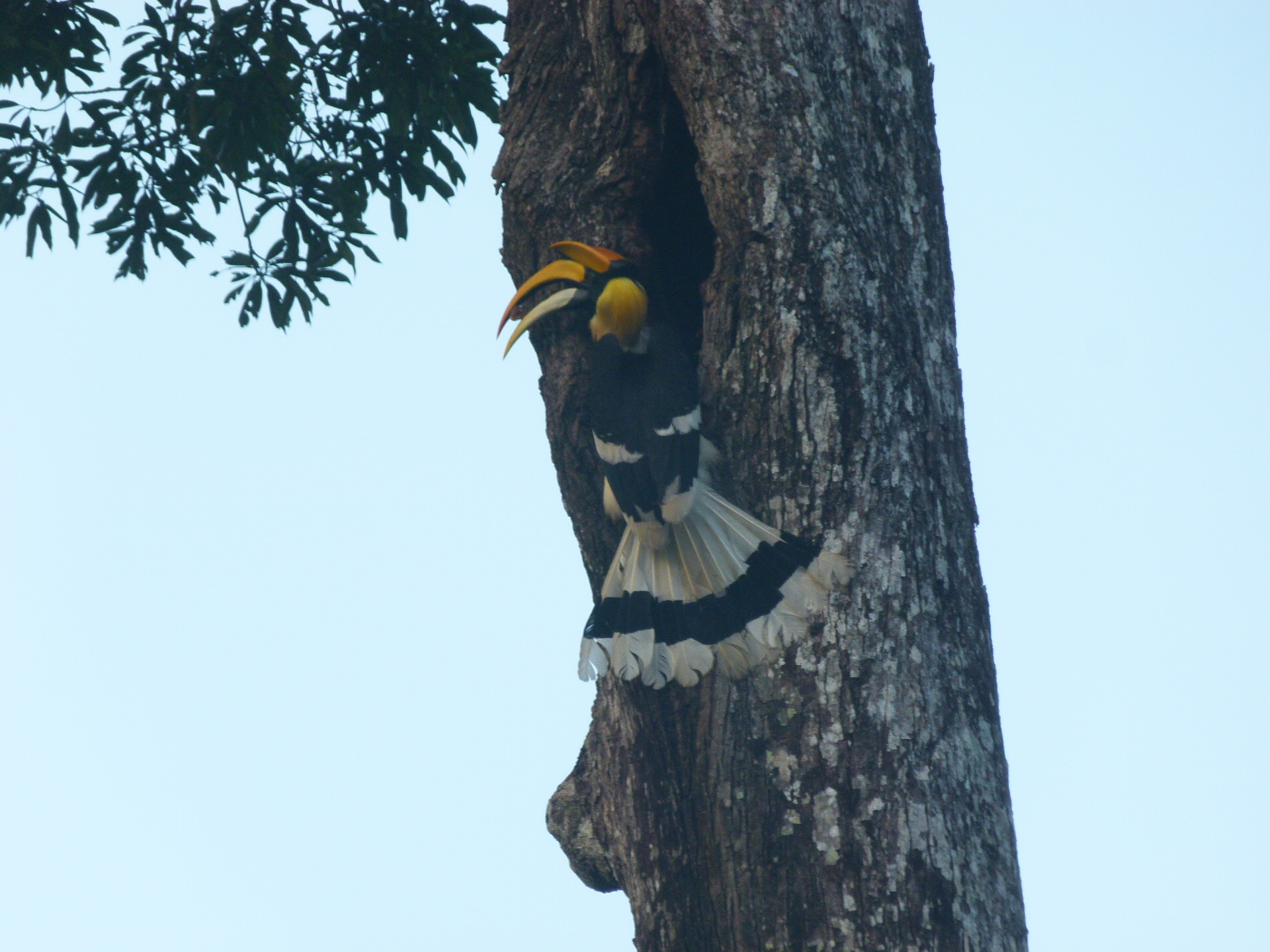
This great hornbill dad has just returned to the nest hole with food to feed his mate, who is trapped inside.
There are many species of hornbills, but the one we'll be focusing on
is the species known as the great hornbill, also known as the great
Indian hornbill. Most species of hornbills are monogamous breeders,
and the great hornbill is no exception. When it comes time to lay
eggs, the female will find a hollow in the trunk of a large tree,
either one made naturally or by a woodpecker; they are often used
more than once by the hornbill pair. Before going into the tree
cavity, the female (sometimes helped by her mate) begins to seal the
entrance with a little fruit pulp and mud, but the primary thing she
uses is droppings, leaving a hole just big enough for her to squeeze
through. Then she'll close the hole up some more, blocking herself
in, save an even smaller hole. They do this to ensure a higher rate
of survival for their chicks. Once inside, the female lays two to
eight eggs (the exact number varies with each species). But because
she's sealed herself in, the mother hornbill can't get out to feed
herself or her young once they hatch. This is why the hornbill father
is one of the best animal dads – while the young are incubating in
their eggs, the father flies to and from the nest, delivering food to
feed his mate and, and later his children. What's on the great
hornbill's menu? How about fruit, insects and small animals? Sound
yummy? After the eggs hatch (which takes 38-40 days) and the chicks
grow a certain size, you can imagine that it might be a bit cramped
inside the nest. This is when the mother breaks out of the nest; in
some species, the mother rebuilds the wall, while in others, the
young do this job. As the young mature, both hornbill parents
continue to feed and care for their young ones. Sounds like the
hornbill dad has a lot of work cut out for him!
Three-Spined
Stickleback
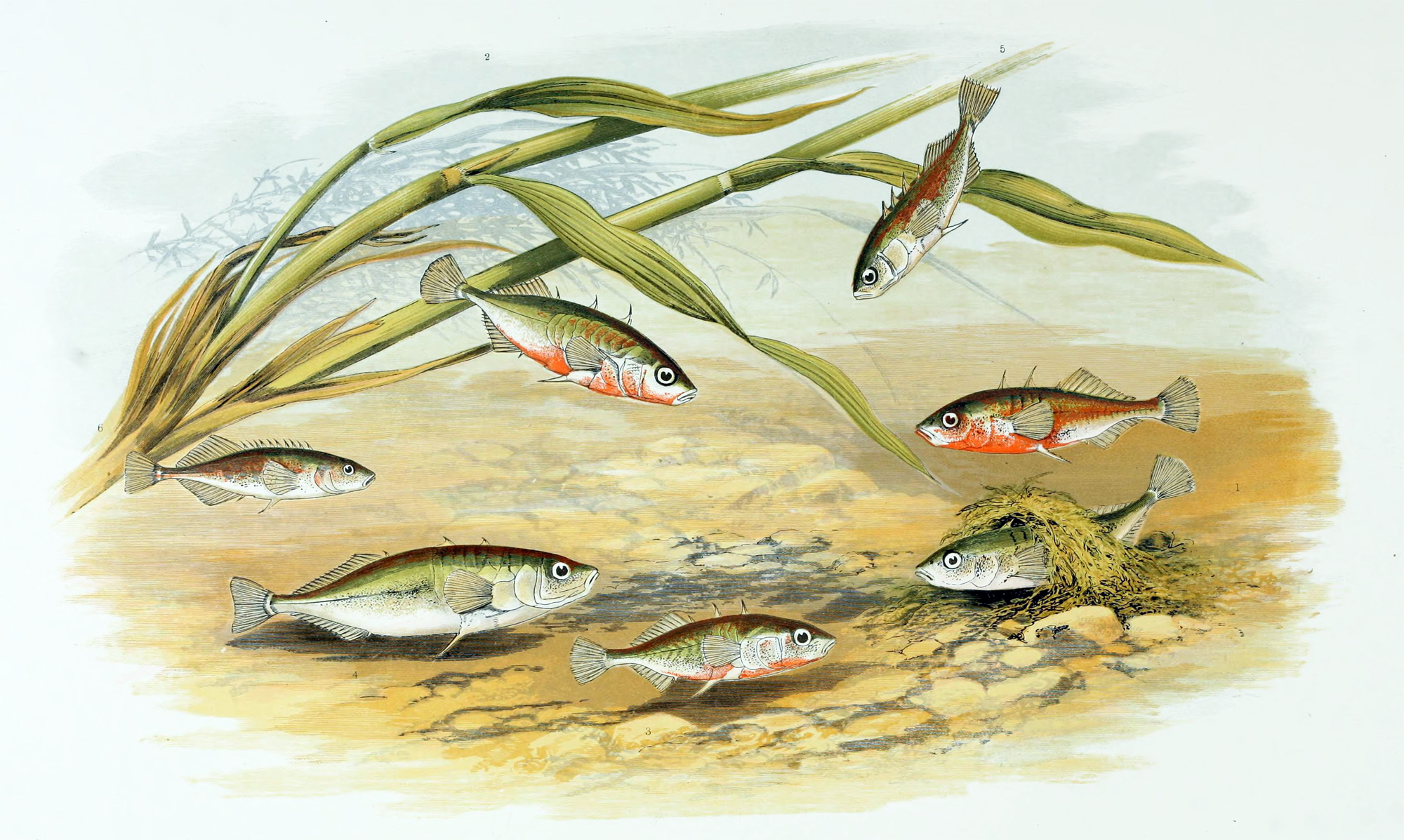
In this illustration, the male Three-spined Stickleback fish (bottom right) builds a nest and tries to attract females nearby.
Most fish could care less as to what happens to their eggs after
their laid. But the 2-inch-long three-spined stickleback is one of
the most unique dads in the fish world. They usually can be found in
coastal waters or freshwater bodies that connect in someway or
another to the coast in the Northern Hemisphere. In late April and
July, both genders of this species leave the deeper waters and head
inland into areas more shallow. This is where male sticklebacks dig
out a small depression and creates a nest made up of plant material,
sand and various types of debris all glued together with a special
substance from his kidneys called spiggin. After the nest is glued
together, he'll make a tunnel in it and attempts to lure females
nearby with a dance that involves zigzag movements. If the female is
impressed, she'll follow the male to his nest and lay 40-300 eggs!
Then it comes time for the male to fertilize the eggs. Other than
actually laying the eggs, female sticklebacks play no role in the
child-rearing process; but you can't really blame her for leaving the
eggs to the male, because he's the one that chases her away from the
area! Apparently, the male stickleback likes being a single parent.
The eggs take about 7-10 days at 18-20 degrees Centigrade and during
that time, the male fans them with his fins to make sure they get
plenty of fresh oxygen-loaded water. He also chases away other
sticklebacks, no matter what sex (however, he will try to attract
gravid females to add their eggs to his nest). When the baby
sticklebacks hatch, the father tries desperately to keep them with
him by grabbing any that exit the nest into his mouth and dumping
them back into the nest. Eventually though, the young are able to get
away from where they hatched. For the dad however, it's time to
either leave the nest or repair it to attract more females!
Emperor
Penguin
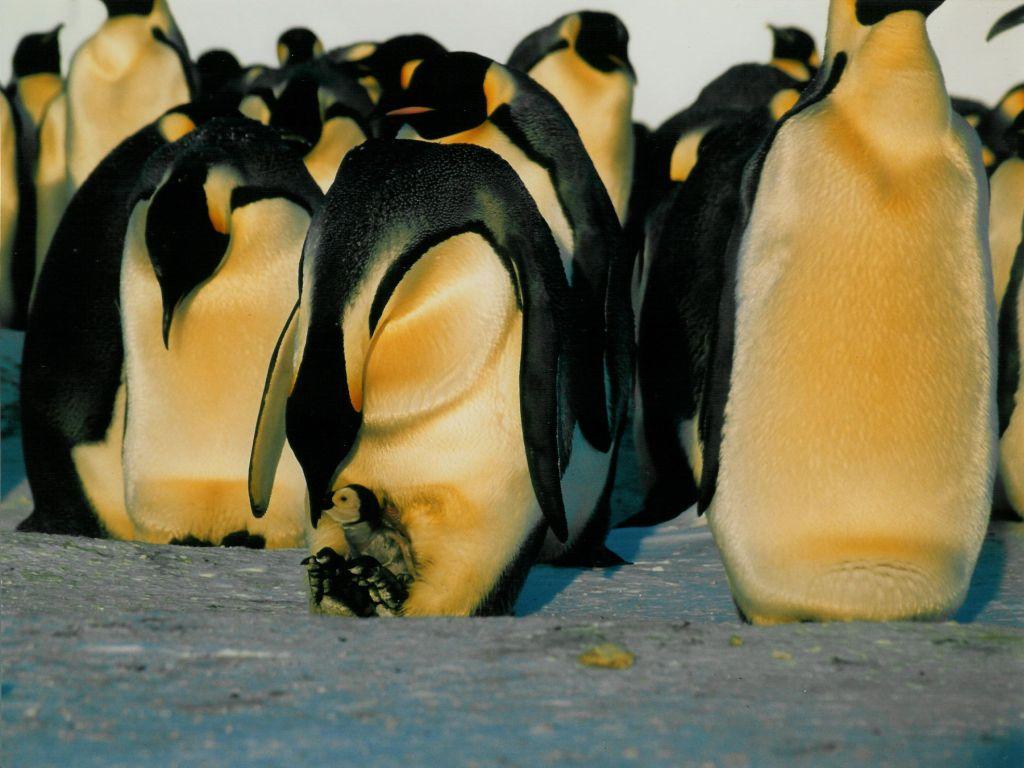
During the long, cold months the father emperor penguin balances his offspring on his feet while waiting for his mate to return, he feeds the baby a milk-like substance to keep it from starving.
Perhaps the emperor penguin of the coldest continent on the planet –
Antarctica – should be nominated as most devoted father of the
year! After reaching the age of three, the emperor penguin is old
enough to join in the yearly ritual of reproducing. Every year,
thousands and thousands of adult birds form a colony and march to
yearly nesting sites 31-75 miles inland so that they may lay their
eggs where the pack ice is nice and thick. This alone is an amazing
feat considering penguins have short, almost non-existent legs. This
species of penguin is monogamous, kind of like the great hornbill,
and after the female lays a single egg about a pound in weight in May
or early June, her nutritional reserves will be so exhausted that
she'll have to return to the ocean to feed . . . for two whole
months! While she's gone, it is the father's duty to protect the egg
from the elements. For 64 consecutive days before the egg hatches,
the father penguin carries the precious egg atop his feet and
underneath a special brooding pouch, all while battling the fierce
Antarctic winter that possesses terrible storms and winds that blow
120 mph! To protect themselves from the cold, emperor penguin fathers
will all huddle together and take turns huddling in the middle of the
group. The time between traveling to the nesting grounds, mating and
incubating the egg is four months, and during this time an emperor
penguin father can loose up to 44 pounds; that's half of his body
weight! Finally, the egg hatches and if the mother has yet to return
from the sea, the father will feed the newborn a special milk-like
liquid from his throat. It isn't until mid-July to early August that
the mother emperor penguins return to their mates and hatchlings to
relieve the father off his duties so that he can make a short trip to
the sea to get something to eat. Talk about pure devotion!
Sea
Horse
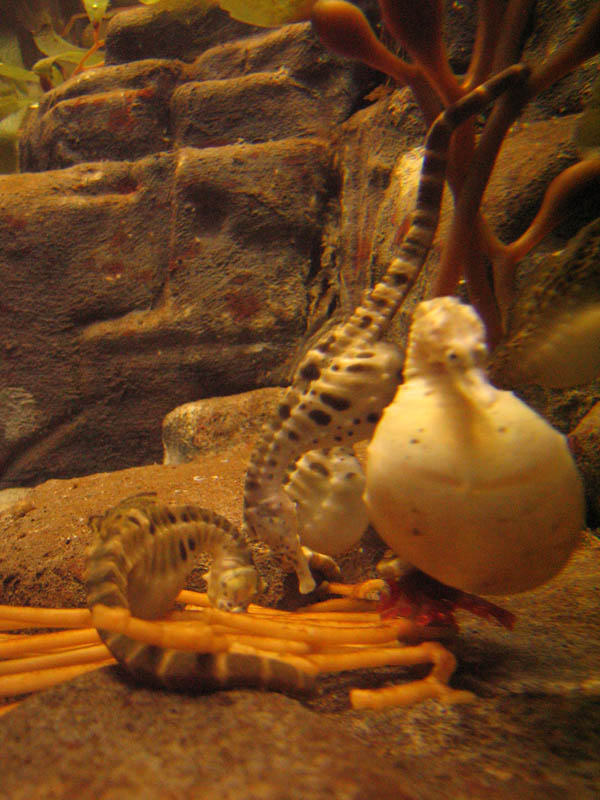
Stuffed full of offspring, the father sea horse (far right) is probably the strangest father in the animal kingdom!
If you think the way your
parents raised you was a bit strange now, your mind might change
drastically after reading about the strangest dad in the animal
kingdom. Sea horses aren't only weird in appearance, but the way they
reproduce is just plain bizarre! When most animals court during the
mating season, it doesn't take too long. Sea horses however often
court for several days before the “official courtship dance”
which lasts eight hours. Then it's time for them to mate. Why is the
sea horse the animal kingdom's strangest dad? Well, after the
courtship dance is complete, the sea horse female will insert her
ovipositor into her mate's brooding pouch, injecting anywhere between
dozens and thousands of eggs. So she isn't even the individual who
gets pregnant – the father does! Inside his pouch, the male sea
horse produces prolactin to keep the developing eggs healthy;
prolactin is the same hormone that causes milk production in mammals,
including humans! However, unlike the sticklebacks and phalarope we
already learned about, the female doesn't abandon the male after
giving him the eggs. Instead, she'll visit him every morning for
roughly six minutes to reminiscent of their courtship. Then it's time
for the young to be born and this extraordinary dad . . . actually
gives birth! Most sea horse dads give birth to 100-1,000 baby sea
horses. From then on, the babies must fend for themselves and receive
no extra parental care; in fact, the sea horse dad will be ready for
his mate to give him more eggs to bear upon her return and the
process will begin again. Talk about a strange upbringing!
So there you have it, the
best animal dads, just in time for Father's Day! We've looked at some
of the most devoted fathers, fathers that do all the work of
child-rearing, fathers that pair up with their mates, fathers that
protect their families from danger and even a father who gets
pregnant and gives birth! While we continue to learn more about these
and other incredible dads in nature, they should also remind us of
just how much our Heavenly Father and our human dads care and love
us!
If you liked this article, please be sure to subscribe to my blog, tell your friends about it and to all the fathers of the
world: HAVE A HAPPY FATHER'S DAY!!!
P.S. 1: Have a puzzling
question about animals (including dinosaurs), myself, my latest book,
my stop-motion movies, Creation or etc? Please post your question as
a comment or send me an email at animaladventures@aol.com.
PS. and/or at animaladventures1314.blogspot.com, as
sometimes messages don't come in via my AOL account.
P.S. 2: Many (or in some
cases all) of the photographs and images above are not mine. If you
own one or more of them and would like them to be removed, politely
let me know via one or both of the email addresses above.
P.S. 3: What’s the new in
the news? Check it out at SMILEY’S
NEWS.
Hello everyone! We're
starting the month of June and let me tell you, where I live, it's
HOT!!!
We've been having temperatures of over 100° F!
That's just too hot! Fortunately, I find writing this blog very
relaxing. Today, I decided to post a rerun article – one from last
year. The writing style is probably really different from the way I
write now, but it's still a good read and loads of information hope
you like it!
Days Till
It is:
10 days till Father's Day
It is:
17 days till Summer Solstice and Summer begins!
It is: 27 days till Independence Day
In the Spotlight
There hasn't been a lot of news concerning Jurassic World (aka
Jurassic Park 4) this week, but we do have an update
nonetheless! The film crew of JW is finally finished filming
in Hawaii and are going to start filming in New Orleans at an
abandoned Six Flags amusement park! You can read more about it here.
Topic of the Week by
Christian Ryan
As you'll recall in the book of Genesis in the Bible, God created all
the land animals on Day 6 (this includes dinosaurs). These animals
would have included an animal we all know and love - the lemur. Now
lemurs might look like monkeys, after all they are both primates, but
lemurs and monkeys are not related, contrary to what those brainwashed
evolutionists say. Lemurs are actually prosimians. Prosimians
(Pro-sim-ee-ans) is a group of primates that along with lemurs also
includes tarsiers and bushbabies. The most famous lemur is no doubt the
Ring-Tailed Lemur, but there are over 100 other species of lemurs living
on the earth today. All can be found on the African island of
Madagascar. Here are a few examples:
Grey Mouse Lemur
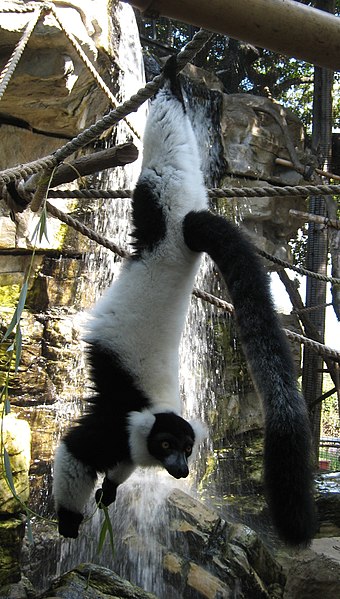
Black and White Ruffed Lemur
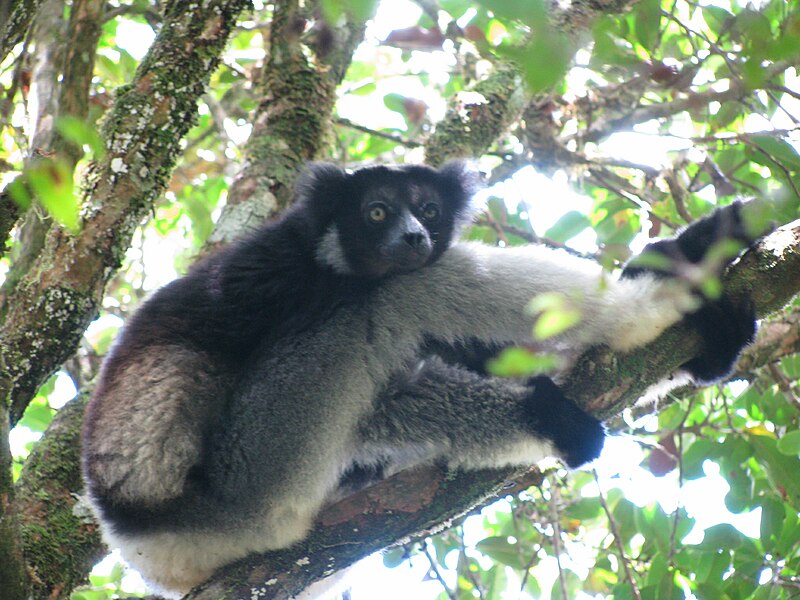
The Indri Lemur
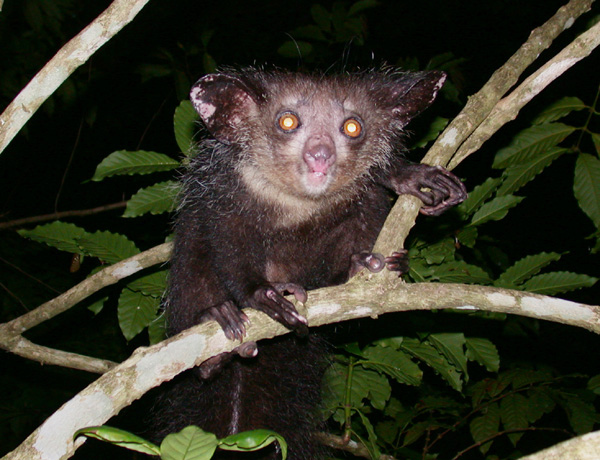
Aye-aye
Golden Bamboo Lemur
Verreaux's Sifaka
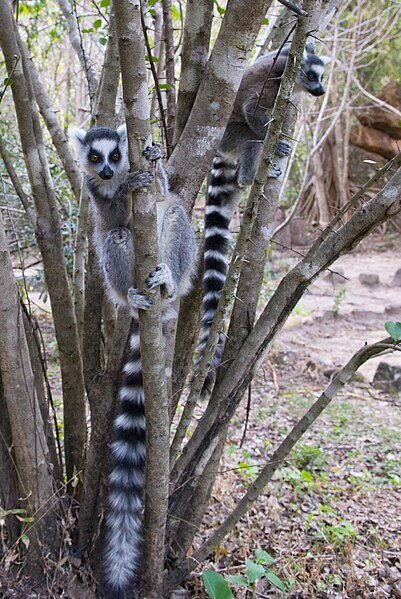
Ring-Tailed Lemur
Unlike
monkeys, lemurs can't hang from their tails. But they are very handy
for balance while scampering among the tree branches. The largest lemur
is the Indri (as seen in one of the pictures above) and the smallest is
the mouse lemur (also seen in one of the pictures above). The mouse
lemur is only 11 inches long! This makes it not only the smallest lemur,
but also the smallest primate.
Lemurs live in groups
called troops and they are normally (but not always in some species)
lead by a dominant female. Unlike most primates, this is a female-ruled
society. The males don't just sit back and relax however, they help in
fighting rival groups over territory. And when the males fight, boy, you
might want to get a close-pin! Males don't just use their hands and
feet to fight, they use stink! You see, God made these guys with special
scent glands on their wrists. They rub them on their tails and then
they wag their tails around to try and frighten the other lemur troop
away.
These furry primates also live in a variety of
habitats too, from cacti scrub-land areas, to dense tropical rain
forests. They also eat a lot of different types of food, including
leaves, flowers, fruit and insects. Mmmmm, sounds yummy! Some lemurs
have more centralized diets e.g. the Bamboo Lemur (see the above
pictures) mainly eats bamboo.
Lemur's vary greatly in size today. But back in the day, lemurs had even greater size ranges. Take the Megalatopus for example.
This
lemur was one of the largest ever. It grew as big as a gorilla and
weighed about 400 pounds! It was perfectly at home in the trees. Lemurs
made it to Madagascar probably by floating on rafts of vegetation after Noah's Flood. Then using natural selection (which is very different
from evolution by the way, but I'll discuss that later) they changed
into a variety of different forms. However, about 2,000 years ago, the
giant lemurs were doomed when humans arrived to Madagascar, they cleared
much of the land and cut down many of the trees giant lemurs needed to
survive. The smaller lemurs managed to cling on, but the bigger lemurs
needed more food and would have needed to cover vast areas to find it.
On the ground giant lemurs were not comfortable, they were most at home
in the trees. So unfortunately they went extinct. However, we still have
over 100 species of lemurs today (and scientists are STILL finding
new species), but if we are to have them in the future, we must
preserve their habitat and be good stewards of the earth like God
instructed us to be in the book of Genesis all those thousands of years
ago.
How did you all like this rerun article? Please be sure to let me know via commenting and I'll see you all next week!
P.S. 1: Have a puzzling
question about animals (including dinosaurs), myself, my latest book,
my stop-motion movies, Creation or etc? Please post your question as
a comment or send me an email at animaladventures@aol.com.
PS. and/or at animaladventures1314.blogspot.com, as
sometimes messages don't come in via my AOL account.
P.S. 2: Many (or in some
cases all) of the photographs and images above are not mine. If you
own one or more of them and would like them to be removed, politely
let me know via one or both of the email addresses above.
P.S. 3: What’s the new in
the news? Check it out at SMILEY’S
NEWS.
This
week, I hope you readers aren't getting tired of dinosaurs, because
we're going full-fledge dino this week! Everything from the In the
Spotlight to the Topic
of the Week . . . well, the
Days Till section of
the article isn't devoted to dinosaurs, but everything else is. For
those readers who might not be as interested in dinosaurs as I am,
you've no need to fear, because we won't be doing a dinosaur-related
blog post next week. Anyway, let's get started!
Days Till
It is:
17 days till Father's Day
It is:
23 days till Summer Solstice
It is:
36 days till Independence Day
In the Spotlight
For
those of you who have been keeping up with reading these blog posts,
you'll know that there's a lot going on concerning the upcoming film
Jurassic World, that is
filming at this very moment. I'm very excited for the film. However,
in all the hullabaloo, many people have leaked “spoilers” onto
the internet (they're not really spoilers, per se, but if you don't
want to know anything about the film, skip to the Topic
of the Week). One of the
most major contributors to the spoilers leaking is Joblo.com,
and they started a rumor regarding the film's plot. You can read
about it here.
These
rumors seemed like they were accurate, but we could never be 100%
sure and we had to take this news with a grain of salt. When learning
or hearing about rumors concerning upcoming films, it's always a good
idea to take them with a grain of salt, because some are nothing more than tales spun up by people on the internet desperatefor attention. Just
yesterday, the result from an exclusive review with the film's
director, Colin Trevorrow puts a lot of conspiracies to rest and
reveals why the film has been shrouded in secrecy. As the interview is far too extensive to put in this blog post, you can read the
whole interview here and here.
Now
we know for a fact
that the new film will take place at a new theme park on Isla Nublar,
the island of the first film. The interview you just read also
corrected many misconceptions about Jurassic World.
One of the ones I found most interesting was that many fans of the
Jurassic Park
franchise believed Velociraptors
would be tamed in the film by Chris Pratt's character – named Owen,
based on what was said by Joblo.
Trevorrow corrected that myth and said that Owen is merely studying
their behavior. He also debunked the myth that there would be “good”
and “bad” dinosaurs. Yahoo!
Chris Pratt's character will be studying Velociraptor behavior in Jurassic World; let's hope he fares better than Dr. Alan Grant does in Jurassic Park III as seen above.
In
other Jurassic World
news, a series of photographs was recently leaked onto the internet
from an unknown source.
They reveal what the new park might look like. Here are the
photographs below:
Of
course, since many of them are either blurry or don't show the whole
map, we can't be certain about everything the park will have to offer
– if this isn't some
hoax spun up by some guy on the internet – but from what we can
see, we can start to learn about what species of dinosaurs and other
creatures will be in the park:
Tyrannosaurus
Triceratops
Gallimimus
Pachycephalosaurus
Flying reptiles that live in Aviary (possibly Pteranodon)
Mosasaurus
Velociraptors
and Diabolus rex
are apparently missing from the map, suggesting either that these two
dinosaurs aren't showcased to the public (we can see that the map is
one for tourists because it says “Welcome to Jurassic
World” and “You are here”)
or that this map is a hoax. I'm also rather skeptical about this map
because there is an apparent lack of enclosures for sauropods, such
as Brachiosaurus,
which appeared in the first and third Jurassic Park
film, and hadrosaurs like Parasaurolophus,
which appeared in all three films released so far. It seems kind of
strange to me that this movie would emit sauropods and hadrosaurs
from the film, considering how iconic they are to the series. But
like I said, much of the map is hard to see, so we can't say for sure
if they are or aren't there, or even if this map is really for the
film and not a hoax.
Last
but not least, Trevorrow posted an image of the badge worn on the
hats of Jurassic World
veterinarians:
With
all the news coming in about Jurassic World,
a JP fan like me can't
help but be excited.
Topic of the Week by
Christian Ryan
I
recently got a documentary on dinosaurs called Dinotasia . . .
and I loved it! For those of you not familiar with it, it is a
dinosaur-starring documentary by Creative Pictures and
DiscoveryChannel and narrated by Werner Herzog. But
it's quite unlike any other dinosaur documentary I can think of, as
it not only portrays the latest dinosaur fossil discoveries, but also
classic storytelling techniques generally unseen since the era of
silent films. This film is almost as if you took the BBCseries Walking
with Dinosaurs and the
Disney
film Fantasia
and blended the two together. Just like Fantasia,
there is slapstick humor, and moments that will make you cry; like
Walking with Dinosaurs,
it's based on real fossil evidence. That's what I feel makes
Dinotasia so unique. Today, as Werner says near the film's
beginning, “We've now returned to a world where life and death are
locked in a merciless struggle.” Welcome to Dinotasia.
P.S.: Don't watch if your squeamish. This film is not
really for young viewers, as there are quite a few instances where
dinosaurs or other animals get eaten, violently killed, injured,
stabbed, stepped on, beheaded and . . . you get the picture!
Before I
get any further into my review about Dinotasia, you might want
to know some background on the film. Back in September of 2011,
Discovery Channel released one of my favorite dinosaur
documentaries (or dino-docs) called Dinosaur Revolution (it
was originally going to be called Reign of the Dinosaurs), a
four-episode series that takes the viewer back in time to see what
the latest fossil discoveries have to saw about these amazing
creatures. Unlike most other dino-docs, it combined enriching
storytelling with loads of scientific facts, often given by
“talking-heads”. There were four episodes:
Evolution's Winners (I wouldn't have picked that title for the
episode, of course), which is about why dinosaurs were unique among
other creatures. Watering Hole tells the story of an
Allosaurus as he struggles to survive in the harsh Jurassic
world. Survival Tactics was all about, as the title suggests,
the dinosaurs' various survival strategies. The fourth and final
episode was End Game; this episode focused largely on a pair
of Tyrannosaurus rex and dinosaur extinction.
Unfortunately,
while the series received lots of praise, it also received lots of
negative comments. Many viewers mainly complained about the quality
of the special effects, the annoying narrator (originally, it was
supposed to have no narration), and the constant switches from
serious to not-so-serious. Frankly, I don't know what there was to
complain about. I LOVED the series. My main complains with Dinosaur
Revolution, along with Dinotasia, is the use of the
secular worldview of evolution and millions of years, of course. But
seriously, other than that, I didn't get why a lot of people
complained. After the series aired, it's creators decided to make
sort of a director's cut of the series; they combined what they
considered the best scenes from the series, used a new narrator,
Werner Herzog and meshed them together to make Dinotasia.
Dinotasia
takes the viewer on a ride back in time to when dinosaurs roamed the
planet. As with the Walking with Dinosaurs: The Movie
review I did, I want to take a moment and say when the scenes in the
film take place, as the earth really isn't millions of years old as
evolution teaches. Most of the scenes in Dinotasia
would fit perfectly in the pre-Flood world, perhaps around 4,500
years ago; that's the time before the global Flood of Noah's time
(which happened about 4,350 years ago) wiped the earth clean of all
recognizable geography and God cast His judgment on the world. The
only exception I feel would be the very first and last moments of the
film, but I'll get to that later.
As
mentioned before, there is a good bit of violence in Dinotasia,
but much of the violence isn't actually thought up by some creative
mind – a lot of it is based on real fossil discoveries! One
dinosaur discovery that backs up what is seen in Dinotasia
is of the broken jaw of an Allosaurus
that was broken during the time the animal was alive (more on this
later). Finds such as this are a problem for Christians who believe
that the Bible and evolution compliment each other. If that were the
case, then you'd have animal death, injury and violence, millions of
years before Adam sinned in the Garden of Eden, but that's not the
world that God said “that it was good” (Genesis 1:31). No, death
and injury of man and animals is a result of mankind's sin and
rebellion against God. Dinotasia
perfectly portrays the kind of violence that happened in the
pre-Flood world; Werner himself even says at one point in the film
that “Eden does not exist here.” How right he is!
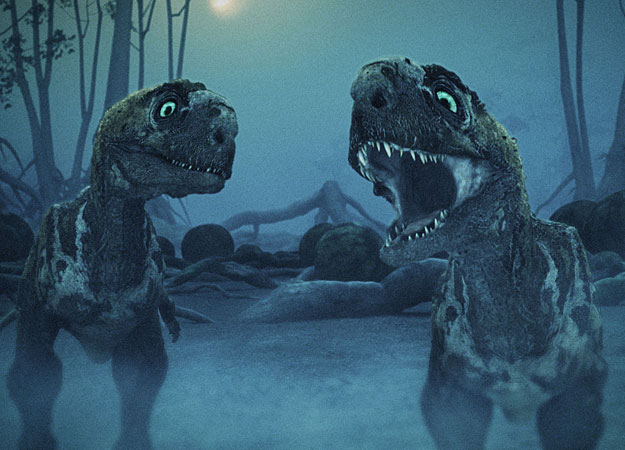
A family of Eoraptors surveys the land in the first episode of Dinosaur Revolution.
Over the
past few paragraphs, I've mentioned time and time again about the
scenes in the film. Well, I might as well not have said that if I
hadn't intended to tell you what scenes were in the film! So here
they are:
The Great Dying – a thrilling short scene in which a pair of Inostrancevia
try to escape the destruction of their world.
Rivals
– this story takes place in Jurassic Portugal (the environment, not
the fictitious time period) and portrays the rivalry between an
Allosaurus and his
prey, a Dinheirosaurus,
along with the other creatures that live around a small waterhole.
Timeless Sea
– A montage of different stories (taking place in the ocean, Utah,
Antarctica, Portugal and China) featuring a mother mosasaur giving
birth, a pack of Utahraptor
trying to bring down a Cedarosaurus,
a Glacialasaurus trying to find a mate, a pair of Cryolophosaurus
fighting over a mate, a cameo appearance from the creatures in Rivals
and a pair of Guanlong.
Sound of Survival
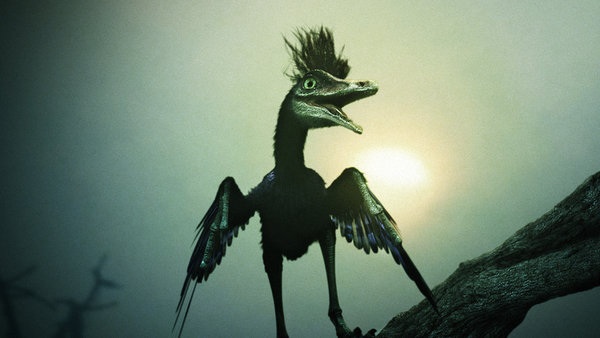
– a tiny Rahonavis
bird forms sort of a symbiotic relationship with a larger titanosaur
and tries to avoid getting stepped on or eaten by the carnivorous
Majungasaurus.
Forbidden Fruit
– a young Shunosaurus
learns a similar leason to the one Adam and Eve learned 6,000 years
ago . . . that disobeying has serious consequences.
Herd Instincts
– a baby Protoceratops
struggles to survive after the death of his herd at the hands
(claws?) of small but extremely underestimated Velociraptor!
Empty Nest
– a mother pterosaurdecides
that it is time for her young to learn the power of flight . . . but
it's a dangerous world for a new flier.
End Game
– a pair of Tyrannosaurus
named Tinkerbell and Stumpy find out how hard it is to raise a family
in Cretaceous Montana with the ominous threat of Jack the
Tyrannosaurus.
Also, a pair of Troodon
struggle to survive in a post-apocalyptic world.
While
watching Dinotasia,
it feels almost as if you can actually travel back in time to see
these amazing creatures. I enjoyed the experience greatly. On this
adventure, there are plenty of amazing and incredible creatures to
see. Now, let's look at some of the creatures that make up Dinotasia:
The Great Dying
Inostrancevia
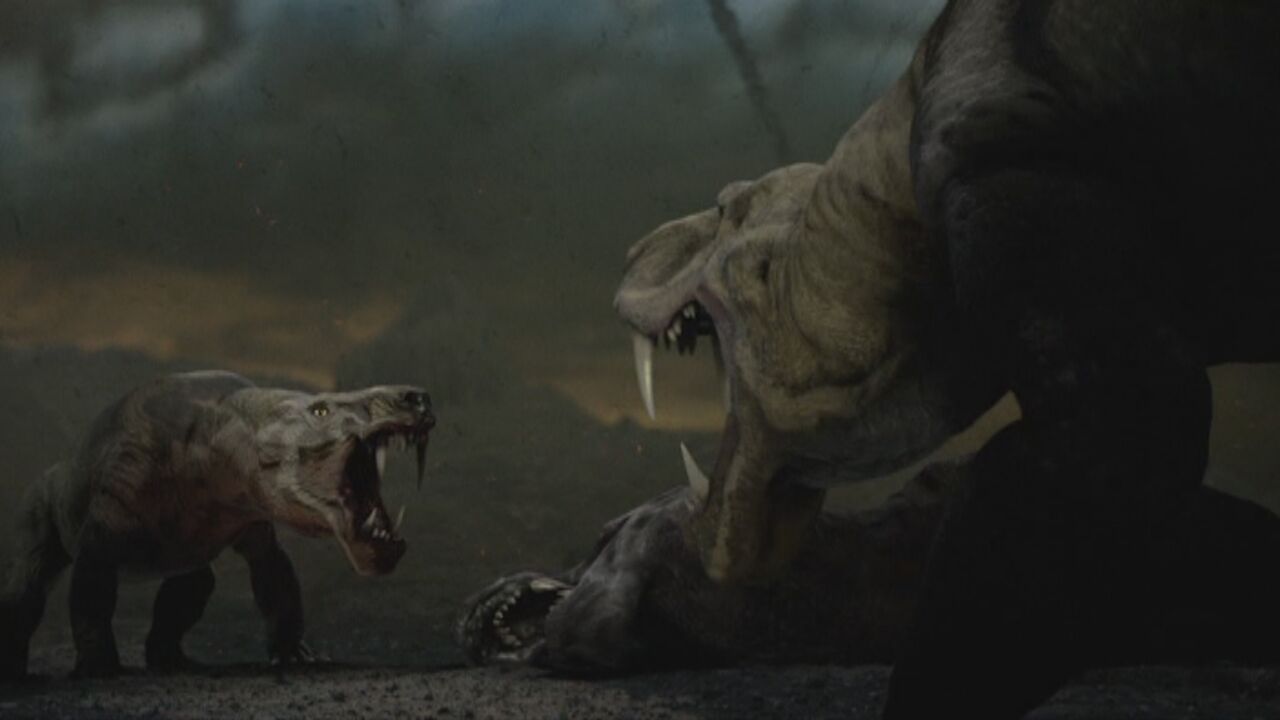
A pair of Inostrancevia fight over a carcass.
Inostrancevia
was the largest member of the gorgonopsid family. These ancient
reptiles were not dinosaurs, but another type of reptile called
therapsids. The gorgonopsids were ferocious predators that hunted
pretty much any other creature in their environment. In the habitat
they lived in, the only creature they had to fear was another
gorgonopsid. Gorgonopsids came in all shapes and sizes, but
Inostrancevia – the
largest – was the size of a rhinoceros! It bore four-inch
saber-teeth in its jaws used to finish off its prey. In the first
scene of Dinotasia, a
pair of gorgonopsids try to survive a nasty meteor shower.
Unfortunately, even if they survive, the world as they know it is
sadly coming to an end. This is probably not the world of the
pre-Flood. Instead, this scene in Dinotasia
seems to fit more of a post-Flood setting, when the world really was
quite apocalyptic and unpredictable.
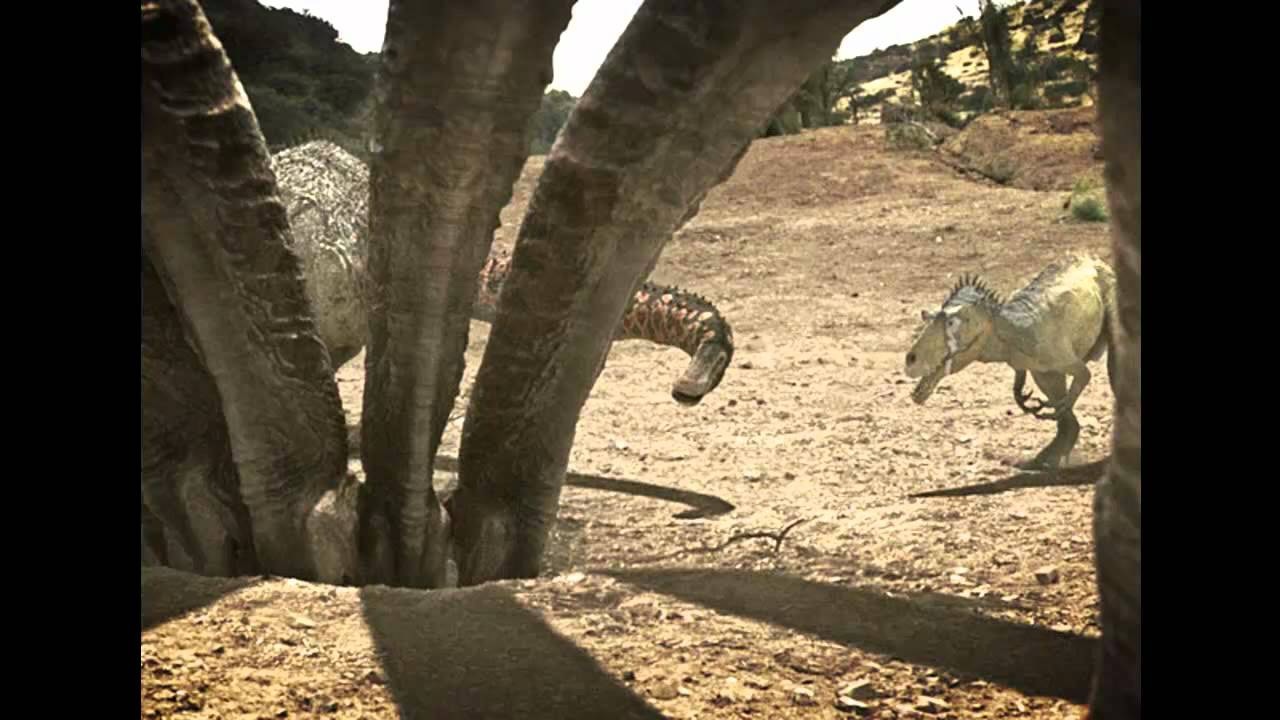
Rivals
Allosaurus
Allosaurus was one of the top predators of Jurassic Portugal.
Allosaurus
is what many have called the “Lion of the Jurassic”, and rightly
so. It was one of the top predators of the Jurassic environment. It
was about 10 feet tall, 28-30 feet long and weighed 3-4 tons. This
dinosaur makes an appearance in Rivals
in the setting of Jurassic Portugal. This story starts off with a
young Allosaurus
having a normal day with his mother and siblings. However, as he
plays by himself, he wonders from his family and ends up near a herd
of traveling Dinheirosaurus.
One of the Dinheirosaurus
doesn't like him so much and lashes out irrationally . . . literally!
A single swipe from its whiplash-like tail snaps the baby Allosaurus'
lower jawbone in two; many fans of the series and the film have
nicknamed this dinosaur “Broken Jaw”. Interestingly enough, this
scene isn't mere storytelling by the film's creators – it's
inspired by real evidence. A lower jaw bone of an Allosaurus
has been discovered and sometime in the past it broke. The tail of a
sauropod is one of the most likely candidates for causing the injury.
Astoundingly, the bone healed before the dinosaur died, so we know
that the Allosaurus
lived possibly years after the incident! Throughout his life, Broken
Jaw learns just how hard it is to be the top predator in Jurassic
Portugal.
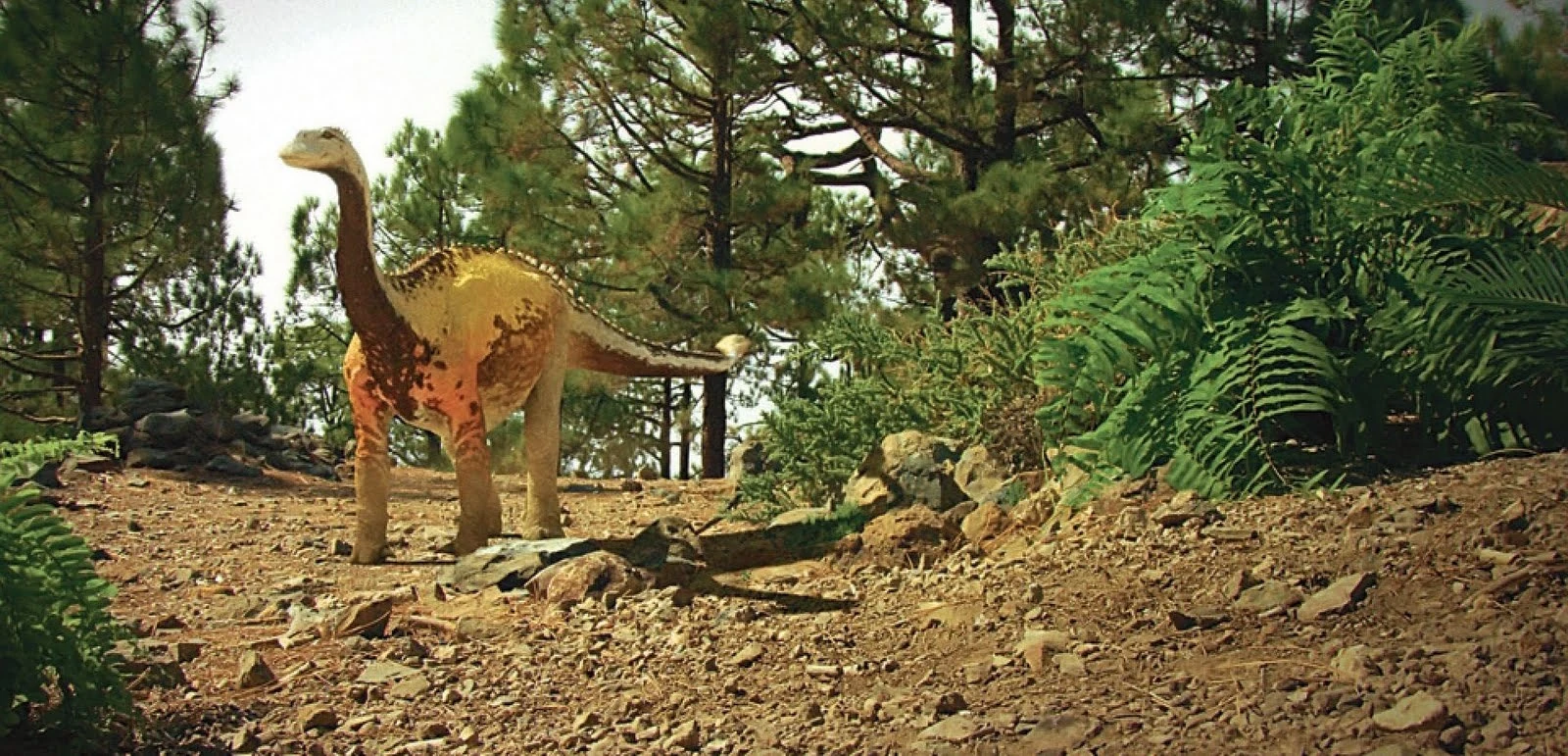
Dinheirosaurus
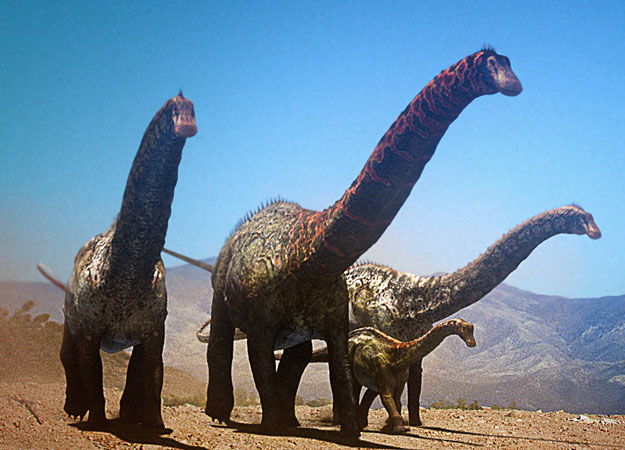
Dinheirosaurus weighed 30 tons and stretched 90 feet in length!
This dinosaur is one of the largest dinosaurs to appear in Dinotasia.
Dinheirosaurus is a close relative of the North American
Diplodocus and Apatosaurus and is about the same size.
Despite its long neck, Dinheirosaurus mainly grazes on
low-growing foliage rather than browsing on tall trees. Weighing up
to 30 tons, most predators would rather not mess with them. They also
have long whip-like tails that can be used to injure attackers, as
Broken Jaw learned the hard way! In Dinotasia, the individual
that snaps Broken Jaw's lower jaw bone in two continues to have a
predator-prey relationship with Broken Jaw into adulthood. She must
always keep an eye on Broken Jaw, because the young Allosaurus
seems set on making a meal, not on her, but on what appears to be her
offspring.
Ornitholestes
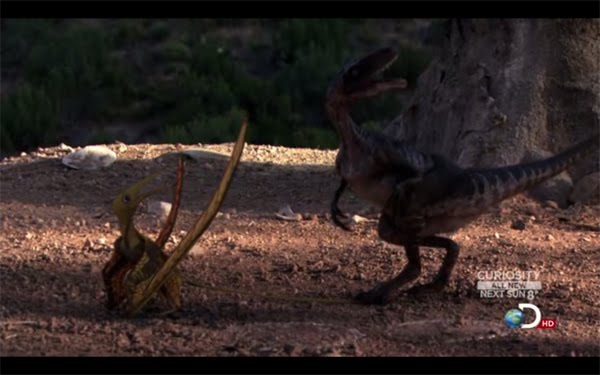
Ornitholestes (right) spends much of his time trying to catch that Rhamphorynchus.
Ornitholestes,
a small sheep-sized theropod, was probably the Jackal of the
Jurassic. Although no fossils of this dinosaur have been found in
Portugal, many of the dinosaurs found in Portugal are the same
species or very similar related species to ones found in another
location called the Morrison Formation, in North America. For
instance, Allosaurus and
Torvosaurus have been
found in both Portugal and North America; Dinheirosaurus
is quite similar to its relative Diplodocus,
Lusotitan is similar
to the North American Brachiosaurus
and Miragaia is
similar to the more famous Stegosaurus.
In Dinotasia, one
Ornitholestes learns
why it should never awake a sleeping Allosaurus.
Another Ornitholestes
spends much of his time on screen trying (and often humorously
failing) to catch a Rhamphorynchus
in a very similar fashion to the cartoon Tweety and Sylvester. I
found the scenes between Ornitholestes
and Rhamphorynchus
some of the funniest scenes in the whole film.
Rhamphorynchus
The Rhamphorynchus of Dinotasia has a symbiotic relationship with Broken Jaw.
Rhamphorynchus
is a small pterosaur from Jurassic Europe. Normally, this species is
a fish-eater, but the individual in Dinotasia
seems to have a taste for insects. It also has formed a symbiotic
relationship with Broken Jaw, similar to the relationship crocodiles
were formally believed to have with African plover birds. Broken Jaw
will open his toothy jaws for the little pterosaur and allow him to
eat the leftover flesh stuck in between his teeth. Like all
pterosaurs, Rhamphorynchus
is not a dinosaur, unlike his pursuer, the carnivorous Ornitholestes.
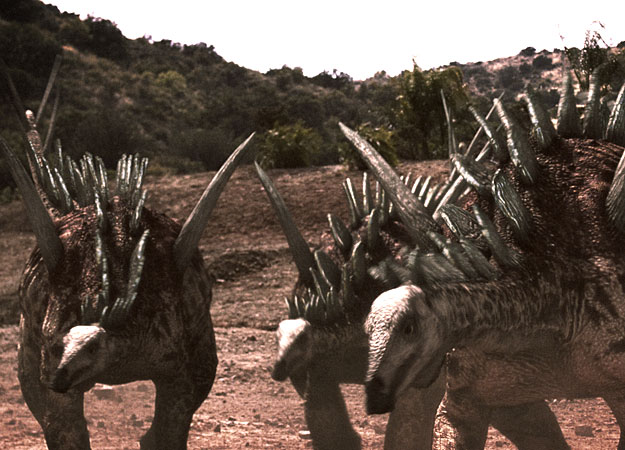
Miragaia
A herd of Miragaia is best left alone, even by large predators!
Miragaia
is a medium-sized member of the stegosaur family. Like its larger
relative Stegosaurus,
Miragaia has tall
plates on its back. Scientists aren't sure what the plates are used
for, but one theory is that they were used for display purposes. What
makes Miragaia
different from many other stegosaurs is the fact that it has a long
sauropod-like neck, a quite unusual trait for a stegosaur. This
dinosaur also has a spiked tail for protection.
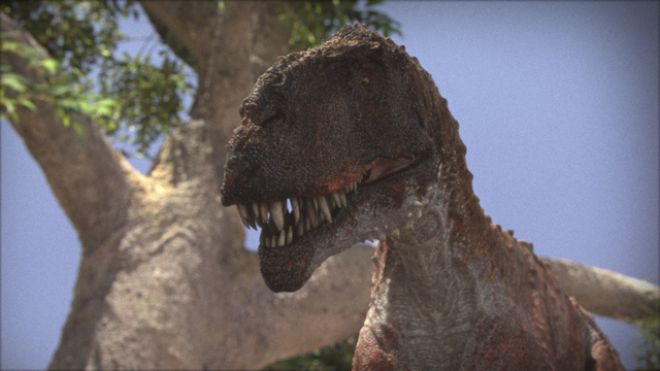
Torvosaurus
Torvosaurus is the largest carnivore ever to walk European lands.
For a time, Broken Jaw believes that he's the largest carnivore in
the region . . . that all changes with the arrival of Torvosaurus.
Torvosaurus is a large megalosaurid that stretched 35 feet or
more in length and weighed 4-5 tons. In Dinotasia, he wants
the territory around the waterhole to himself, even if that means
kicking Broken Jaw off of his favorite turf. He is also a major
threat to juvenile Dinheirosaurus.
Lusotitan
Lusotitan can drink lots of water in one sitting!
The largest dinosaurs to appear in the series are sauropods called
Lusotitan, with emphasis on “titan”. They stand 60 feet
tall, are 80-90 feet long and weigh 50 tons! At this size, they could
peer into a six-story building with no trouble at all. Lusotitan
are very closely related to Brachiosaurus of North America and
Giraffititan of Africa. Unlike the smaller Dinheirosaurus,
this sauropod uses its long neck to browse on leaves in the treetops.
Sound
of Survival
Rahonavis
Rahonavis is certainly a bizarre creature!
Sound
of Survival portrays the little
extinct species of bird, Rahonavis
struggling to stay alive on what is now the island of Madagascar.
Though it looked like a member of the dromaeosaur or raptor family,
Rahonavis' skeletal
design reveals it is actually a bird. Like a raptor, it had a
sickle-shaped enlarged talon on each foot. Paleontologists aren't
sure if this bird could fly or not. Dinotasia
seems to portray it as a creature that can fly at least a little bit.
However, its long legs make it an ample runner, able to escape
dangerous predators. Back then, Madagascar wasn't home to cute and
cuddly lemurs and scaly chameleons. Before the Flood, ravenous
dinosaurs roamed the area. Rahonavis
wasn't very big – at only the size of a raven, it would have made
the perfect meal for many predators.
Majungasaurus
Even baby Majungasaurus are ferocious hunters!
Madagascar's largest predator in the pre-Flood world was a carnivore
by the name of Majungasaurus.
This species of
dinosaur belonged to the abelisaurid family and was related to
dinosaurs such as Carnotaurus
and Aucusaurus.
It probably hunted creatures like the large sauropods it shared
pre-Flood Madagascar with. In Dinotasia,
even the babies are ferocious predators at a very young age. While
their mother attempts to kill big game, her young try their hunting
skills on a Rahonavis
who must use his roadrunner-like running ability to escape danger if
he wants to survive.
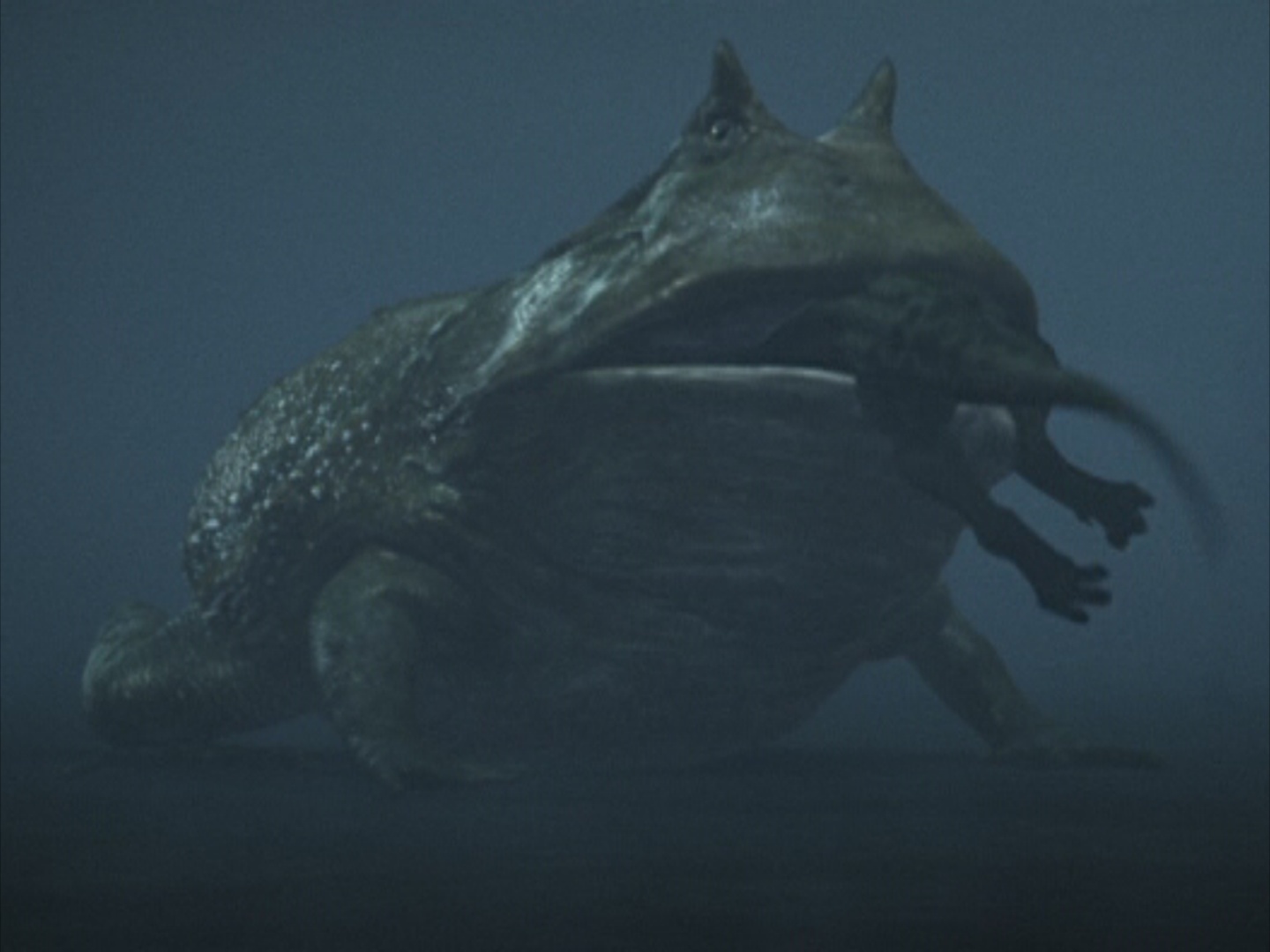
Beelzebufo
Beelzebufo was large enough to eat baby/small dinosaurs!
One of the largest frogs ever to exist was Beelzebufo. It was
about the size of the modern African bullfrog. African bullfrogs
aren't very frightful creatures like many frogs are; in fact, they
won't hesitate to bite human beings. If African bullfrogs are like
this, one can only imagine what meeting Beelzebufo would have
been like! This extinct frog was so large that it could consume other
frogs, and even baby/small dinosaurs, including Majungasaurus
babies!
Forbidden
Fruit
Shunosaurus
Shunosaurus has a club on its tail for defense.
Shunosaurus
was a bizarre sauropod; unlike most sauropods, it had a club on the
end of its tail, similar to the ones possessed by ankylosaurs. In
Dinotasia, a juvenile
or sub-adult Shunosaurus
decides to disobeys his elders and sample some red mushrooms.
However, he soon learns that his choice was a poor one when he
becomes disorientated and starts feeling sick. This is a bad time for
this to happen, because no sooner does he come under the effects of
the mushrooms does a pair of Sinraptors
approach, deciding they want their next meal!
Sinraptor
Sinraptor is a predator you don't ever want to run into!
The name of carnivorous Sinraptor is deceptive, as its not
sinful (though it did become carnivorous due to man's sin) and it
isn't a raptor. Instead, it's in its own family. A
pair of these dinosaurs attacks the disorientated Shunosaurus
in Dinotasia.
Herd
Instincts
Protoceratops
In Dinotasia, this baby Protoceratops learns why it is important to stay with other members of his own kind.
Protoceratops
was a sheep-sized herbivorous relative of the larger Triceratops
– they were both in the ceratopsid family. As portrayed in
Dinotasia, scientists
believe these dinosaurs traveled the plains of what is now Mongolia
and China in herds to protect themselves from predators. Also for
protection, they have a bony frill jutting out of the backs of their
skulls to protect the neck. Unlike Triceratops,
Protoceratops lacked
ferocious-looking horns on its head – it had a parrot-like beak
that would not only have been useful for eating tough plants, but
also snapping the bones of predatory dinosaurs. One dinosaur that
preyed upon Protoceratops
is none other than the infamous Velociraptor!
By the way, we know that Protoceratops
was prey to Velociraptor
not only because we've found tooth marks and teeth of raptors on and
around Protoceratops
bones, but we've also found the skeletons of these two dinosaurs
preserved locked in a deadly battle they were having before being
rapidly buried by the waters of the Genesis Flood. In Dinotasia,
a baby Protoceratops
loses its herd to a pair of Velociraptor
who insist on making him their dessert. Could a mysterious stranger
save him from death?
Velociraptor
Even at the size of a large turkey, Velociraptor was one of the most deadliest predators ever to walk the earth!
Made famous by its portrayal in Jurassic Park, Velociraptor
has a rightly deserved reputation in terms of its ferocity! The real
Velociraptor wasn't as large as the man-sized one in the movie
– it was only about the size of a large farm turkey. But anyone who
was fooled by the raptor's small size paid a deadly price! Pound for
pound, Velociraptor was one of the most deadly of dinosaurs.
Scientists believe that it might have hunted in packs or pairs to
bring down prey larger than itself. As if this weren't bad enough, it
also had an enlarged retractable claw shaped like a sickle on each
foot used to finish bring down its prey. In Dinotasia, this
wily predators are responsible for the death a young Protoceratops'
family and are soon after him too. A lone bull Protoceratops
soon shows up . . . has another dinner option arrived or have the
Velociraptors met their match?
The
Empty Nest
Anhangeura
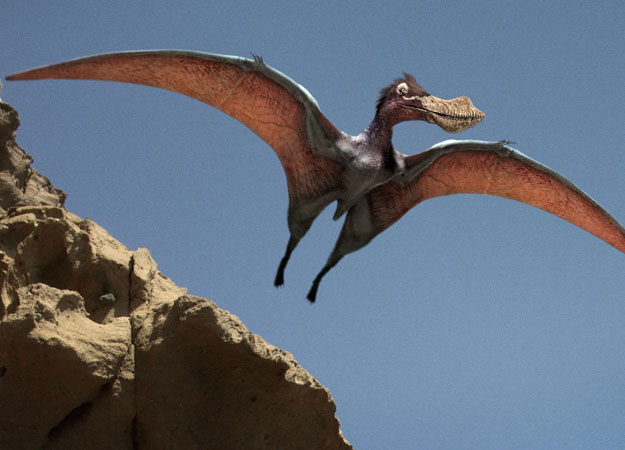
Anhangeura was a pterosaur, and not a dinosaur.
At the beginning of this sequence, a mother Anhangeura arrives
at her nest of offspring with a freshly caught fish in her jaws. The
babies squeal excitedly, waiting for their mother to feed them . . .
before gulping it down herself! Anhangeura was, like
Rhamphorynchus, a species of pterosaur, but with a 15-foot
wingspan it was much larger. Fossil eggs of pterosaurs have been
found and reveal that the babies were born with fully-functional
wings, suggesting that they didn't remain in the nest for a long
period of time. In Dinotasia, the mother Anhangeura has
the same idea and decides that it's time for her young to learn to
fly! One young Anhangeura isn't so sure he can accomplish this
feat. Unfortunately, there are plenty of dangers around the nesting
area that make it risky for a young flier. Anhangeura had a
bizarre crest on its beak that was probably used for display. This
pterosaur's remains have been found in Argentina.
End
Game
Tyrannosaurus
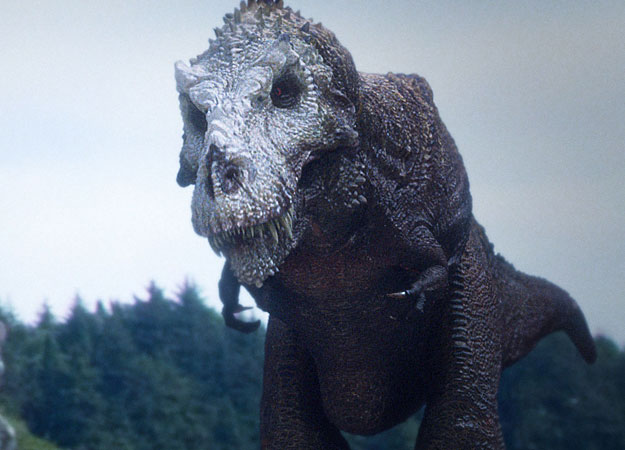
Tyrannosaurus rex, like Jack Palance as pictured above, were 40 feet long, 20 feet tall, weighed 7 tons and were made of pure terror!
Tyrannosaurus
rex is the most famous dinosaur
of all time! It was the largest member of the tyrannosaur family,
measuring 43 feet long and weighing 6-7 tons; it plays a huge part in
Dinotasia, which
centers around the lives of a pair of Tyrannosaurs,
named Tinkerbell and Stumpy. Early in this section of the film,
Stumpy battles with another, larger tyrannosaur named Jack, who's
mere appearance is enough to give most dinosaurs a run for their
money! During the battle, Jack successfully rips one of Stumpy's arms
off with his powerful jaws (hence the name “Stumpy”). Yes, we
have evidence for this gruesome behavior as well: a fossil “shoulder”
bone from a T. rex reveals that its arm was completely ripped off by
another predator, and there was only one dinosaur that lived in T.
rex's locale that could do damage like that – another T. rex!
Despite their violent nature, many scientists believe that
Tyrannosaurus, as
portrayed in Dinotasia,
cared for their young before and after hatching. Tinkerbell and
Stumpy appear to be wonderful parents and even go as far as to help
their young escape their eggshells. Unfortunately, the pair learn
that their Cretaceous Montanan home is a hard place to raise a
family, especially with egg-eaters about and the threat of Jack. Life
for a dinosaur can be hard, especially for the King of the Tyrant
Lizards.
Even the mighty T. rex can be good parents.
Triceratops
Triceratops is the largest member of the ceratopsid family.
Triceratops
– a 30-foot long, 6-12 ton behemoth – was a favorite meal for T.
rex. We know this because bite marks have been found on Triceratops
bones; also, many bite marks made on Triceratops
bones from T. rex were made when the Triceratops
was alive because the bone healed before the herbivore died.
Triceratops was the
largest member of the ceratopsian family and had a beak strong enough
to chomp through tree branches as thick as a man's arm! For
protection, Triceratops
boasted a neck frill and three sharp horns on its head. Because of
this dinosaur's defenses, Stumpy and Tinkerbell will work together to
bring it down.
Ankylosaurus
Ankylosaurus is built like a tank!
One of the most heavily armored dinosaurs ever to exist was the
Ankylosaurus. It was covered in bony knobs and spikes from its
neck to the tip of its tail. At the size of a school bus, it was
built like a tank. An added bonus possessed by Ankylosaurus
was the large bony club on the end of its tail used to protect itself
from danger. It weighed as much as four to six tons and is a creature
best left alone, a lesson Junior, one of Stumpy and Tinkerbell's
offspring learns the hard way.
Troodon
Troodon might have nested in colonies.
The final creature I'm going
to talk about in this review is the wily Troodon,
the fox of the Cretaceous. It was a sheep-sized omnivorous theropod
similar in design to Velociraptor.
Unlike raptors, Troodon
probably wasn't too keen on hunting big game very often and mainly
stuck to smaller prey, such as smaller reptiles, amphibians, eggs and
baby/smaller dinosaurs. A major similarity they have to raptors is
the enlarged sickle-shaped claw on their feet. In Dinotasia,
this small dinosaur lives in pairs and likely mates for life. They
are also very protective of their nests and eggs; this is based on
fossil evidence. We've found close relations to Troodon
sitting on top of their nests – they were brooding their eggs and
refused to leave them unprotected, just as any good parent will do
even as the waters of the Genesis Flood covered them. This sort of
reminds me of the Bible verse (Under God's protective wings) . . .
Dinotasia portrays a
pair of Troodon
struggling to cling to survival after an asteroid strikes the earth,
(according to Dinosaur Revolution,
as this isn't said in Dinotasia)
setting off global wildfires and afterward an impact winter, similar
to a nuclear winter; they are portrayed as some of the last dinosaurs
on earth.
Creationists
know that dinosaurs were not sent to extinction by an asteroid from
space like evolutionists belief; there is actually much evidence
against that theory.
However, the events portrayed in the film's climax and the first
scene featuring Inostrancevia
aren't as untruthful as they might seem to a Bible-believing
Christian at first glance. (Don't worry, I'm not about to get
Theistic evolution-ish here! Just bear with me!) Geological evidence
suggests that our planet once went through a time of major
catastrophes and asteroid collisions. This has led many creationists
to believe that they happened during
the Genesis Flood! In fact, an asteroid collision might have even
started the Flood. How? Well, that's beyond the scope of this
article, but here's a linkwhere you can learn about how God might have used asteroids and/or comets to start Noah's Flood.
Evolutionists
believe that a six-mile wide asteroid struck the Gulf of Mexico 65
million years ago and it wiped out the dinosaurs. Well, we know it
didn't happen 65 million years ago, but that asteroid collision did
happen. How do we know? We have the crater to prove it! Asteroid
impacts such as these (and the lava fields showed in the
Inostrancevia sequence) both happened during Noah's Flood.
So what about the end of Dinotasia
that portrays the Troodon
struggling for survival? How close to the truth is that? After a
Flood of the magnitude described in the book of Genesis, the world
wouldn't have been pretty as is often depicted in portraits. It
probably would have been pretty barren. The volcanic activity during
(and after) the Flood would have expelled a lot of volcanic debris
into the air, blocking out lots of the sun's heat. The world Noah
stepped into after his voyage on the Ark would have probably looked
somewhat similar to an impact winter, causing much snow in some
regions of the world, as is portrayed in Dinotasia.
(You can find more information on the post-Flood world here).
So
there you have it: my summary of Dinotasia.
While watching it, all the violence and predatory behaviors in the
film really reminded me of the world we live in that has been marred
by sin – our sin! But God never intended us to stay in this state
forever. He sent His Son Jesus Christ to live the life of a mortal
before paying the penalty for your – and my – sin: death.
However, He rose again three days later. He did this so that one day,
Christians can live in a perfect world without sin and death. (If you
are interested in becoming a Christian, please visit this page).
Aside
from my objections to the film mentioned above, I really loved it and
felt almost as if I'd been transported back in time (at least, what
we believe the world would have looked like back then). I hope you
enjoyed this look into what our world might have been like after the
Fall in the pre-Flood world: the world of Dinotasia.
Welcome to the world of Dinotasia!
PS 1: To post a comment
(this is highly encouraged), please simply click the post you wish to
comment on, scroll to the bottom of the page and put what you wish to
say or ask in the comment box. Then in the box below the comment box
choose who you’re going to comment as. And then click preview
or publish. If you aren’t signed into Google, you’ll be
asked to type in a word and a number in the space provided. Type the
word, put a space and then put the number. Then your comment is on
the blog!
PS 2: Have a puzzling question about
animals (including dinosaurs), myself, my latest book, my stop-motion
movies, Creation or etc? Please post your question as a comment or
send me an email at animaladventures@aol.com.
PS 3: What’s the new in the news?
Check it out at SMILEY’S
NEWS.