Friday, February 6, 2015

The History of Valentines Day


The month of January passed by in a flash of lightening. I am positive the rest of the year will go fast as well. Anyway, I have great Jurassic World news today, so you'll want to check that out, along with my special Valentine's Day article. Exciting stuff! But first, let's get started with the "Days till" section.

Days till:
It is: 6 days till President Lincoln's Birthday
It is: 8 days till Valentine's Day
It is: 10 days till President's Day
It is: 39 days till St. Patrick's Day

In the Spotlight:
As promised last month, an all-new trailer for Jurassic World was released during the Super Bowl! This trailer is shorter than the one that showed on Thanksgiving, but there are a lot more dinosaurs seen in it and, in my opinion, it gives us a better sense of the plot. Check it out below:


Cool, huh? Here are some screenshots from the film:


After the first trailer was released, many complained about the quality of the CGI dinosaurs and other "extinct" creatures (though I saw nothing to complain about). However, it is clear they were not, and are likely still not finished with editing. You can see below that several scenes from the first trailer were greatly improved in the Super Bowl trailer. It is probably going to look even better by the time of the movie's release:


As if this were not enough, we even have the trailer for the Lego Jurassic World game we've been constantly hearing about! Here it is below:


And as if this were not enough, there's even a picture of the Owen character in Lego form:

Owen from Jurassic World in Lego form!

Jurassic World comes out on June 12th, but in the meantime, check out the viral site because loads of new content was uploaded, including the park's mounted camera feeds, information on some more attractions and even Indominus rex's bio page.

Topic of the Week by Christian Ryan

Valentine's Day is almost here!
Valentine's Day is generally associated with hearts, love, roses, hugs and kisses and happy couples. But how did this holiday start? Did you know that even though Valentine's Day is a “fluffy” time of year for us today, the origins to this day were anything but. Read on to find out the roots of Valentine's Day.

My heart goes pitapat!
The simple answer to Valentine's Day's origins is that no one really knows how it got started. However, this does not by any standard mean the trail is completely cold. Some historians believe the roots to Valentine's Day lie with a Roman (or possibly earlier) festival that took place between February 13th  till the 15th and it was called Lupercalia. This celebration gets its name from either Lupercal, the cave in which, according to mythology, a “she-wolf” named Lupa (who the festival was partly in honor of) nursed Romulus and Remus or the mythical Roman god Lupercus, the god of shepherds. The purpose of this festival was to further fertility and dispel evil. This event had several bizarre practices that were not what one would expect for a day possibly linked to Valentine's Day; the festivities included sacrificing goats and a dog, the offering of cakes by the Vestals and the horrifically peculiar ritual regarding fertility. This ritual involved two young men – wearing animal skins – who would run around the city with strips of goat skin. The goat skin was used to slap women and was believed to result in pregnancy in infertile women and help delivery if the women slapped were already pregnant.

Was Lupercalia, a Roman fertility festival, where Valentine's Day found its origins? Most historians don't think so.
Most historians don't believe Lupercalia, saying that there is no proof this event was related to the holiday in any fashion. The jury is still out for now. Regardless of which opinion rings true, Pope Gelasius I (492-496) was the man who eventually abolished Lupercalia in 496 AD. Thank goodness for Pope Gelasius!

Pope Gelasius abolished Lupercalia in 496 AD.
There is a historical legend that might be responsible for the actual origins of Valentine's Day. After the end of Lupercalia, Pope Gelasius established another event set for February 14 – St. Valentine's Day, to honor a man by that very name. Today, it is unknown which St. Valentine Gelasius was referring to, as according to the Catholic Encyclopedia, at least three Christian saints had this very name. Many scholars think the St. Valentine Gelasius was referring to was a priest whom was disliked by Claudius II, the emperor of Rome in the year 270.

Once again, the history of Valentine's Day steps into the shadows of uncertainty, but there is a legend about this priest St. Valentine that might hold some clues. The story goes that Claudius II banned marriages for young men because he believed unmarried men would make better soldiers for his army; perhaps one reason for this was because he figured they were less likely to get distracted homesickness when out at war. But St. Valentine decided to marry couples in secret. He was found out and put under arrest. His sentence was to become executed. But before his execution, he fell in love with his jailer's daughter. St. Valentine is said to have given her a note which simply said, “From your Valentine” – this would have been the very first “valentine”. Historians often doubt the legitimacy of this legend, as history indicates Claudius II's marriage ban was never issued and he even encouraged his soldiers to take for themselves two or three women when they had victory of the Goths. Another legend has it that St. Valentine was executed because he refused to reject his religion. But after his death, the jailer and his household accepted Jesus Christ and became baptized. Will we ever know the truth about St. Valentine's connection with Valentine's Day?

This is a shrine of St. Valentine in Whitefriar Street Carmelite Church in Dublin, Ireland. Was St. Valentine responsible for Valentine's Day as we know it?
Perhaps not. However, in the end, we don't celebrate Valentine's Day because of how it started. We celebrate for the love of loved ones around us and the love we feel for that “someone special”. Before I end this article, I should like to remind you of our first love – the love God felt for us. He wanted a relationship with us, but our sin caused us to fall away from Him, as God cannot be associated with sin. So God sent His Son, Jesus Christ, to pay the penalty for our sin – death. Now, we can have that relationship with God. It is the love God has for us that we can spread around to those around us this Valentine's Day!

But God demonstrates His own love for us in this: While we were still sinners, Christ died for us.” Romans 5:8.

HAPPY VALENTINE'S DAY!

References:


Disclaimer: Many (or in some cases all) of the photographs and images above are not mine. If you own one or more of them and would like them to be removed, please kindly let me know.

Friday, January 30, 2015

Re-run Article: Rabbits and Crabs and Dragons...OH MY!

Again, I had a very uneventful week. Yawn. But on the bright side, I have some awesome news to share about, you guessed it, Jurassic World!

Days till:
It is: 3 days till Groundhog's Day
It is: 15 days till St. Valentine's Day
It is: 17 days till President's Day
It is: 46 days till St. Patrick's Day

In the Spotlight:
As promised, I have a lot to report on concerning the upcoming third sequel to Jurassic Park: Jurassic World! How exciting! First, off Lego is producing a JP game based on not only Jurassic World, but the other three movies as well. Here is their official description:
"Following the epic storylines of Jurassic Park, The Lost World: Jurassic Park and Jurassic Park III, as well as the highly anticipated Jurassic World, LEGO Jurassic World is the first videogame where players will be able to relive and experience all four Jurassic films. The game will be available in June for the Xbox One, all-in-one games and entertainment system, the Xbox 360 games and entertainment system from Microsoft, PlayStation®4 and PlayStation®3 computer entertainment systems, PlayStation®Vita handheld entertainment system, the Wii U™ system from Nintendo, Nintendo 3DS™ hand-held system, and Windows PC."- Business Wire
You might recall that last week, I wrote an article about hybrids. Well, wouldn't you know it, we finally have some (officially revealed, this time) information on the terrifying Indominus rex hybrid from the upcoming movie! The Masrani Global Corporation website breaks the news this way:
"Today at Masrani, we have a fantastic announcement to make. Over the last three years, the brilliant minds at InGen, lead by the great visionary Dr. Henry Wu, have brought us a new attraction for Jurassic World – the likes of which have never been seen before. While I cannot reveal any important information behind its creation at this time, I can reveal the title of our finest endeavor: the Indominus Rex." - Simon Masrani
The Jurassic World viral site has even more information about this beast on its bio page. It states that currently, Indominus rex is a 40-foot, hyper-carnivore that can run up to 30 mph...in her enclosure!

As had been rumored, she is indeed a hybrid, but, get this, she isn't a hybrid between a cuttlefish, a snake, a T. rex and a Velociraptor as Joblo had led us to believe. It is actually a hybrid between four different species of theropod dinosaurs: Giganotosaurus, Carnotaurus, Majungasaurus, and Rugops, the latter three are members of the abelisauridae family. Though Indominus rex may look a little like a T. rex to some at first glance, the arms of this creature are longer, she has spines extending down her arms and neck and she bears a pair of horns on her head. Her aggression level is very high.

Behold, the long-awaited for: Indominus rex!
What the creature looks like, other than what we gathered from that leaked bunch of photos I refuse to show, is unknown. But we will be seeing more of her this summer. And don't worry, I am sure Indominus rex will be kept safely in her confinement throughout the entire movie and won't be chasing and eating people. After all, Jurassic World is 100% safe!...right?

Indominus rex, coming this summer to Jurassic World!
Topic of the Week by Joy Hammond 
I went out and searched for interesting animals on the internet, when I came across a fun and furry critter. It’s called the Angora rabbit.  They are the oldest domestic animals that came from Turkey. They were considered royal pets in France. They eat a lot of hay and their personalities are very energetic. Their playful and enjoy other rabbits. They like toys such as pinecones, stuffed socks, and rubber balls.
The French Angora is the more bunny-like of the Angora rabbits.
 There are five different types of Angora rabbits: American, French, German, giant, and satin. American Angora Rabbit is like a stuffed animal. It is gentle but needs grooming at least twice a week. French Angora rabbits look like a sheep in a way. Its fur is used for sweaters, baby clothes, and millinery. This rabbit can’t shed its fur like the rest so it has to be sheered. Giant Angora rabbits are extremely fluffy; they need to be sheered at least every 180 days to prevent hair clots that would end up causing death if not treated. A satin angora is almost like a normal rabbit, only a bit furrier.

The French Angora rabbit is definitely woolly!
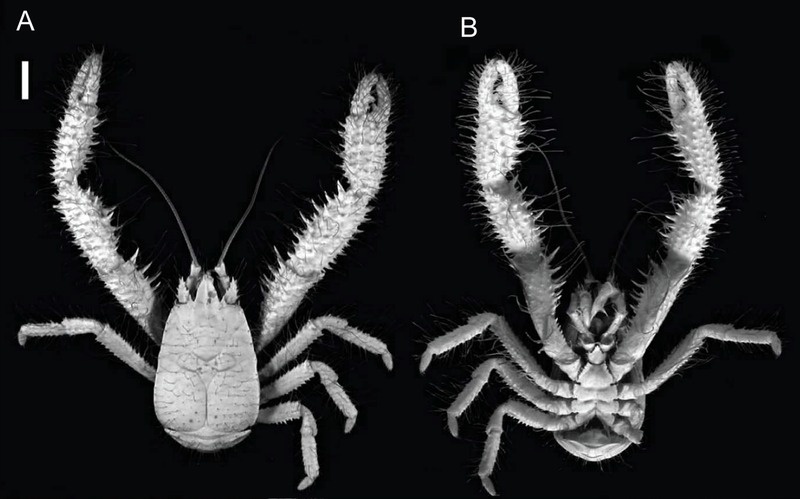
Another interesting animal is a Kiwa hirsuta or the yeti crab. The crab is found in the Pacific Ocean. The yeti crab was discovered in March 2006. It is seems to be blind and a carnivore, although it eats bacteria. Its furry claws are one of the best qualities about the yeti crab. The claws detoxify poisonous minerals in the sea, where it lives. The crab was discovered by Robert Vrijenhoek and his group in the Monterey Bay Aquarium Research Institute in Monterey, California.

The Yeti crab wasn't discovered until recently because it makes its home in the depths of the ocean near volcanic vents.
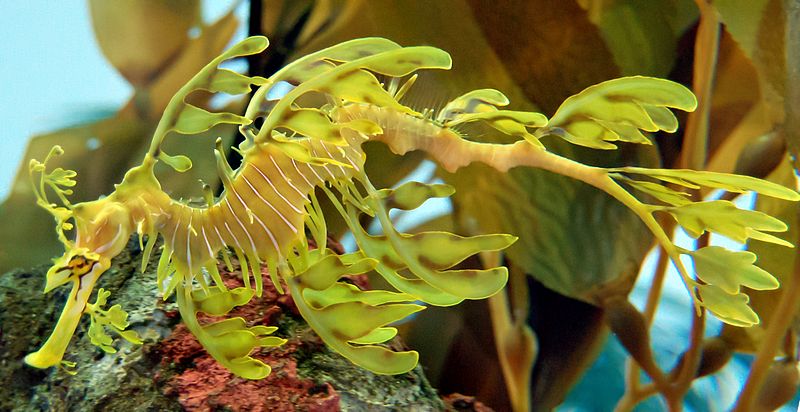
One last animal is the Leafy sea dragon. It is mostly found in the coasts of Australia, one of my favorite countries/continents that I’d like to visit. The sea dragon’s skin camouflages and makes it appear like seaweed. It eats amphipods and mysid shrimpplankton, and larval fish. Leafy sea dragons have a major threat when their first born. They are slow swimmers and sea dragons are also used in alternative medicine. Dive into the ocean this summer and see the world beneath the surface.

The leafy sea dragon uses its leaf-like fins for camouflage.
Thanks for reading today's article. Please be sure to stop by next Thursday for some more exciting information about nature and about upcoming movies! Good bye!

Disclaimer: Many (or in some cases all) of the photographs and images above are not mine. If you own one or more of them and would like them to be removed, politely let me know via one or both of the email addresses above.

Friday, January 23, 2015

Wonderful Hybrids


There is a very interesting Topic of the Week today that I have written. If you are interested in animals, this is the article for you! I also have some interesting information regarding Jurassic World merchandise!

Days till:
It is: 10 days till Groundhog's Day
It is: 20 days till President Lincoln's Birthday
It is: 22 days till Valentine's Day

In the Spotlight:
The added bonus of an upcoming Jurassic World movie is lots and lots of cool merchandise! Hasbro has advertised a new line of toys that will come out just in time for the movie. In fact, they even made a cool poster for it:

This is the Hasbro poster for their new Jurassic World line.

While it is doubtful that the dinosaurs or sets seen in the toy sets accurately reflect everything that will take place in the movie (meaning we shouldn't have to worry about spoilers), the toys are helpful in telling us what coloration the dinosaurs might have in the film (keep in mind that the toys could still be very different from their movie counterparts). Here are some of the new toys below:

"Titan Raptor Echo"


"The Chomping Rex"

"Allosaurus Basher"

Dimorphodon - in Jurassic World, will it be friendly or dangerous?

Velociraptor
Cool, huh? It is believed the toy line will be released in May. To see more toys, check out this link.

Topic of the Week by Christian Ryan
Lions, and Ligers and Tygons...oh my!
Many people believe that animals can only breed with members of their own species. But animal reproduction isn't nearly as limited to this as most people think! In fact, many times both in the past and present times, animals of different species have together produced offspring, many times fertile. Welcome to the world of hybrids!

How are hybrids even possible? How can animals that are two completely different species breed with each other? Well, the answer is easily found in the Bible. In Genesis 1:21 and 25 states that when God created animals, He made them to reproduce after their own kind. The word “kind” is also used in a similar context in Genesis 6 and 8, when God instructed that Noah take two of every kind of land and flying animal on the Ark (in addition to seven or seven pairs of clean animals). Now the Biblical term “kind” is different from our usage of the word “kind” today. Today, a “kind of animal” can mean “species”, “family” or etc. in modern classification methods. But the Bible's definition of “kind” seems to indicate that the word implies groups of animals that can breed with each other. In other words, God created animals to reproduce within the boundaries of their “kind”. For example, today we have the “dog kind”, “cat kind”, “horse kind”, “elephant kind” and etc. There are different variations within each kind of animal, and different species within this kind can interbreed, but that's where it stops. They don't change from one kind of animal into a different kind of animal. Modern science not only supports this, but it also doesn't offer any proof that they animals can evolve into different kinds of animals (I could go into why humans didn't evolve from apes or why dinosaurs didn't evolve into birds, but getting that specific is beyond the scope of this article). The proper word for a “created kind” is baramin. Most creationist scientists agree that usually, the word baramin is synonymous to the level of “family” in modern classification methods. After the Genesis Flood, each baramin exited the ark and reproduced; overtime, different variations came about within the specific baramins (e.g. African and Asian elephants and mammoths all descended from the “elephant kind”; coyotes, wolves, great Danes and poodles descended from the “canine kind”). So in a nutshell, the easy way to tell if two animals are from the same baramin is if they can breed with each other. You can check out the references below for a more scientific method of determining baramins.

 
All the different members of the ceratopsid family are in the same baramin. Illustrated above (top left to right bottom) are: Triceratops, Chasmosaurus, Styracosaurus and Pachyrhinosaurus.
But here's the cool thing: while most animals breed with members of their own species, many breed with other members of their baramin. Today we're going to look at just a few of these remarkable hybrids:

Felines
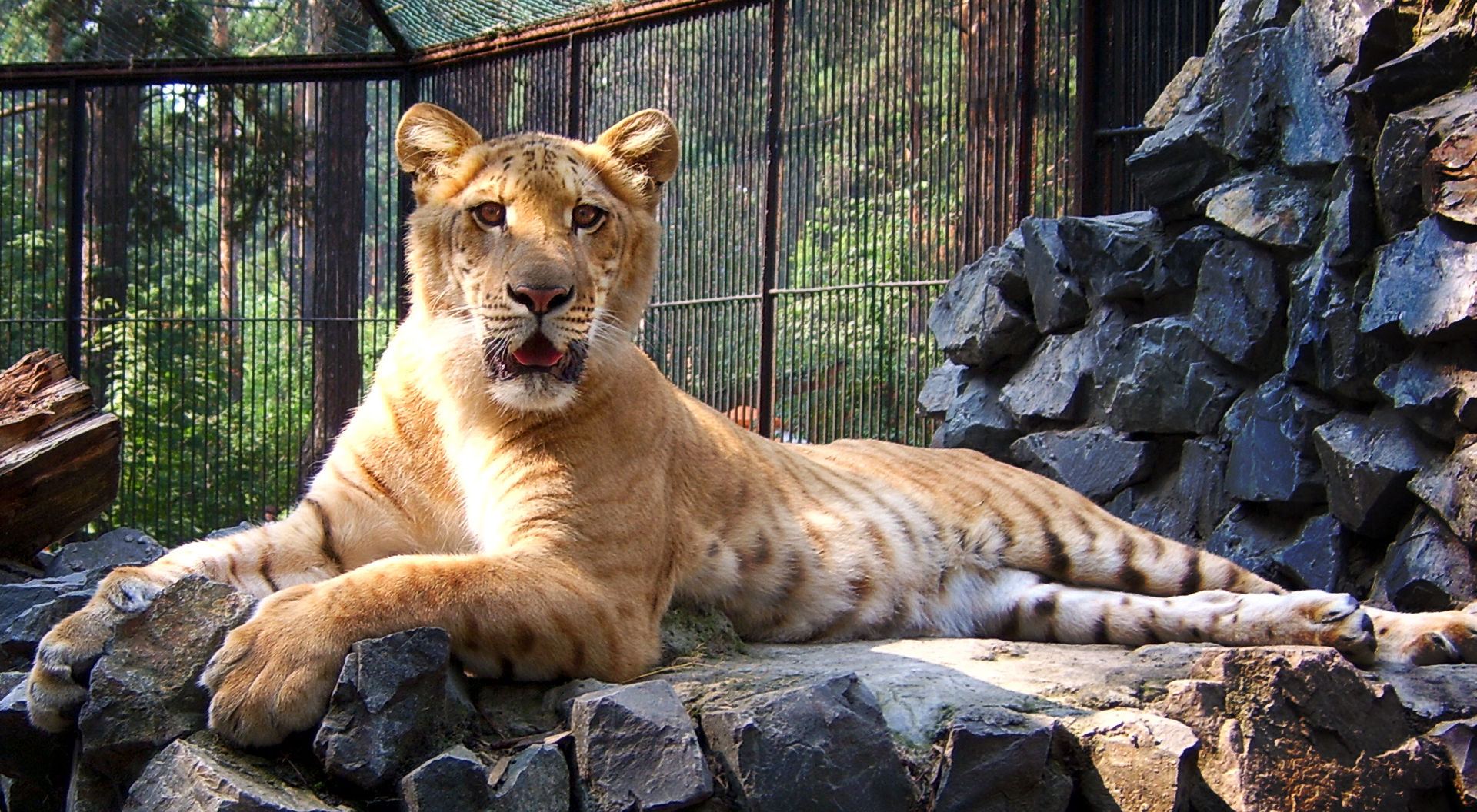
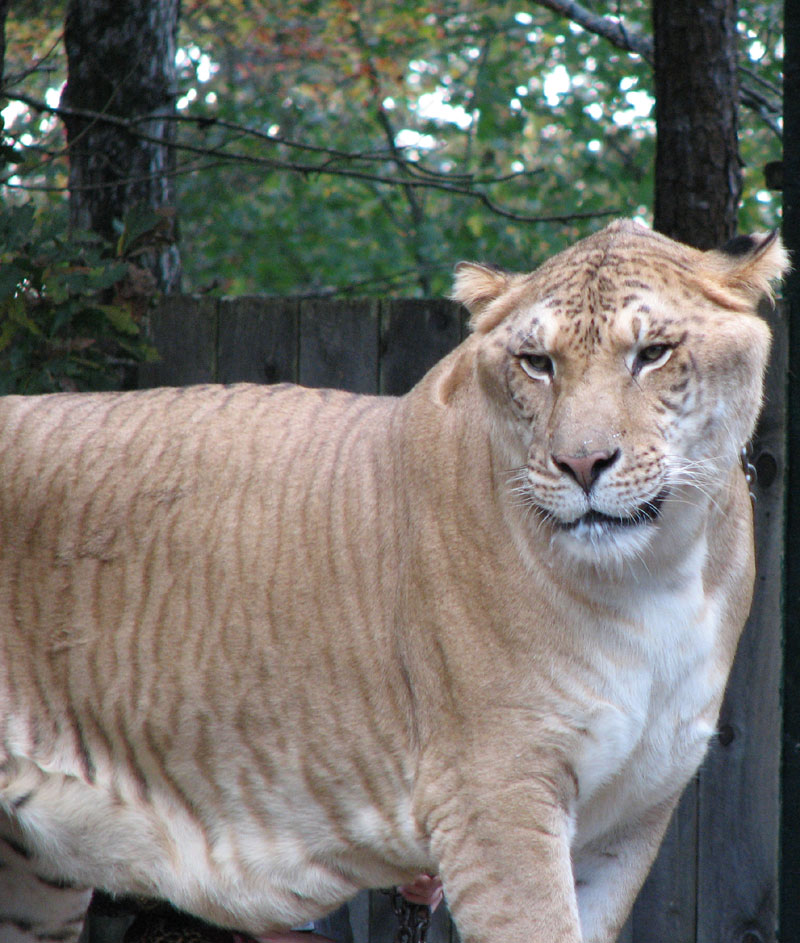
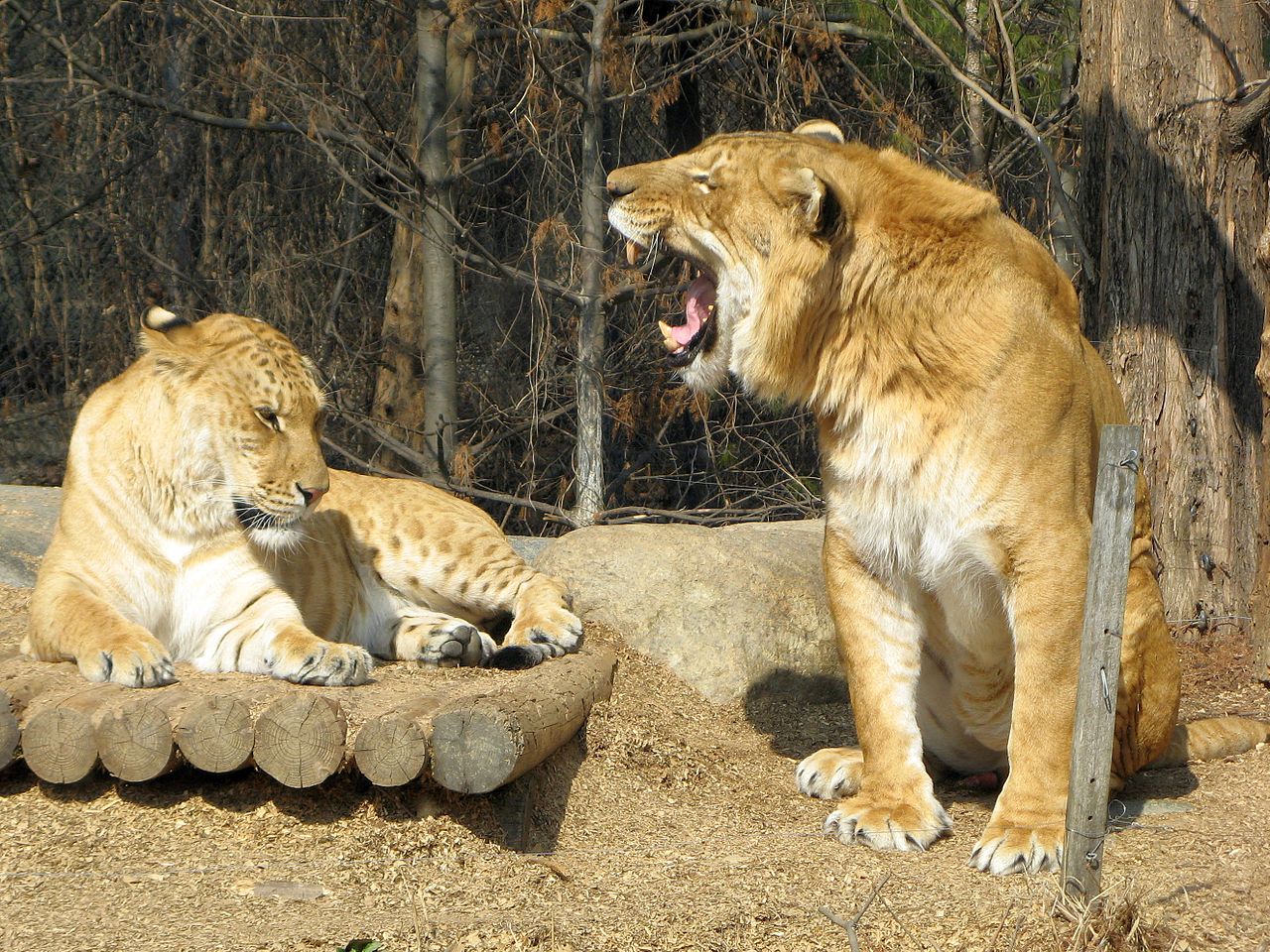
The liger is a cross between a male lion and a female tiger.
Perhaps one of the most famous hybrids of all is the liger. You can probably guess or already know that ligers are the descendants of a lion and a tiger, but it has to be a male lion and a female tiger to be considered a liger. If you get offspring from a female lion and a male tiger, the cub is called a tigon. Weighing as much as 1,000 lbs and stretching 9-10 feet long, ligers are the largest cats that have ever existed, even larger than the largest wild cat, Smilodon populator, also known as the saber-toothed cat, that weighed up to 880 lbs. As you would expect, ligers have traits of both lions and tigers: ligers possess a (faint) striped coat and love to swim like tigers, and like lions they are very social creatures and have rosette markings. Did you know that ligers are not sterile as is commonly believed? In fact, several female ligers have been known to reproduce offspring.

Ligers are the largest cats ever to exist on earth.
Ligers and tigons aren't the only cat hybrids out there. Pumapards – crosses between pumas and leopards –, jaglions – crosses between jaguars and lions –, Blynxes – crosses between bobcats and lynxes (this pairing has occurred in the wild) – and lynxcats – crosses between lynxes and domestic cats.

Jaglions are crosses between jaguars and lions.

Equines
Mules are crosses between a male donkey and a female horse.
Even though many people are familiar with ligers, the most well-known hybrid of them all is the mule, a cross between a male donkey and a female horse. A cross between a female donkey and a male horse is called a hinny. Even though most mules are infertile, some female mules have given birth to offspring when they have mated with a purebred horse or donkey.

Should the zonkey be placed in a zoo or a farm? I don't know either.
Have you ever heard of a Zonkey? This is a cross between a male zebra and a female donkey. Zorses are the result of breeding a male zebra and a female horse. Both zonkeys and zorses have a mixture of traits from each parent, one of which is the characteristic stripes of the zebra parent.

Cetaceans
 
This is a baby Wolphin.

Hybrids aren't only limited to terrestrial creatures. At Hawaii's Sea Life Park in 1985, a female bottlenose dolphin mated with a male false killer whale, resulting in a wolphin. There is only one wholphin in captivity today, but they have also been reported in the wild. The wholphin is a fertile animal; this was proved when the individual at Sea Life Park successfully mated with male dolphins and over time has given birth to three calves, only one of which (the third one born) is still alive to this day. Like her parents, Sea Life Park's wholphin is a regular part of the park's tour.

Camels
The cama is a cross between a camel and a llama. PHOTO CREDITS
Even though the llama looks like a cross between a sheep and a camel, it and its cousin the alpaca, are members of the camel family. The cama is a cross between a male dromedary camel and a female llama. The first cama ever was born on January 14, 1998. The hopes of the breeders was to create an animal with higher wool productions than a normal llama, but with the strength and size of a camel and cooperative temperament. Like the camel, they can survive for long periods of time without water.

Ursines
The pizzly bears pictured above are a cross between polar bear and brown bear.
In 2006, a Idahoan hunter named Jim Martell went to Canada after buying a license to hunt a polar bear for $45,450. He found a bear and shot it, believing it to be a polar bear. But on closer inspection, he was confused about the bear he shot – it had the thick, cream-colored fur and long claws expected to be seen in a polar bear, but it also had a muscly hump over its shoulder, brown patches around its eyes, nose and back and a shallow face like a grizzly bear. What had shot? As he didn't buy a license to kill a grizzly bear, Jim would have possibly been charged a fine of $1,000 and up to a year in jail if he did indeed shoot a grizzly. Fortunately for him, he didn't shoot a grizzly, but he didn't shoot a polar bear either. He had shot a creature descended from both animals! A similar incident occurred in 2010.

This cross between a grizzly bear and a polar bear has been referred to as a “pizzly” or “grolar” bear. The cause of this hybrid is believed by scientists to result from the overlap of the habitats of grizzly and polar bears in Canada. Pizzly bears have been bred in zoos and, as expected, exhibit features and behaviors of both parents.

Bees
The killer bee was accidentally released into the wild in 1957.
In the 1950's, biologist Warwick E. Kerr decided to breed African bees with European bees to create a type of bee that produced more honey and was more suited for tropical environments. The new type of bee he bred was called the Africanized bee. These bees were initially bred in Brazil and were noted to be particularly defensive. But in October 1957, a beekeeper visiting the place where these bees were kept accidentally released 26 swarms of the Africanized bees! The bees began moving northward and spread out, multiplying fast. Eventually they moved into the United States, with the first permanent colony sited in 1990 in Texas. Most people know these bees as “killer bees”. These bees differ from their European ancestors in many ways:

  • They like to swarm and go farther than other types of honey bees
  • Are more likely to migrate in response to lowered food supply
  • Entire colonies are more likely to leave hives to relocate in response to stress
  • Has greater defensiveness when in resting swarms compared to other honey bee types
  • Lives more in ground cavities than European bees
  • Higher portion of guard bees within hive
  • Deploys in greater numbers for defense and pursues perceived threats over much longer distance from hives
  • They can't survive extended periods of forage deprivation, preventing introduction into areas with harsh winters or extremely dry late summers

Despite their reputation, however, killer bees really aren't the assassins Hollywood makes them out to be; they aren't larger than normal bees, nor do they have more potent venom or stalk people in deadly swarms. The reason why they are more dangerous than other honey bees is because they have more perseverance and are easier to agitate. This aggression comes from their African bee ancestors, which have to fend off much more dangerous honey-thieves than European bees, such as the honey badger.

Elephants
Motty was the first confirmed cross between an African elephant and an Asian elephant. PHOTO CREDITS.
Hybrids have also occurred between members of the elephant kind. Whereas most baramins are synonymous to the level “family” in modern classification, the elephant baramin might be an exception and instead might be at the classification level of the order “proboscidea”, which would include all modern elephants, and also mammoths, mastodons and several other extinct trunked mammals, with a few exceptions, such as the tapir-like Moeritherium.

Motty was a hybrid between a female Asian and a male African elephant that was born on July 11, 1978 at the Chester Zoo in Cheshire, England. Motty was a male and bore features from both of his parents, including the cheek, long and pointed lobed ears, longer and slimmer legs, wrinkled trunk of an African elephant and the number of toenails (5 front, 4 back), sloping and domed head and the single-fingered trunk of an Asian elephant. Unfortunately, the elephant was unhealthy upon birth and died 12 days after birth. Other unconfirmed elephant hybrids have been reported.

Contrary to what many evolutionists wish was true, the variety within each baramin doesn't prove evolution is true, but rather, they brilliantly showcase the amazing genetic diversity God provided each of His creations with. Over time, this genetic diversity enables animals to change and adapt to their environmental needs via natural selection and mutation. This enables us to have an amazing diversity among animals today. We don't know everything about the different baramins God created, but that gives us all the more reason to continue studying and learning about all of God's wonderful animals.

References:

Disclaimer: Many (or in some cases all) of the photographs and images above are not mine. If you own one or more of them and would like them to be removed, politely let me know via one or both of the email addresses above.

Friday, January 16, 2015

Inside Scoop Into the World I'm Apart pt. 3

Nothing too eventful happened over this past week. So there's not a whole lot to talk about in my introduction. So without further ado, let's move to our "Days till" section:

Days till:
It is: 3 days till Martin Luther King Jr. Day
It is: 17 days till Groundhog's Day
It is: 29 days till St. Valentine's Day

In the Spotlight:
Ok, technically, there is some major Jurassic World news for this week, but I am not going to show or support it on my blog. You see, the news is the leakage of our first image of Indominus rex that occurred yesterday. I am a little disappointed that it leaked, because I wanted to see it for the first time in the movie theater and because director Colin Trevorrow worked so hard to keep its appearance a secret. Now the secret is out because some inconsiderate blockhead decided "Hey, I'm going to leak this and ruin the hopes and dreams of people everywhere until the movie comes out in theaters!" (I'm sure he didn't say that exactly, but my point still remains). While I have promoted relatively minor leaks on this blog in the past, the leakage of Indominus rex is a major leak. The leaks I promoted were things we would have learned when the trailers for the film come out. Indominus rex's full body was likely to never appear in a trailer until after the film premiered, as Trevorrow wanted. Therefore, I encourage others to join us Jurassic Park fans who want to refuse to promote this leakage.

Many fans might feel that the movie will have no surprises now that Indominus rex has been leaked. This is not the case. To date, only pictures have been leaked; we still have so much to learn from Indominus rex and the other dinosaurs we'll see in the movie like how they walk, eat (people), run and roar. I am only getting more and more excited about the release of Jurassic World in 145 days on June 12th!
Topic of the Week by Joy Hammond
This and all the images involving Club Penguin are NOT my own!
Hey guys, it's time to learn some secrets around Club Penguin. Here are the four last places I will talk about. There's actually a few more but, well, I don't want to take all the surprise away from the island. You're just going to have to find out yourself. First off, the Iceberg! The Iceberg is where you can go into the Aqua Grabber (like a submarine) and go on deep sea adventures (above). Rumor has it that if try to drill the Iceberg, it might just tip. Many penguins have tried and given up, but perhaps they're just missing someone like you. 

Second place is the, well it's not really a sewer, it's just the Underground Tunnels. This is where you can ride mine carts, go on puffle rescues, search for gold, go on a quest for the golden puffle, discover the hidden lagoon with a mysterious underwater door, enjoy the pool, or even the boiler room. All these tunnels are connected to the Plaza, the Town, The Mine, and the Forest.

The Underground Tunnels is where you can ride mine carts, go on puffle rescues, search for gold, go on a quest for the golden puffle, discover the hidden lagoon with a mysterious underwater door, enjoy the pool, or even the boiler room.
The Third place is the Dojo. Yes, you hear me right. The Dojo. Here is where you earn you're belts and learn your elements. Learn the ancient moves of Card-jitsu. Card-jitsu is where you match your smarts against another players with types of power cards. The training varies in difficulty levels and the game is like rock-paper-scissors just better. After you've earned your black belt, you should go on to further your study as a ninja. You can study all of the three elements available: fire, snow, and water. Once you've collected the stone pendant than you will be a ninja master. Master Sensei is the one responsible for the Dojo and it's mysterious secrets. He is willing to teach anyone with the motivation to try. The best part would be, challenging Sensei. This is the final test to earning your huge honor or reward.

The Dojo is where you earn you're belts and learn your elements.
The last place has a secret that even I shouldn't tell you. I can't help but spoil somethings. There is a building called the Everyday Phone Facility. Curiously enough, no one on Club Penguin really owns a telephone. The Facility was created after the previous shop, the Sports shop, was apparently destroyed by popcorn - a popcorn bomb. Not every penguin notices what goes on behind the scenes in this mysterious building. It looks ordinary enough but there might be something more going on. Well I'm leaving you suspense. I won't say a single word more. You'll have to find out yourself. Until then Waddle On.
 
The Everyday Phone Facility was created after the previous shop, the Sports shop, was apparently destroyed by popcorn - a popcorn bomb.

Disclaimer: Many (or in some cases all) of the photographs and images above are not mine. If you own one or more of them and would like them to be removed, politely let me know via one or both of the email addresses above.