Hello, welcome to my blog. I can't believe that Dolphin Tale 2 is out in theaters today! I'm so excited! Finally, three years after the first one, a sequel has been produced. To celebrate the release of the movie, I'll dedicate this blog post to Dolphin Tale 2 and its dolphins.
Days till:
It is: the theatrical release of Dolphin Tale 2 today!
Yesterday was: Patriot Day
In the Spotlight:
Well, with the filming of Jurassic World complete, as I expected, updates that are being released to the public are becoming few and far between. However, this shouldn't last too long, perhaps until January, a mere five months before the film's release.
Though there isn't much news to report today, ComicBookMovie.com revealed some important information concerning one of the characters in the film portrayed by Judy Greer. In her interview, she explained that she is in fact portraying Claire's (Bryce Dallas Howard) sister in a "small, but poignant role." Whether or not she'll meet any dinosaurs is at this point uncertain. Whatever the case though, I can't wait to see the film!
In additional news, Dolphin Tale 2 is being released in theaters today! I can't wait to see it.
In additional news, Dolphin Tale 2 is being released in theaters today! I can't wait to see it.
Topic of the Week by Christian Ryan
 |
| Dolphins are surely one of the most interesting of God's creatures. |
Just last week, the film Dolphin Tale 2 came out in
theaters. So I figured why not focus on everyone’s favorite marine mammals?
Dolphins are popular with everybody. Everywhere you go, you'll see dolphins in
movies, books, TV shows, aquariums and even theme parks like Sea World.
But how much do you really know about these amazing creatures?
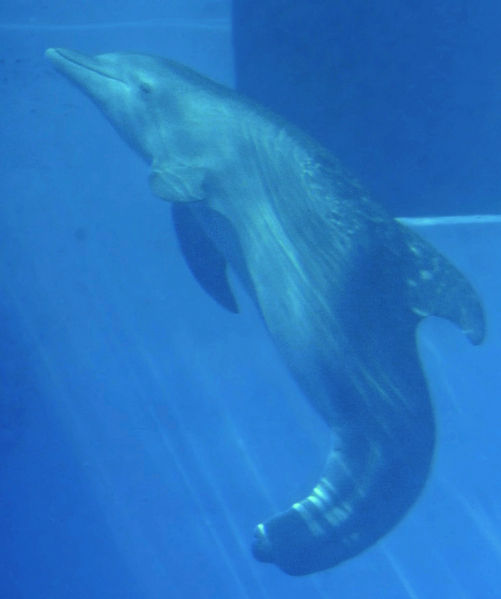 |
| Here is Winter the dolphin from the Clearwater Marine Aquarium! |
When the word “dolphin” is said or read, people picture a
gray-colored creature with a relatively long-snout. But there are many
different species of dolphins within the suborder Odontoceti and are
classified in the order cetacea (this group contains all whales and
dolphins). Most of the dolphins we'll be looking at today are members of the
family delphinidae, or the dolphin family. But before we start talking
about different species of dolphins, let's go over what dolphins are in
general. Despite the fact that they are aquatic animals, dolphins aren't fish;
they're mammals, just like dogs, cats, elephants and us. Dolphins come in a
great variety of shapes and sizes. As sea creatures, the Bible tells us that
God created dolphins on Day 5, with other sea and flying animals.
.jpg) |
| A mother bottlenose dolphin swims with her calf. |
Dolphins vary in size, the smallest is Maui's dolphin at 4
feet long, while the largest is none other than the orca, or killer whale at 30
feet long and 11 tons! However, as the genus Tursiops, or the bottlenose
dolphin is the most famous and easily recognized, this is the one we'll focus
most of this article on. However, we will also touch on other species of
dolphins. The bottlenose dolphin can grow between 6-13 feet in length and weigh
330-1,430 lbs in weight; males are generally larger than females.
 |
| Maui's dolphins are one of the smallest dolphin species, measuring only four feet long! |
Dolphins are specially designed for life underwater. Firstly,
they have long and streamlined bodies. Unlike all other mammals, dolphins are
mostly hairless – a few hairs are found on the tip of their snouts and are lost
either before birth or shortly after. The lack of hairs means that dolphins are
able to move through the water at fast speeds, as hair would produce drag.
Another important feature dolphins have is the blowhole on top of their heads.
Since they don't filter oxygen out of water with gills like fish do, they must
return to the surface to breath. They often hold their breath for 2-3 minutes
at a time. To propel them through the water, God designed these mammals with a
strong tail fluke. The tail fluke is so important to a dolphin, that dolphins
in the wild would die if the tail was lost. This is clearly evident in the case
of Winter, the now-famous bottlenose dolphin with a prosthetic tail at the
Clearwater Marine Aquarium.
_(8783448529).jpg/800px-Blue_Horizons_(Dolphin_Stadium)_(8783448529).jpg) |
| Dolphins are able to use their tails to "walk" through the water. |
Dolphins live in every ocean on the planet, from the warm,
clear waters of the equator, to the frigid waters of the Arctic and Antarctic;
whatever the habitat, dolphins have adapted to thrive. Did you know dolphins
aren't only found in the ocean? Different species of river dolphins can be
found in bodies of water in the Amazon, and in Asia. It's very easy to forget
that these mammals are fierce predators (it's just that humans aren't on the
dolphin's menu). The bottlenose dolphin and most of its kin like to eat small
fish (though some dolphins in some parts of the world include tuna and mackerel
in their diet), crustaceans and squid, which they catch with their needle-sharp
teeth.
 |
| The blue coloration represents where bottlenose dolphins like to live. |
How do dolphins catch their prey? Well to answer that, we
have to learn a bit about their social behavior. Many species including the
bottlenose are social and live in groups called pods. The number of bottlenose
dolphins within a pod varies depending on what region the dolphins live in,
their gender and whether or not females are in the mood for mating. Adult males
are normally found alone or in groups of two or three. Females and young
individuals are much more social, living in groups of up to 15. But, as I said
before, dolphins are very social creatures and groups of dolphins will
often fuse together to create a massive pod numbering 100 to over 1,000
animals!
 |
| Dolphins, like these spinner dolphins, often form large groups called pods, sometimes numbering in their hundreds and thousands! |
Now we can tackle the question of how dolphins catch their
food. God gave dolphins and several other animals an amazing ability: they can
use echolocation to navigate. Here's how echolocation works: the dolphin emits
up to 1,000 high-pitched clicking sounds per second. The sounds zoom through
the water until they bump an object and travel back to the dolphin's head. The
dolphin then receives the bouncing sounds through a special organ in the
forehead called the melon. Now the dolphin knows everything about its
surroundings. In fact, dolphins are so good at using echolocation that they can
be blindfolded and still find their way around as if they could see! This
method is much like sonar used on submarines. Isn't the Creator of the dolphin
amazing?
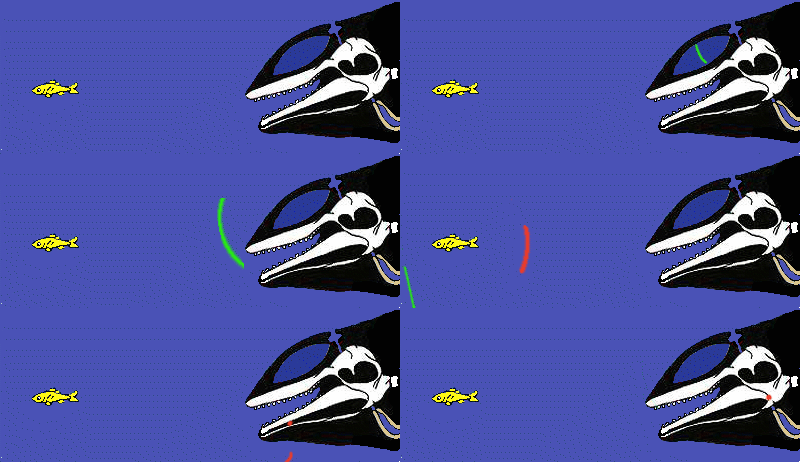 |
| This is how echolocation works: the dolphin sends out a high-pitched sound; when the sound bumps into an object in the water, it returns to the dolphin. |
Ready to go on the assault, dolphins have a number of ways of
catching the fish and other prey they like to eat, but they like working as a
cooperative team. If they encounter a shoal of fish, they will drive the fish
into a large ball shape and they all take turns diving into the fish-ball to
gobble down fish. Some dolphins in Georgia and South Carolina engage in a very
unique way of catching fish called “strand feeding”. What they do is herd the
fish toward the shore until they are practically on the sand itself and the
dolphins breach themselves to catch the squirming fish. What makes this
technique interesting is that only dolphins in Georgia and South Carolina have
been known to do this, meaning this behavior is not instinct. It is in fact a
learned behavior and the dolphins have passed down from generation to
generation.
 |
| Dolphins use a variety of techniques to catch fish; above you can see one example. |
Speaking of which, dolphins are extremely intelligent animals.
They're some of the most intelligent organisms on the planet. Not only are they
capable memory, acoustic and behavioral mimicry, monitoring self-behavior,
mirror self-recognition and numerical values, but they also are able to
interact cooperatively with other species, including humans. Some dolphins have
learned to assist Mauritanian fishermen to catch fish, and both parties reap
the rewards.
 |
| To sleep, dolphins shut off half of their brain and close one of their eyes; meanwhile the other half of the brain and other eye are still functioning, alert and active. |
Dolphins are smart and social creatures. They not only are
fierce hunters, but they can also prove more than a match for many predators.
The only predators that pose a threat to dolphins are sharks, such as the
dusky, bull, tiger and great white shark. Dolphins not only are agile enough to
dodge many shark attacks, but they also can fight back with great ferocity by
charging at the predatory fish; a group of dolphins will also team up to mob
the predator, forcing it to retreat or risk serious injury (dolphins often
target the vulnerable gills of sharks when driving them off). Some killer
whales (which are dolphins themselves) sometimes also hunt smaller dolphins,
but others swim with smaller dolphins peacefully.
 |
| Just like humans, dolphins love to surf! |
Now that we've learned a lot about dolphins, let's look at a
few species:
Bottlenose Dolphin
 |
| Bottlenose dolphins are some of the most intelligent animals on the planet. |
Atlantic Spotted Dolphin
_NOAA.jpg/800px-Atlantic_spotted_dolphin_(Stenella_frontalis)_NOAA.jpg) |
| Atlantic spotted dolphins resemble bottlenose dolphins at birth; they develop spots as they mature. |
As their name suggests, Atlantic spotted dolphins (Stenella
frontalis) are found throughout the Atlantic ocean and are covered in
beautiful white spots. These animals typically grow seven feet long and weigh
up to 310 pounds. Strangely enough, spotted dolphins don't have spots or
dark-colored skin at birth, but as they grow and mature, the skin darkens and
spots are more distinctive. These incredibly fast swimmers often ride the waves
caused by the bows of ships.
Amazon River Dolphin
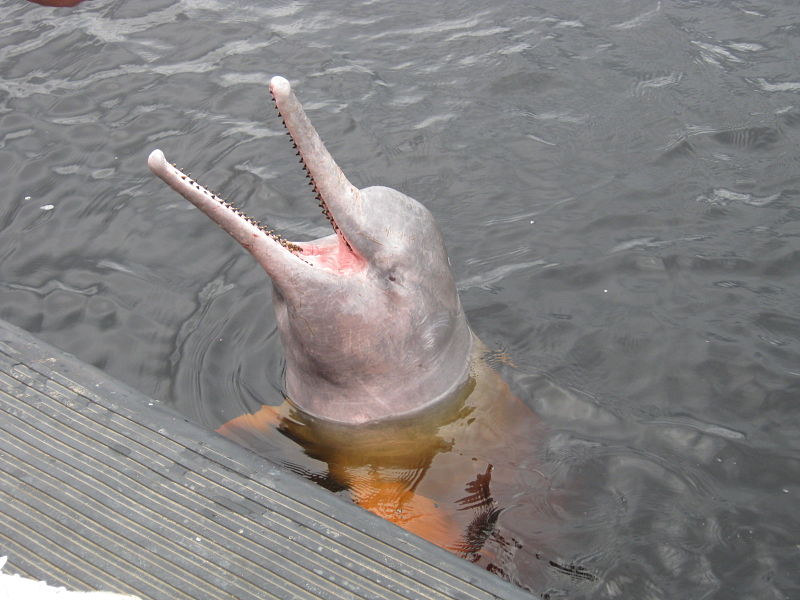 |
| Amazon river dolphins are also called Botos. |
Before you saw the picture above, you would probably think
I'm telling tales if I spoke of a pink dolphin that lives in Amazon rivers.
Well, the Amazon river dolphin is no joke! These dolphins are quite unlike any
found in the ocean – they have long snouts and large foreheads. Their diet
consists of crabs, catfish, crustaceans, shrimp, small turtles and other river
fish. For the Amazon river dolphin, echolocation is extremely important because
the rivers of the Amazon are often murkier than the ocean and are therefore
much harder to see through (and in the flooding season, echolocation helps the
dolphins navigate through the tree trunks). Some river dolphin species in Asia
have lost their eyesight almost completely, relying on echolocation.
False Killer Whales
 |
| False killer whales were once thought to be extinct. |
The creature you see in the picture above may look
like a cross between a killer whale and a dolphin, the false killer whale is a
member of the dolphin family and is not in the same genus as the true killer
whales (hence their name). Nonetheless, they're very similar in appearance and
thrive in many of the same waters. Believe it or not, the false killer whale,
described by paleontologist and biologist Richard Owen (the same scientist who
invented the word “dinosaur”), was thought to be an extinct species until
Johannes Reinhardt found a large pod of them in Kiel Bay in 1861. These awesome
cetaceans can grow up to 20 feet long and can weigh 4,900 lbs.
Orca
.jpg/800px-Orcas_%26_humpbacks_(3730256151).jpg) |
| The Orca is the largest species of dolphin. |
Despite their awesome size, the killer whale, or Orcinus
orca, or orca for short, is also a member of the dolphin family. At 30 feet
from snout to tail fluke and weighing up to 11 tons, they're the largest
species of dolphins. The name “killer whale” is a bit of a misnomer, as they
aren't “killers” as they were often depicted in movies – as oceanic savages
ready to eat anything they see – and they're closer related to other dolphins
than true whales. Orcas are quite different from most other members of their
kin, as they're the top natural predators of the ocean. There are three to five
different “races”, types or subspecies of orca. In fact, scientists are
wondering if they should be split into different species. The three main types
are resident, transient and offshore orcas. I mention this because each of the
three types has its own diet. Resident orcas, that live in waters of the
Northern Pacific, eat mostly fish, but will also go for squid. Transient orcas
prefer eating marine mammals (fortunately humans are not on the menu!).
Offshore orcas eat mostly fish, but also mammals and even sharks. (Keep in mind
that orcas are very opportunistic predators and aren't only limited to their
main food choices). Unlike most other dolphins, orcas are not only capable of
fending off sharks, but actually eating them! Even the great white shark is no
match for the mighty orca! Orcas live in large, complex societies and can live
up to 90 years of age.
Dolphins are quite amazing animals that God created, aren't
they? These beautiful creatures are not fast swimmers, intelligent, vocally and
socially sophisticated, but they're also perfectly designed for life beneath
the way, just like we'd expect if they were created by an intelligent,
all-powerful Designer.
References:
http://en.wikipedia.org/wiki/Bottlenose_dolphin
http://en.wikipedia.org/wiki/Atlantic_spotted_dolphin
http://en.wikipedia.org/wiki/Amazon_river_dolphin
http://en.wikipedia.org/wiki/False_killer_whale
http://en.wikipedia.org/wiki/Killer_whale
http://www.nmfs.noaa.gov/pr/species/mammals/cetaceans/spotteddolphin_atlantic.htm
http://animals.nationalgeographic.com/animals/mammals/bottlenose-dolphin/
http://en.wikipedia.org/wiki/Atlantic_spotted_dolphin
http://en.wikipedia.org/wiki/Amazon_river_dolphin
http://en.wikipedia.org/wiki/False_killer_whale
http://en.wikipedia.org/wiki/Killer_whale
http://www.nmfs.noaa.gov/pr/species/mammals/cetaceans/spotteddolphin_atlantic.htm
http://animals.nationalgeographic.com/animals/mammals/bottlenose-dolphin/
Disclaimer: Many (or in some cases all) of
the photographs and images above are not mine. If you own one or more of them
and would like them to be removed, politely let me know via one or both of the
email addresses above.



_-_Weltvogelpark_Walsrode_2013-01.jpg/800px-Coua_caerulea_(Blauer_Seidenkuckuck_-_Blue_Coua)_-_Weltvogelpark_Walsrode_2013-01.jpg)
_-_12938113005.jpg/800px-Greater_roadrunner_(Geococcyx_californianus)_-_12938113005.jpg)
_-_12937890555.jpg/800px-Greater_roadrunner_(Geococcyx_californianus)_-_12937890555.jpg)
_(3399096675).jpg/800px-Greater_Roadrunner_(Geococcyx_californianus)_(3399096675).jpg)