Thursday, April 3, 2014

The Dinosaur Renaissance pt. 2: Our Knowledge of Dinosaurs Increases

Well, the year's already flying, yet it feels as if it's just begun! Isn't that strange? Things are going pretty well with our Easter drama, “The King on a Cross” – we had our first dress rehearsal last Sunday. It's surprising how much of an impact costumes make (and after spending several hours in my costume, it sure felt like I'd visited the Holy Lands, man that thing makes me hot!). I can't wait for the night of the drama and the second performance on the day after (contact me using the email address at the bottom of this blog post for specific details).

With the update on the play out of the way, let's get started with our “usuals” before we dive into the second part of my three-part series on the “Dinosaur Renaissance”.

Days Till
It is: 10 days till Palm Sunday
It is: 14 days till the Friday night performance of “The King on a Cross”
It is: 18 days till Easter Sunday

In the Spotlight
This week we've got a good dose of news concerning the fourth film in the Jurassic Park series, Jurassic World! Just last week, I showed you all some pictures of some JW concept art for the movie's Visitor Center. This week, I've uploaded some photographs recently taken of the helipad that's going to appear in the film! Here they are:


It's not much too look at yet, as it's still unfinished, but one can just imagine the type of scenes that might take place here; this location would look fantastic with some hadrosaurs and sauropods in the background, or maybe near the end of the movie the film's heroes must escape a pack of raptors or tyrannosaurs by reaching the helicopter in time. Who knows?

Also in other news, Irrfan Khan – who is playing Patel, the owner of the new theme park – has revealed his upcoming filming schedule is anything but not-busy. He described his schedule in a recent interview with Bollywood Hungama. Here's what he had to say:
"It's a brief schedule to begin with, though my role is anything but brief. At the moment all I can tell you on record is that it's a pivotal role. I am very excited about the project. It's the second American global franchise after Spiderman that I am part of . . . After the first brief first schedule of Jurassic World, I'll be back in India to shoot for Shoojit Sircar's Piku. I'll complete one long schedule of Piku and then return to the US for a long schedule of Jurassic World. So it'd continue for the rest of the remaining part of the year."
It has been suggested by some fans that his role will be similar to the one that of John Hammond in the first film, mainly trying to stay out of harm's way while Chris Pratt's and Bryce Dallas Howard's character will be trying to fight for their lives!

The last bit of JW news is about one of the young actors named Ty Simpkins. As you might recall, we've known about him being in this film for quite some time, but it was only just revealed that his character name is going to be “Gray” (exactly what he does in the film is unknown at this point). By the way, Simpkins has just arrived in Hawaii to do some film shooting! I can't wait to see the finished project! Every bit of JW news only gets me more and more excited. As you guys might or might not already know, they start filming next week! Finally, after 13 years of pre-production, Jurassic World is heading to the production stage of the process!

Topic of the Week by Christian Ryan
Two weeks ago, we looked at how early discoveries of dinosaurs changed rapidly as we made more and more fossil finds. Now moving on into the 1870's, scientists were becoming very interested with the “terrible lizards”. And also during this time, more dinosaurs were being discovered not in Europe where the first findings took place, but in the United States – particularly in the western states.

It is now that we reach one of the greatest “dinosaur revolutions” in history, and it all started with two important men: Othniel Charles Marsh and Edward Drinker Cope. These two scientists were very different, but were drawn together (and later apart) by the same goal – the desire to discover classify more dinosaurs! Marsh was an American paleontologist born in 1831 in Lockport, New York. Cope was also an American paleontologist and he was born in 1840 in Philadelphia, Pennsylvannia.

Othniel Charles Marsh (left) and Edward Drinker Cope (right) were both American paleontologists with a great interest in dinosaurs . . . and this would eventually drive them both nuts!
Now, at first, these scientists, who were friends at the time after they met in Berlin in 1864, set out toward the western portion of the United States to find more species of dinosaurs. When they did find some new species, they even named some of the species after each other. But that's when trouble started brewing – the two scientists went to Cope's marl pit in New Jersey (where the first Hadrosaurus was found) and the moment when Cope turned his back, Marsh had the fossils being dug up diverted to him instead of Cope. From then on, it got from bad to worse; the two men turned from friends to enemies and by 1877, the Bone Wars (or “Great Dinosaur Rush”) had begun!

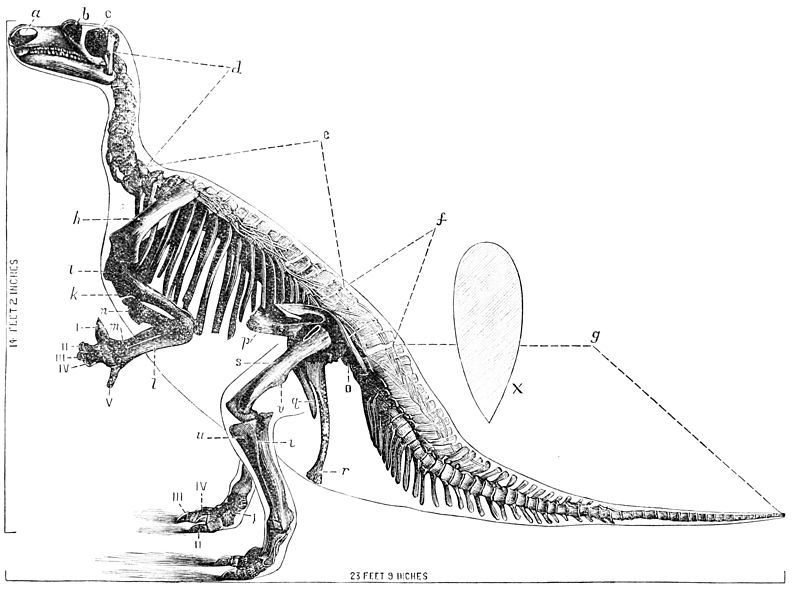
This is a sketch Marsh drew of a dinosaur he discovered called Claosaurus. This image clearly represents how scientists viewed dinosaurs at the time, notice the creature's tripod body posture.
The two scientists were determined to find and classify more fossils of extinct animals than the other; they were so desperate, that they even used spies to scope out the other's dig sites, planted fake bones in their opponents digging area, stole and even sometimes destroyed the other's fossils! Talk about Bone Wars! Most of the places Cope and Marsh were digging were in the states of Colorado, Nebraska and Wyoming, and here the two scientists found many new dinosaur species and helped early scientists of the time to learn more about the incredible beasts they were uncovering. The Bone Wars finally met its end in 1892 when Marsh and Cope were both financially ruined and could no longer continue their feud (partly because of Cope's death). But it was thanks to the efforts of these scientists that 142 new species of dinosaurs were discovered! Now scientists had even more fossils to work with.

But despite the fact that the two scientists were discovering more fossils, they still made a few mistakes with their reconstructions. When Cope discovered a marine reptile known as Elasmosaurus, he reconstructed the beast as a sea creature with a short neck that propelled itself through the water with a long tail. But Cope noticed that the fossils didn't fit very well together, so he had Professor Joseph Leidy take a look at it and he found the problem – Cope had placed Elasmosaurus' head on its tail and vise versa! This creature in reality was a long-necked marine reptile with a short tail. Leidy then had a scientific paper about Cope's mistake published and Cope – based on his next course of action – must have been terribly embarrassed. So to avoid being disgraced, Cope bought ever one of the papers Leidy published he could find to avoid anyone else knowing about his mistake.

When initially reconstructed, Cope accidentally placed the neck bones of Elasmosaurus where the creature's tail should have gone!

It turned out that Elasmosaurus had a long neck and a short tail, and not the other way around.
A popular myth is that it was Marsh who pointed out Cope's error and published his input on it, but the truth was that Marsh apparently liked the story of his enemy making a mistake and 20 years later, Marsh claimed that he was the one who pointed out Cope's error. However, if you ask me, Marsh made an even more serious mistake.

Among the creatures Marsh discovered was the famous brontosaurus, but he overlooked a tiny problem – when he found the original specimen of “brontosaurus”, it was without a head, so he placed the skull of another specimen found nearby on it to complete it. Little did he know that the skeleton and the skull were of two very different species: the skull was of a Camarasaurus and the skeleton from an Apatosaurus! It wasn't until the 1900's that scientists found out that brontosaurus never existed; to this day, the general public is still oblivious to this fact. That's why I think Marsh made a worse mistake than Cope, because Cope's error was pretty much forgotten soon after it happened.
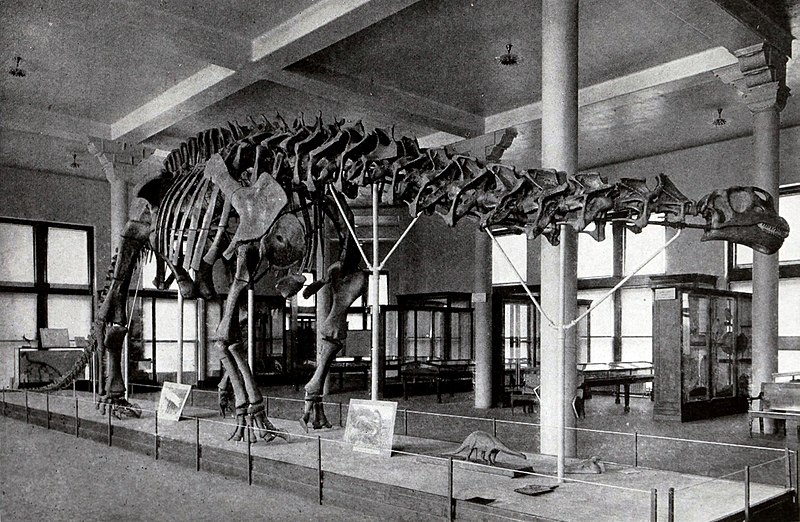
This is the original reconstructed skeleton of Apatosaurus, aka "brontosaurus", with a Camarasaurus skull.
In reality, Apatosaurus had a more elongated skull, similar to its relative Diplodocus
But our two paleontologists didn't only make fumbles in the Bone Wars. During the Bone Wars, Marsh and Cope discovered numerous fossils of what would become one of the most famous carnivorous dinosaurs ever (at least to dinosaur enthusiasts): Allosaurus fragilis, a ferocious theropod dinosaur with a crested head. Now we were able to paint a better picture of how dinosaurs looked and behaved. From the late 1800's onward, scientists knew that many dinosaurs walked on two legs instead of four, though two-legged dinosaurs were still portrayed as walking and standing in the tripod position. Carnivores such as Allosaurus were depicted walked with their heads held high up in the air and their tails dragging along the ground.

Allosaurus was one of the many dinosaurs discovered during the Bone Wars.
But that's not the only dinosaur discovered in this era – new dinosaur species making their appearance included Coelophysis, Stegosaurs, Camarasaurus, Triceratops, Apatosaurus, Diplodicus, Ceratosaurus, Camptosaurus, Barosaurus, Torosaurus, Laosaurus, Dryosaurus, Drinker, Othnielia (I wonder who that dinosaur was named after . . .), Labrosaurus among many others.
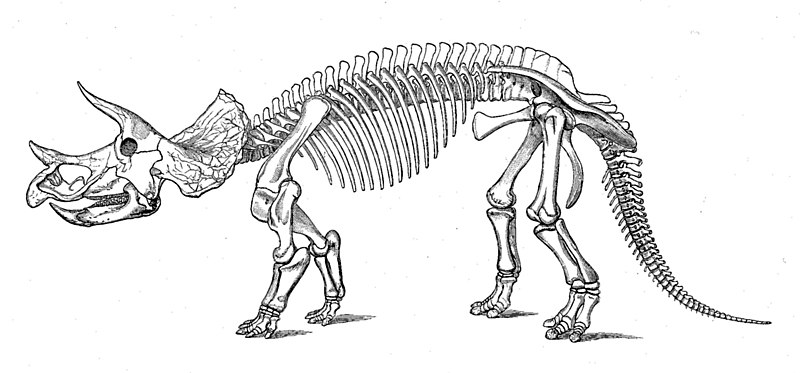
Triceratops, another Bone Wars discovery, was originally thought by Marsh to be an extinct species of Bison and initially called it Bison alticornis!
After the Bone Wars were over, scientists continued to find more new species of dinosaurs; the year was 1902 when the most famous dinosaur of all was discovered by Barnum Brown in the Hell Creek Formation – he discovered "The Tyrant Lizard King": Tyrannosaurus rex! At the time, T. rex was thought to be the largest carnivorous dinosaur ever to exist, easily overshadowing the other large carnivore known at the time, Allosaurus.

This leads us to another key figure in how dinosaurs have been portrayed over the years: Charles Knight. Charles, who lived from1874-1953, was an American artist who painted beautiful recreations of many extinct creatures – including dinosaurs. Though most of his pictures of dinosaurs and other extinct reptiles are considered inaccurate today, they are a vivid reminder of what we used to think these creatures were like.
Here is a portrait by Charles Knight of a pair of hadrosaurs.
Charles Knight modeling a Stegosaurus.
Dinosaurs at the time were portrayed as very reptilian beasts that were extremely dimwitted. One dinosaur that brought on this way of thinking was the discovery of Stegosaurus (once again, it was discovered during the Bone Wars). When scientists peered into its brain case, they thought that the brain was only about the size of a walnut – an alarming thought considering the dinosaur was about as long as a school bus and weighed five tons! Today, we know that Stegosaurus actually had a brain the size of a dog's. Even though its brain was still quite small for a dinosaur, we must remember that Stegosaurus didn't need a large brain to survive; God created Stegosaurus with enough intelligence to survive and that's all it needed. Unfortunately, everyone (scientists and the general public alike) thought that the small brain-thing applied to all dinosaurs and viewed all dinosaurs as over-sized dummies. That's not the only idea we got wrong at the time.

The relatively small brain of Stegosaurus (inaccurately depicted here with the wrong dorsal plate and tail spike arrangement) gave rise to the false idea that all dinosaurs were dimwitted.
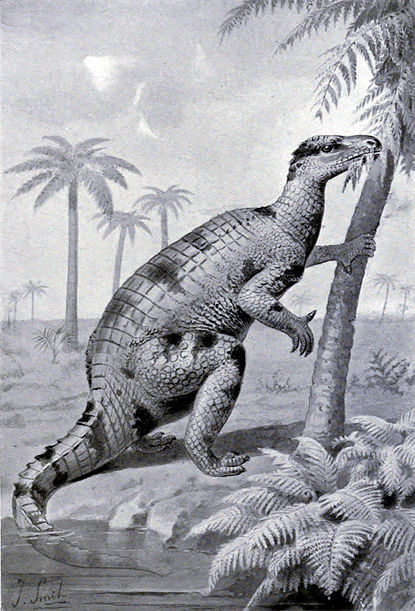
The “terrible lizards” were also thought to be quite sluggish and cold-blooded, having to bask in the sun to raise their body temperatures. Carnivores such as Tyrannosaurus and Allosaurus were believed to have a tripod posture; they were thought to walk with their heads held high and their tails dragging along the ground (at the time, there wasn't much difference between T. rex and Allosaurus other than size). In fact, that's how pretty much all bipedal dinosaurs – including hadrosaurs and the Iguanodon we learned about in part 1 – were pictured.

Iguanodon was portrayed as a dinosaur that walked in a tripod posture for much of the 20th century.
These Tyrannosaurus rex are inaccurately posed in a tripod posture and they have three fingers; today we know they only had two.
Four-legged herbivores were also thought to let their tails drag on the ground, and many were even thought to have been at least semi-aquatic. Take the sauropods, or long-necked dinosaurs, for example; here were dinosaurs that were much larger than anything walking the land today. Sauropods, like Apatosaurus, Brachiosaurus, Camarasaurus, and Diplodocus could weigh anywhere from 30-50 tons (and back in before the Dinosaur Renaissance, most weight estimates for sauropods went much higher) and were imagined as lumbering and lazy behemoths that were so heavy, that they couldn't support their weight on land. Scientists of the time thought that these dinosaurs must have lived in swamps to support their weight. Creatures such as hadrosaurs were also believed to live in swamps.
Sauropods like "brontosaurus" were once thought to spend their lives wallowing in swamps.
Even still, the general public was falling deeply in love with dinosaurs. By the early 1900's, dinosaurs were quite popular and started making their appearance in movies and books. The first dinosaur ever to appear in cinema was Gertie the Dinosaur, who made her theatrical debut in 1914. The Lost World by Connon Doyle, published in 1911, and the movie based on the book with the same name that was released in 1925 were instant hits. The views of dinosaurs as slow, poorly evolved, dimwitted brutes and creatures destined for extinction were prevalent by this point, even up into the 1940's and 50's. And it stayed that way . . . up until the 1960's, that is! In the final part of this series, we'll explore how our view of dinosaurs changed with the coming of the Dinosaur Renaissance and learn just what they mean to us in the 21st century. We'll learn how the Dinosaur Renaissance first began!

PS 1: To post a comment (this is highly encouraged), please simply click the post you wish to comment on, scroll to the bottom of the page and put what you wish to say or ask in the comment box. Then in the box below the comment box choose who you’re going to comment as. And then click preview or publish. If you aren’t signed into Google, you’ll be asked to type in a word and a number in the space provided. Type the word, put a space and then put the number. Then your comment is on the blog!

PS 2: Have a puzzling question about animals (including dinosaurs), myself, my latest book, my stop-motion movies, Creation or etc? Please post your question as a comment or send me an email at animaladventures@aol.com.

PS 3: What’s the new in the news? Check it out at SMILEY’S NEWS.

Thursday, March 27, 2014

The Dinosaur Renaissance pt. 1: Early Discoveries

How is everyone enjoying their spring so far? Mine is going pretty good so far. Not a lot is going on around here except our work on the Easter drama, “The King on a Cross”, coming up in just a few weeks. As you might recall if you've read my previous posts, there will be two performances: one on Good Friday (the 18th) at 7 p.m. and the other on Saturday the 19th at 2 p.m. Be sure to contact me if you're interested in more details with the email address at the bottom of this blog post.

Days Till
It is: 17 days till Palm Sunday
It is: 22 days till the Friday performance of “The King on a Cross”
It is: 24 days till Easter Sunday

In the Spotlight
I can't tell you how exciting it has been for me as a Jurassic Park fan over the past several months! News concerning the new forth movie, Jurassic World, has been literally pouring into the media. Earlier this week, two pictures of concept art have been revealed! For those of you that don't know, concept art is pictures made for movie-makers when they're trying to get their ideas for a movie into visual form. Here are the two concept arts:


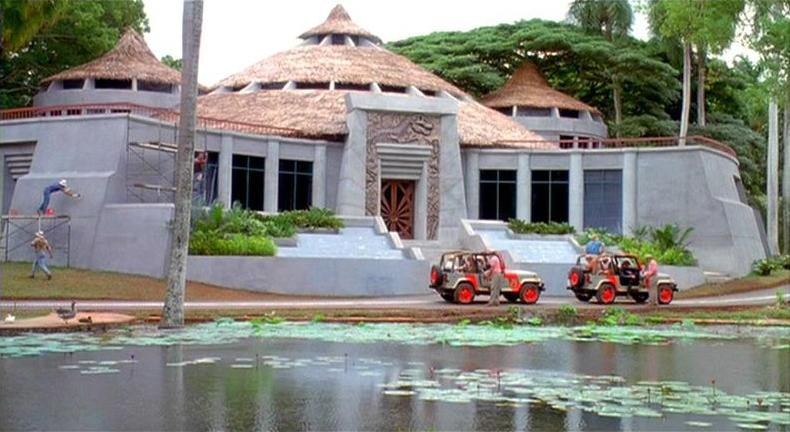
To me and many other Jurassic Park fans, these two pictures seem to be portrayals of the new Visitor Center for the new Jurassic World theme park. As you can see, the central rotunda is similar to the one in the first movie, but more futuristic. This makes sense when you remember that the movie will take place in 2015, while the events of the first movie took place in 1993. Here's the Visitor Center from the first film and the concept art for the new film for comparison:

This is the Visitor Center from Jurassic Park.
This is the concept art depicting the Visitor Center from Jurassic World.
Also, you can tell based on the pictures that the new film will feature monorails running across Isla Nublar. These could potentially lead to some really cool action sequences in the film!

Since these pictures are dated 2013, it is possible that this is just early concept art and it may not reflect what the Visitor Center in the movie will really look like. Perhaps they've changed the design of the buildings and/or the monorails since these were created. I guess we'll have to wait till June 12, 2015 to find out!

That's not the only news in the Jurassic World universe – two more actors' involvement with the film has just been confirmed. The actors are Omar Sy and Jake Johnson. We don't know what parts they will be portraying yet, but I can't wait to find out. The film's director, Colin Trevorrow has also given us some more insight as to who will be in the picture; there are three more yet-unnamed main female roles to fill. And as if that wasn't great enough, you might recall that I mentioned in a blog post several months ago that Universal Pictures will start the production phase for this movie next month! Finally, after over a decade Jurassic World is finally going to see the light it deserves!

Topic of the Week by Christian Ryan

Dinosaurs: you've seen them in books, movies, television programs, video games, computer games, in museum halls, advertisement . . . and even in toy shops! Perhaps these animals are so popular because we humans are so drawn toward creatures or concepts we don't really understand well. And compared to animals living today, we really don't know too much about dinosaurs at all if you think about! But our knowledge of these beasts is increasing year by year; there once was a time we knew even less about these beasts God created: they were portrayed as nothing more than sinister, primeval, evil, lazy, cold-blooded creatures destined for extinction. But that was before a great revolution in dinosaur science known as . . . the Dinosaur Renaissance (sometimes called the Dinosaur Revolution). So how did we get from the older depictions of dinosaurs to the ones we're familiar with today? Well, this three-part series of mine called "The Dinosaur Renaissance" will help you understand just how much about dinosaurs we've learned since they were first discovered!

The Dinosaur Renaissance is a period of time when scientists began to learn new and amazing facts about these dinosaurs. But before we learn about the Dinosaur Renaissance, there are some other facts you should now about what happened before this time period, and some basic dinosaur science in general. First off, the area of science devoted to the study of dinosaurs and other ancient animals and plants is called paleontology. Scientists who study paleontology are called paleontologists. Fossils of dinosaurs – dramatic reminders of the several (billions of) lives lost in the water's of Noah's Flood – have been uncovered from the ground for thousands of years, but nowhere near the scale we dig them up today. This is because we weren't looking for them and/or we didn't know what to look for. Many early discoveries were thought to be the bones of dragons (and people who believed that were actually pretty correct; post-Flood dinosaurs inspired dragon legends before their extinction). And some scientists of the 1600's actually believed that dinosaur fossils were the bones of large elephants or even giant humans! Today, we know the largest confirmed human was the giant Goliath described in 1 Samuel in the Bible.

Back in Victorian Times, depicting dinosaurs as lively and agile creatures was unheard of!
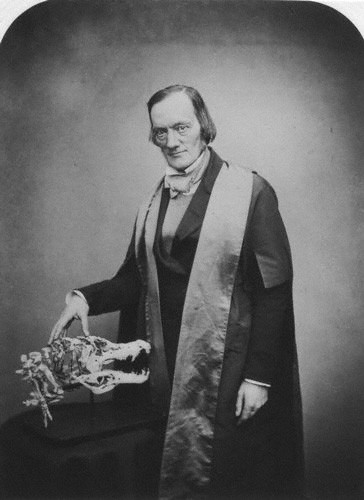
But when did people actually learn that dinosaur bones were completely different from animals we know today? Well, that all started between 1815 and 1824, when a geology professor named Rev. William Buckland collected the fossils of a dinosaurs later named Megalosaurus. He can be credited as the first person to successfully describe a dinosaur as a dinosaur and not something else (e.g. a giant elephant or giant human). The second fossils recognized as an animal new to science were discovered by Mary Ann Mantell, the wife of English geologist Gideon Mantell, in 1922. She showed the finds to her husband, who had a great interest in fossils, and he published his findings in 1825. These fossils were later named Iguanodon, based on the similarities of their teeth to a modern iguana. In 1841, an English scientist named Sir Richard Owen correctly identified these two new creatures as animals that no longer existed and made a new name for them, a name that strikes fear and amazement into our hearts to this day: dinosaur, which means “terrible lizard”.

Sir Richard Owen invented the name "dinosaur" in 1841.
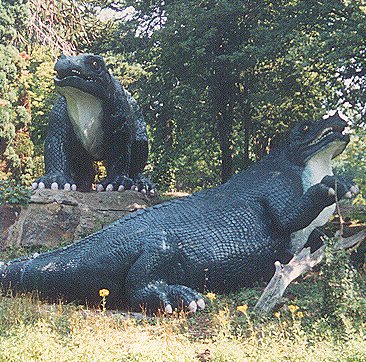
Soon, scientists and artists from the Victorian era began trying to reconstruct these magnificent beasts . . . but their efforts were . . . well, let's just say they weren't the most accurate! Sir Richard Owen had the first reconstructions of the Iguanodon depicted as a lizard and rhinoceros-like creature, with a horn on its snout, a bulky body, pillar-like legs and a thick tail. One of the very first Iguanodon sculptures ever made was, before it's completion, used to hold around 20 scientists for a dinner! You can imagine it was very uncomfortable!

These two Iguanodon scultptures, in Crystal Park, were some of the first depictions of dinosaurs ever made.
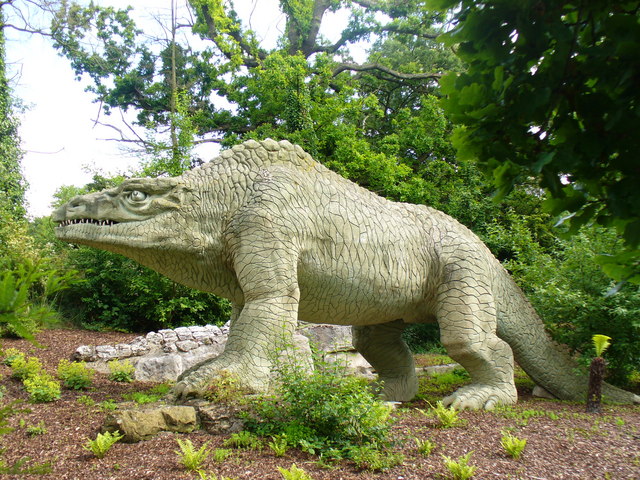
Megalosaurus didn't fare much better in its recreation! It was portrayed sort of like a half crocodile/half rhinoceros type of animal that walked on all four legs. Megalosaurus, we now know, didn't really look anything like the initial depiction, as you'll read later on. The first reconstructions of the two mentioned species were placed in Crystal Park, right outside of the the Crystal Palace. The palace burned down since then, but the dinosaurs can and are often still visited there to this day! It wasn't long before the first reconstructions of Iguanodon and Megalosaurus were obsolete. (However, even the initial Iguanodon wasn't the worst mistake paleontologists have made over the years; one scientist we'll learn about in the "The Dinosaur Renaissance pt. 2" placed an extinct reptile's head where the tail should have gone!)

Megalosaurus was the first dinosaur ever correctly described as a dinosaur. This sculpture is also located in Crystal Park among other Victorian recreations of extinct reptiles.
More and more dinosaurs began being discovered, not only in England, but also in the America's. Before the next big dinosaur discovery, scientists believed all dinosaurs walked on four legs. But in 1858, this all changed with the new discovery of Hadrosaurus, a large hadrosaur, or duck-billed dinosaur, in New Jersey. It was clear, based on the skeleton, that the dinosaur could walk in a bipedal fashion, meaning it could walk on four legs. And scientists were about to get a BIG shock coming from a dinosaur they already knew about: workers in a Belgian coal mine discovered 38 specimens of Iguanodon in 1878. Many of them were complete or almost-complete. This made scientists realize that their original reconstruction of Iguanodon was wrong – now that they had more fossils, they knew that, like Hadrosaurus, Iguanodon could also walk on two legs. That wasn't the scientists' only surprise: thanks to all of the new specimens discovered, they learned that the supposed “nose horn” of Iguanodon was really a thumb spike (only one spike was found on the original specimen in 1822 and it wasn't attached to the dinosaur's hand); this dinosaur had a spike on each hand that would have been used for defense and/or to help it forage.

After the discovery in the Belgium coal mines, scientists learned that Iguanodon could walk on two legs and that the "nose horn" was actually a thumb spike. However, their depictions of this dinosaur would still be wrong until almost a century later.
Scientists kept digging more and more dinosaur fossils out of the ground. In fact, even to this day, there are more fossil discoveries than there are scientists to actually study them! By the late 1800's, dinosaurs were becoming very popular . . . but this isn't the end of our tale. In fact, by the late 1800's, the tale of dinosaur discoveries was only just beginning!

I hope everyone enjoyed reading the first article in The Dinosaur Renaissance series. Please come back next week for my co-author Joy's latest article and, the week after that, we'll continue with my series and see what happens when scientists get a little too anxious to discover more dinosaurs!

PS 1: To post a comment (this is highly encouraged), please simply click the post you wish to comment on, scroll to the bottom of the page and put what you wish to say or ask in the comment box. Then in the box below the comment box choose who you’re going to comment as. And then click preview or publish. If you aren’t signed into Google, you’ll be asked to type in a word and a number in the space provided. Type the word, put a space and then put the number. Then your comment is on the blog!

PS 2: Have a puzzling question about animals (including dinosaurs), myself, my latest book, my stop-motion movies, Creation or etc? Please post your question as a comment or send me an email at animaladventures@aol.com.

PS 3: What’s the new in the news? Check it out at SMILEY’S NEWS.

Thursday, March 20, 2014

Ancient Monsters of the Deep - Now in Color!

Well, spring is here and winter is finally over! Isn't it great! Here in Utah, we don't have a whole lot of seasonal changes, but we have been experiencing dogwoods and other trees in bloom. Their very beautiful this time of year. Anyway, let's get started with our “usuals”.

Days Till
It is: Springtime!!!
It is: 24 days till Palm Sunday
It is: 33 days till our Friday performance of the “The King on a Cross”
It is: 31 days till Easter

In the Spotlight
Today we've got some more terrific news from two great upcoming films: Dolphin Tale 2 and Jurassic World. Concerning DT2, as many of you might know, they recently finished the production process and have moved on to the post-production stage. On April 11, the first trailer for the film is going to appear on television!!! I can't wait to see it!

Just last week, it was revealed that the Asian actor Irrfan Khan is portraying the owner of the new Jurassic Park in the film Jurassic World (initially titled Jurassic Park IV). Earlier this week, we learned some more terrific news about the film: IGN had a recent interview with the film's director Colin Trevorrow and he not only spills some facts we never knew before about the the new characters in the film, but he also revealed a character from the first Jurassic Park that will be in JW – Dr. Henry Wu!!!

B. D. Wong is going to portray Dr. Henry Wu in Jurassic World!!!
Dr. Henry Wu – who was portrayed by B.D. Wong – was the head geneticist at Jurassic Park and is one of the people responsible for bringing John Hammond's dream to reality. Jurassic Park: The Game (which is considered part of the Jurassic Park film canon) reveals that Dr. Wu took over the role as head geneticist after the former head geneticist, Dr. Laura Sorkin, disagreed to take “short cuts” when it came to recreating the dinosaurs and was demoted. In the first film, Dr. Wu has a very small but also very crucial part. In the fourth film however, it appears that he'll have a much larger part. Here is a snippet of the interview with Trevorrow where he talks about Dr. Wu and some information about the film's new characters:
"I know a lot of fans want to see the original characters back. They’re iconic. But I respect those actors too much to shoehorn them into this story for my own sentimental reasons. Jurassic Park isn’t about the bad luck of three people who keep getting thrown into the same situation. The only reason they’d go back to that island is if the screenwriters contrived a reason for them to go. But there is a character from the first film who makes sense in our world. This hasn’t been announced yet, but BD Wong will be returning as Dr. Henry Wu. He had a much larger role in the original novel, he was the engineer of this breakthrough in de-extinction. He spent two decades living in Hammond’s shadow, underappreciated. We think there’s more to his story."
He went into detail about Chris Pratt's character, Owen:
"He’s a classic hero in a very modern context. He’s the guy who will get you through the jungle alive – but like Malcolm, Grant and Sattler, he’s an expert in a scientific field that’s connected to our story. The character allows us to explore some new ideas about our relationship with these animals, without losing the humor and sense of adventure. He’s a great contrast for Bryce Dallas Howard’s character, who starts off very corporate, very controlled. Until the running and screaming starts. Then they need each other."
I'm really glad that Dr. Henry Wu is making a comeback and I agree with Trevorrow's decision not to include Dr. Ian Malcolm, Dr. Alan Grant and Dr. Ellie Sattler in the fourth film; after all, they criticized the park! Why on earth would they be in JW's new park if they despise it? So really, Trevorrow's decision makes a lot of sense to me.

Topic of the Week by Christian Ryan
In the January of 2014, scientists at the Lund University in Sweden discovered that by looking at the melanosomes on specimens of fossilized marine reptile skins, they've been able to tell what their most likely skin color was in life! There were three marine reptiles involved in this study: one was an extinct species of leatherback sea turtle, an agile dolphin-like reptile known as an ichthyosaur, and (my favorite of the three) a colossal sea-going lizard called the mosasaur. Mosasaurs looked a lot like a cross between a monitor lizard, a whale and a great white shark; some mosasaurs grew 40-50 feet in length!

New research has shown that at least one species of mosasaur (bottom) and an extinct species of leatherback sea turtle (top) were black with lighter colored underbellies, while at least one species of ichthyosaur was completely black.
The coloration of most extinct creatures has been a mystery since coloration doesn't (normally) appear in fossils. So pretty much since we dug up the first fossils of extinct creatures, scientists and others have had to make educated guesses as to what colors they were. However, this all changed a few years back; a few months ago, I wrote an article concerning the discovery of melanosomes (those are special cells which contain the color pigment in both animals and humans) that could be seen with a microscope on the fossils of some dinosaurs and extinct birds. It turns out that scientists can look at the size and shape of the melanosomes and the distance between the melanosomes to determine the coloration of some creatures! Now, this same science is being used to color other extinct creatures – this time creatures of the sea!

So how did the scientists determine the creatures' color? Well, first they wanted to see whether or not the microscopic objects in question were really melanosomes or from the result microbial contamination. What they did was use a special technique known as “energy-dispersive X-ray microanalysis”. In other words, they used an X-ray to test how the sample of the specimen reacted. The scientists learned that the objects in question were in fact associated with preserved skin film that was found on the three fossilized creatures and not something else. Thanks to this information, the scientists began looking closely at the melanosomes of the three animals (which were oval-shaped, by the way) to determine their distance apart from each other.

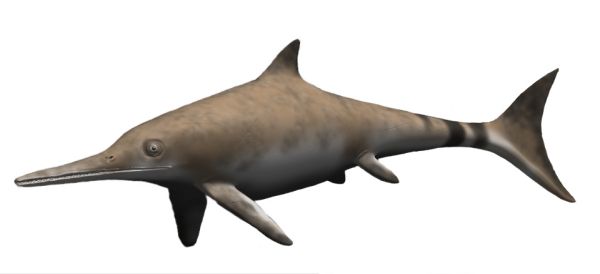
Despite its appearance, ichthyosaurs, like this Ichthyosaurus, were not fish, but reptiles.
The study revealed that the leatherback sea turtle was – like the modern leatherback sea turtle – was probably mostly blackish on the upper regions of its body with a paler underbelly. They found this to be true with the mosasaur as well! The ichthyosaur was a different story – instead of being blackish on the top and whitish on the bottom, it seemed to be all blackish colored! (This study doesn't mean however that all species of mosasaurs or ichthyosaurs were these colors) Why did all three of the animals have black on their bodies? Was it just coincidence? And what was the purpose of the black coloration anyway?

Prognathodon was one of the many species of mosasaurs.

Well, we can't say for sure, but scientists can make some educated guesses by looking at modern animals. You might have noticed that mosasaurs and the extinct species of leatherback sea turtle have a similar coloration to a wide variety of modern sea animals; killer whales, great white sharks, modern leatherbacks, penguins, dolphins and many others have a darker coloration on the top portions of their bodies and lighter portions on the bottom portion. It turns out that this form of coloration can be very helpful to marine animals, both living and extinct.

Penguins and many other animals have black or dark-colored tops and paler undersides.
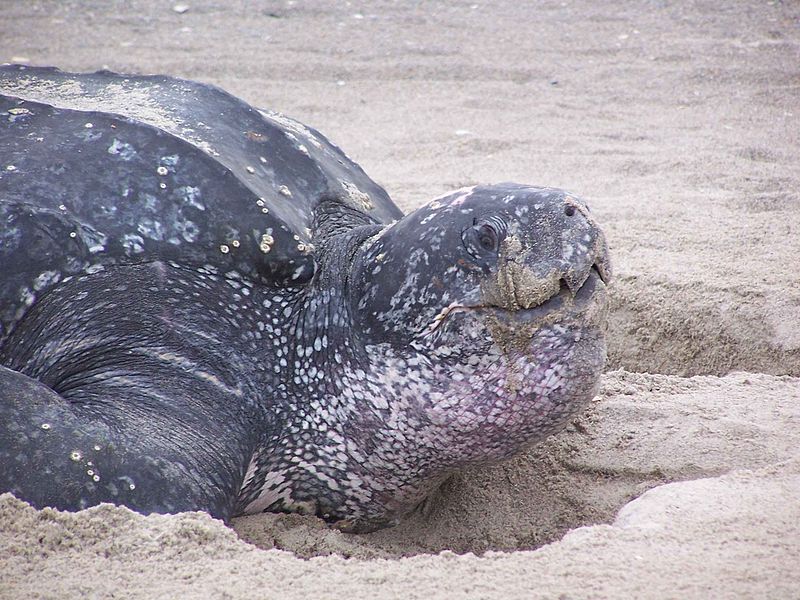
Modern leatherbacks' backs can become quite hot when exposed to the sun. This is helpful since the turtle is a cold-blooded reptile that needs to stay warm in order to move its body around, and that's not easy for the leatherback because these widespread reptiles often can be found living within the chilly waters of the arctic circle! Darker colors – black in this case – attract more heat than lighter colors, so therefore black coloration warms up the turtle more than a lighter color would. While the extinct species of leatherback was coldblooded, we have no idea whether mosasaurs and ichthyosaurs were or not. However, even a warmblooded animal can find black pigmentation on the top useful.

The leatherback sea turtle of today has the same coloration as its extinct relative.
While mosasaurs use could swim at high speeds (probably as fast as 30mph) using their powerful tail flukes, they couldn't keep up the high speed for long. So instead of chasing prey over long distances, when mosasaurs found prey nearby, they probably stalked them like great white sharks do today, far below their prey (mosasaurs ate pretty much anything they could catch – fish, sharks, plesiosaurs, sea birds, turtles and even other mosasaurs). Then when the moment was right, the mosasaur would probably undulate its tail fluke to launch itself upward and catch the prey in its five-foot, toothy jaws. The black coloration of mosasaurs was probably used a lot like modern predators: while stalking their prey, the black coloration would help them blend in with the depths so that prey won't notice them above. And from above, the lighter colored underbelly would make a mosasaur or sea turtle hard to see because the lighter color breaks up its outline. Cool, huh? While the turtle wouldn't be stalking fast-moving prey, its coloration would probably be helpful in staying out of sight from hungry predators. This is important because unlike most sea turtles, the shells of leatherbacks aren't made of hard shell, but rather are constructed of bony struts under the skin, making the shell much easier to bite into.

Mosasaurs, such as the 50-foot Tylosaurus, could have used their coloration to remain concealed from prey until the attack!
What about ichthyosaurs? Why was the one involved in the study completely black? Well, long before the coloration of the creature was discovered, scientists suspected that ichthyosaurs would often hunt deep underwater because of their large eyes. One species of ichthyosaur, Opthalmosaurus, has some of the largest eyeballs of any animal in proportion to body size at four inches across! Their large eyes would help them see both prey and predators in the darkness of the water. If the species of ichthyosaur involved in this study was a deep-diving creature, a lighter colored underbelly like the mosasaur had would possibly give its presence away. But with an all-dark body, an ichthyosaur has a lesser chance of getting detected. The modern sperm whale bears similar coloration to this ichthyosaur – dark colors all over the body – for this exact reason.

Opthalmosaurus had some of the largest eyes in proportion to its body size of any creature.
All three of these amazing reptiles we looked at seem to be beautifully designed for marine life, even down to the color of their skin. Evolutionists are often puzzled why some animals bear similarities to other animals if they just evolved. In fact, some evolutionists have questioned whether or not the fact that the animals involved in the study mentioned above had black coloration because of mere coincidence. But how likely is that? I mean, this isn't the only “coincidence” in nature; there are many animals with features similar to other unrelated animals. For instance, four kinds of animals are capable of powered flight: birds, bats, pterosaurs and insects, and evolutionary scientists believe that the power of flight evolved four different times! And it's the same thing with the three marine reptiles mentioned earlier. How likely would it be that creatures would be similar to other creatures in this way?

The fact that many animals are often designed with features similar to other unrelated animals should actually point us to the One who created these amazing animals. Its way more believable that these animals have similarities with other animals because they have the same Designer. By looking in the first chapter of the book of Genesis, we learn that God created mosasaurs, sea turtles and ichthyosaurs on the Fifth Day of the creation week, no more than 6,000 years ago. Isn't it wonderful that God designed these creatures to thrive in the environments He placed them in? So the next time you see an animal that has similarities with another unrelated animal, sit back and think about all the thought God placed into making both of them and praise Him for that.

God provided many ways for the creatures He made to thrive in the environments they lived in.
PS 1: To post a comment (this is highly encouraged), please simply click the post you wish to comment on, scroll to the bottom of the page and put what you wish to say or ask in the comment box. Then in the box below the comment box choose who you’re going to comment as. And then click preview or publish. If you aren’t signed into Google, you’ll be asked to type in a word and a number in the space provided. Type the word, put a space and then put the number. Then your comment is on the blog!

PS 2: Have a puzzling question about animals (including dinosaurs), myself, my latest book, my stop-motion movies, Creation or etc? Please post your question as a comment or send me an email at animaladventures@aol.com.

PS 3: What’s the new in the news? Check it out at SMILEY’S NEWS.

Thursday, March 13, 2014

The Truth About Global Warming

Welcome back everyone! This week, my church has been really busy on the Easter production we've been working on. We won't be allowed to use our scripts this coming Sunday! There's also some big news on one of the movies I've been writing updates about and I think you'll find today's article very exciting. So let's get started.

Days Till
It is: 4 days till St. Patrick's Day
It is: 7 days till Spring
It is: 31 days till Palm Sunday
It is: 35 days till the Friday performance of "The King on a Cross"
It is: 38 days till Easter

In the Spotlight
According to a recent interview with Jurassic World star Irrfan Khan by ABPLive, the rumor that he will be portraying the owner of the new 'Jurassic Park' (the theme park, not the movie). In the interview, he said,
"We start filming from April in New Orleans and Hawaii. I have watched the first one. Because it is a [Steven] Spielberg production and the kind of writing they do, amazing. One scene of mine is just four lines but it says so much about so many things. I play a park owner."
Irrfan Khan will be portraying the owner of the new Jurassic Park, named Patel.
He not only reconfirmed that he is in the film as has been rumored, but he also confirmed that the rumor about the fourth Jurassic Park film will take place at the new theme park that's actually in operation! I don't know about you, but I find this really exciting! Though this cast news is great, I still hope that the movie-makers will reveal some dinosaur-related information soon!

Topic of the Week by Christian Ryan
Global warming is a very serious issue and is often discussed in the media. Many people say that it's in fact a risk to life on earth as we know it! Another popular claim – even by some scientists – is that we are mostly or completely responsible for the warming of our planet. However, many of these claims are based on a Unitarianism and are actually rooted to evolutionary ideas about our planet – ideas that do not line up with what the Bible teaches to be truth. Since Earth Day is coming up next month, this article is going to focus on the popular topic of global warming and whether we as Christians should be concerned about it.

Global warming is an actual event
Scientific observations over the past four decades has proven that global warming is actually happening! But before we dive into the topic of how a Christian should respond to the global warming issue, it would be kind of nice to know exactly what it is, right? OK, so basically, as its name suggests, global warming is the increasing of the earth's all-round temperature, and as I previously mentioned, it's on the rise.

First of all, you'll want to know that the sun's warmth reaches the earth, it is stopped from escaping thanks to the ozone or greenhouse effect. The earth's atmosphere acts like a greenhouse, pulling the sun's heat toward it and keeping a good bit of it in in order to keep the earth at a suitable temperature to support life, yet, it also dispels some heat, letting it go off into space so we don't boil up! This is one way to explain how the greenhouse effect works, but here's another good way to sum it all up:


 Now that you've seen the video, you'll know something about how heat is trapped next to the earth, but I doubt getting rid of that heat is going to be as easy as dropping “a giant ice cube into the ocean every know and then”.

Many critics – most notably Al Gore – claim that global warming is a threat to the livelihood of the planet and our way of life. Is this true? Before we answer this, we need to know exactly what is causing global warming: is it natural or man's fault? Well, measuring the earth's overall temperature over a long period of time is very difficult because we weren't able to study it the way we can today. In fact, even measuring the earth's overall temperature now is difficult due to different kinds of conditions including: the time of day, the particular season and weather patterns. However, there is a way to get a global temperature relatively easily: the use of satellites. Though they have their issues as well, satellites are one of the best ways to measure the earth's global temperature. So why are we having so much debate over who or what is causing climate change?

Thanks to space satellites, we are able to determine the average temperature of the planet and find out if it has been rising over time.
The answer to that question is frankly that we don't have a lot of good data. Most of the research into the global warming issue hasn't been around before 30-40 years ago, so it's difficult to know what the overall temperature was like longer than four decades. In order to construct actual climate models with more definite answers, we need more time. But did you know that we weren't always debating about global warming? In fact, in the late 1970's, people were debating whether the earth's climate was cooling! This is a vast difference! So what's the truth about global warming?

So what do temperature graphs actually reveal about global warming? Well, if one were to look at the change in climate over the past 30 years or so, it would be easy to conclude that the earth is warming more than before. BUT, if we want to be accurate, we need to look at a wide range of time and not just the last few decades. In fact, if we do this, we'll learn that the temperature was rising between 1900 and 1940, and between 1940 and 1970, it was cooling. Between 1980 and 2000, it was back on the rise. Instead of global warming becoming a catastrophic, perhaps it's part of a natural pattern. And that's not all!

Greenland wasn't always contradictory to its own name! Vikings were once able to farm in what is now a land of ice.
Global temperature fluctuations have actually happened numerous times in the past. For example, by looking at history, we learn that Vikings were able to conduct agriculture in Greenland around a thousand years ago. Contrary to its name, Greenland is covered with snow and glaciers today and it's Iceland that's covered in greenery. Go figure! But back to the point: a few hundred years passed and the climate cooled, putting a stop to agriculture. And then, after a cooling that lasted a few hundred years which resulted in the regular freezing of the Thames in London, the climate began to warm once again in about 1700 A.D.! As a matter of fact, if the warming we're experiencing today continues, we'll probably be able to start farming in Greenland again and this island will actually be green. So the fact that ice caps are melting today shouldn't really worry us. There was also an event known as a “Little Ice Age” in Medieval times (“little ice ages” are just drops in temperature; the actual Ice Age was the period of time in earth's history when glaciers covered much of the earth's surface). The climate around us is constantly changing on a natural cycle.

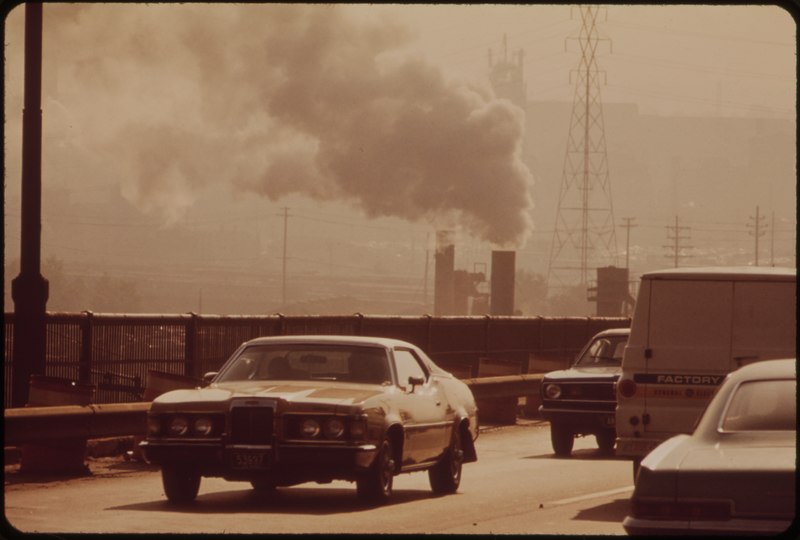
Is human pollution the actual cause of global warming?
But what is the actual cause of global warming? Is it us? Many people place their blame on us humans because of our use of fossil fuels that expel carbon dioxide into the atmosphere. This isn't actually true – the truth is that most of the greenhouse gases in our sky are actually made up of . . . you guessed it, water vapor! Didn't guess that? Well that just goes to show you how much alarmists have “informed” us about global warming. Did you know that water vapor makes up 80-90% of the greenhouse effect? Carbon dioxide makes up at most 20%, and at least 4% of what's left! And man-produced carbon dioxide makes up around or less than 1% of the greenhouse effect! Strangely though, many scientists are still alarming us about how we're causing global warming.

Besides, carbon dioxide is actually very healthy to us and the ecosystems of the earth – plants need it to survive so that they can produce oxygen.

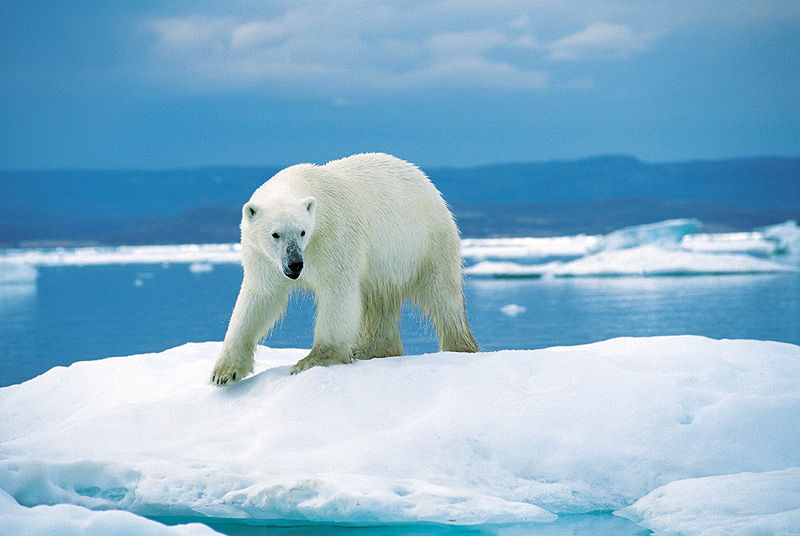
In his documentary, An Inconvenient Truth, Al Gore mentions that animal species are being threatened by global warming; he specifically mentions the polar bear. He claims that because the ice caps are melting, polar bears have to swim farther distances to reach ice floes that they need to survive and many of them drown on their journey. This couldn't be farther from the truth! In fact, while some polar bear may be in decline, the majority are actually thriving! Some populations of polar bears are increasing!

 Most polar bear populations are actually not being endangered by melting ice . . . some are even increasing!
Why on earth is there such a difference in beliefs considering the global warming issue? This is all because there are two world views we're dealing with here. If we start from man's assumptions and believe that the earth is millions of years old, then we'll also have to believe the climate models that come with it. If you believe in this secular world view, then you'll believe that we are nothing more than highly evolved animals that came into existence because our own universe came into existence thanks to pure chance. So in a sense, we were lucky.

However, if we start with a biblical world view, then we'll learn that we were actually created with a purpose by a loving and intelligent Creator. We're not here by chance at all! If we believe this, then we'll also have to believe that the world was affected by a global Flood (the Genesis Flood) that altered the earth's initial climate, starting it on a roller coaster of climate conditions that would change over time, but stay on a cycle. In fact, God gives us a promise of what to expect in the future all the way back in Genesis 8:22. It reads:
“While the earth remains, seedtime and harvest, cold and heat, winter and summer, and day and night shall not cease.”
So it makes lots of sense that God must have created the earth with a temperature control system, kind of like the ones God made for our own bodies.

Now back to the question of how a Christian should deal with the global warming issue. Well, though it's true that we're not causing global warming and that the earth's temperature is on a cycle, we still should not just waste away at natural resources. In fact, God tells us in Genesis 1:28 that He wants us to subdue the earth. This means that we're to care for and “nurture the earth”, so to speak. We're not supposed to go around and kill off the last of a plant's or animal's kind or use up natural resources. So staying “green” is a good thing! We're to use it wisely as long as the earth remains.

Let's do what God says and do our part to keep earth healthy!

PS 1: To post a comment (this is highly encouraged), please simply click the post you wish to comment on, scroll to the bottom of the page and put what you wish to say or ask in the comment box. Then in the box below the comment box choose who you’re going to comment as. And then click preview or publish. If you aren’t signed into Google, you’ll be asked to type in a word and a number in the space provided. Type the word, put a space and then put the number. Then your comment is on the blog!

PS 2: Have a puzzling question about animals (including dinosaurs), myself, my latest book, my stop-motion movies, Creation or etc? Please post your question as a comment or send me an email at animaladventures@aol.com.

PS 3: What’s the new in the news? Check it out at SMILEY’S NEWS.