Thursday, February 14, 2013

How Birds Say, "Be My Valentine!"

Happy Valentine’s Day everyone! I had no idea that Valentine’s Day was on a Thursday. So I have done everything possible to make sure that this website is as “Valentin-ish” as possible!


During the different times of the year, I like to stay in theme – even with the movies I watch. Last Friday, (February 8th) I received a Netflix called, “Little Manhattan”. This is a love story between two people named Gabe (Josh Hutchinson) and Rosemary (Charlie Ray). The story takes place in the Big Apple – Manhattan, as the movie’s title suggests. But there’s a catch to this love story – they’re both in fifth grade! Throughout the story, Gabe is beginning to see his friend-since-kindergarten as a girl rather than just another kid and develops romantic feelings for her. How this story ends I will not mention to avoid spoilers. So if you’d like a romantic movie to watch, go and rent “Little Manhattan”. I must warn you though, if you’re a little squeamish (like me), you might want to shield your eyes through some of the beginning of the movie. There’s a brief puking scene, but it lasts less than a minute. Other than that, it’s for the most part a great romantic movie for the whole family! (Still, some parents might want to preview the movie before letting younger children watch it!).

The theatrical poster of "Little Manhattan"
Anyway, “The King on a Cross” play we are working on is coming along great! We are having our third rehearsal tonight! If you are interested in helping out, I’d encourage you to send an email to animaladventures@aol.com. Remember, we don’t only need actors, we also need behind-the-scenes people. Some spots we need filled in are:

Mary Magdalene
Crowd members
Soldiers (at least 2)
Angels (at least 2)

“Planet of the Dinosaurs” (my latest stop-motion project) is about 25% finished. As of last Monday, I just started the fourth episode in the series, entitled “Asian Marvels”. This episode will transport viewers 4,900 years into the past back to, as the title suggests, ancient Asia – the Gobi Desert in Mongolia to be precise. The episode that I most recently completed picture-taking for is episode three, entitled: “Back to the Jurassic”. Today, I completed a demo-clip for you all to see. So please enjoy:


Valentine’s Day is here! Love is in the air for many. I don’t know about you, but some people do some pretty strange things to attract the “object of desire”. However these strange things people do is nothing compared to what amazing lengths animals go to attract a mate, birds in particular. Birds have a number of ways to attract members of the opposite sex. Normally, it is the male who does the attracting and unlike humans, is normally the most colorful and vibrant of the two genders. So this Valentine’s Day, lend an ear as we explore “Love in the World of Birds” (or perhaps I should have said, “Lend a pair of eyes” considering you are reading)!

One of the most popular of all birds can be found in South East Asia where it will do an amazing display of color to attract a female. We all know what this bird is – the peacock! This bird, also known as the peafowl has a thing for style. Did you know that there are three different species of peacocks? They are:

Green Peacock
Congo Peacock
Indian Peacock
While the Green and Congo Peacocks are interesting, they aren’t what we normally think of when you hear peacock, so I’ll just stick with the Indian Peacock today, the most elaborate of the peacock genus. You might already know that it is the male peacocks that have that beautiful fan of feathers on their tails. But did you know that much of the male peacocks coloration does not come from pigment? That’s right! Their feathers are actually iridescent. This means that the beautiful colors are made when light hits the feathers and bounces off of them and into the eyes of the observer. So in the dark, both male and female peacocks (called peahens) are dull colored, but in the light, the male can be seen in shades of blues and greens. Females are normally a mixture of dull greens, browns and grays.

A male peacock in a tree; yes, they CAN fly!
When a male peacock is in the mood for love, he really knows how to strut his stuff – he fans out that beautiful fan (called a “train”) endowed with hundreds of iridescent “eyes”. Then with his train open wide, he will strut and prance around and sometimes will turn around to display his tail. And if the female isn’t paying much attention (which is more often than not), he simply calls to her. Sometimes to woo her into being his mate, a male peacock will display his tail over some food to get her into a form of courtship feeding. The peacock’s tail, while not only attractive, can also be used to direct the sound of a male’s voice toward a female’s ears because of its satalite dish-like shape. Cool, huh? And if that’s not enough, the peacock also uses its tail to warn its mates and young that danger is nearby before flying up to the nearest tree. While both Indian and Green peacocks are believed to be polygamous, it has been suggested by some that the Green peacock is actually monogamous.

A male peacock courting a peahen. Do you think she's impressed?
A mother peahen with her chicks
You can hardly tell it now, but yes, this little guy is a peacock chick!
If peacocks are some of the most beautiful birds, then the Sage Grouse takes the second place prize for the Weirdest Courtship Displays (second only to Birds of Paradise, which I’ll talk about later). The Sage Grouse is the largest grouse in North America and when they are in the mood for love, they let everybody know about it – with sounds! Male and female Sage Grouse will gather in groups, called leks, in open clearings and begin to strut. Like peacocks, they also fan out their tail feathers but they aren’t as long as those of the peacock. Then to attract females who are nearby, the males will begin to inflate two large sacks on their chests. These two sacks produce a sound that sounds like a high-pitched bouncy ball. With every sound, the sacks bounce. While the sound may sound silly to us, female Sage Grouse can’t resist a male with a fine singing voice. Only the most successful males get to mate, and normally there are only two successful males per lek.

A male Sage Grouse, see the two yellow sacks on his chest?
To see a visual display of the Sage Grouse, click on the video below:


Some birds get real noisy to attract mates. Others just get plain showy. When a male Frigatebird wants to attract the love of his life, he pours his heart out – almost literally! These birds live by the ocean in large groups and males of the species don’t look like anything special; in fact, they are almost identical to the females except that females have white chest feathers and light blue-colored beaks, while the beaks and chest feathers of males are black. When an attractive female flies by a male sitting in either a tree or on a cliff, he will inflate a loose patch of skin on the throat. When inflated, it almost looks like a big red heart! (When I was little, I used to think the pouch was caused when the Frigatebird swallowed a strawberry!) After his sweetheart sees a male she likes, she will fly down to him and they start the courtship process. Frigatebirds are monogamous creatures and are great parents. Both parents will faithfully care for their single chick for a full three months until it’s ready to go out on its own. When the next breeding season comes, Frigatebirds choose a new mate. But I don’t think finding a new mate is ever a challenge for these birds – what female Frigatebird can resist a male with a big heart?

A few male Frigatebirds with their pouches inflated
A Frigatebird couple. "What a big pouch you have!" says the female. "The better to woo you with my dear," says the male.
A male Frigatebird with a BIG pouch

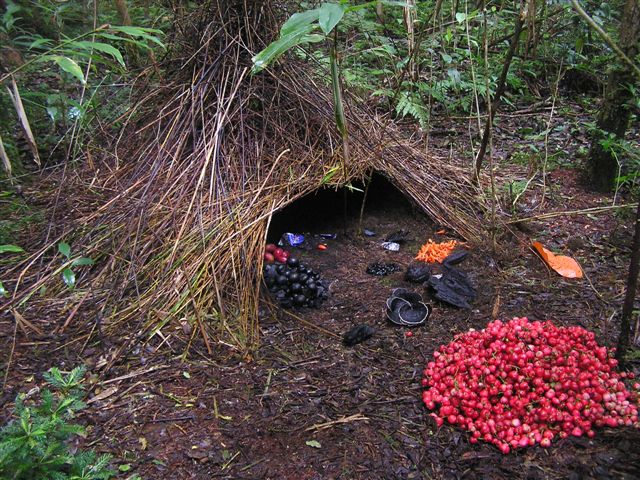
Little Huts in the Woods

This image came from here

This image came from here
Who do you think made these huts? Animal lovers who wanted to make a home for some birds? Nope. No human hands touched these huts. In the Bible, it is made clear that love is not an emotion, but rather an action (and the sentimental feeling we from someone we love is the result of real love). You can read an excellent passage about love in 1 Corinthians chapter 13. The aptly named Bowerbird seems to follow this love-as-action rule (even though birds don’t feel love like humans do). When the breeding season for bowerbirds comes around, males get really creative. While the male bowerbird doesn’t look like a very special bird, looks aren’t important when they want to attract a mate. Instead, they make a bower of love. Depending on the species, male bowerbirds will look around their forest home (in Australia and New Guinea) for certain materials to make a bower. Today we will focus on two species of bowerbirds: the Satin Bowerbird (pronounced sat-in) and the Vogelkop bowerbird (pronounced FOH-gull-kop). Both species are unique in their own ways. The Vogelkop bowerbird makes one of the most extravagant bowers. While the bower itself looks no different from its neighbors’, each bowerbird adds unique arrangements to their own bowerbird. Some go for a berry-style bower, others for flowers and leaves, and others for pebbles, shiny beetles or deer dung, and some like the trash we humans leave behind.

A Vogelkop Bowerbird observing a bower (this image came from this link)
Satin bowerbirds have a blue tint in their feathers; perhaps this is why they’re blue for the color blue. They will put a variety of objects in and surrounding the bower – as long as their blue! These items can consist of things in nature such as feathers or berries and on the not-so-natural side, plastic caps, paperclips and even car keys! (So if you ever go to Australia, be careful what you put on the ground!) And if that’s not enough, they will even mash up little plant bits and after mixing it with saliva, “paint” the newly made mixture on the walls of the inside of the bower! (Guys, don’t try this at home, human females don’t like a paint made in this way as much as bowerbird females do) Talk about DIY!

A male Satin Bowerbird

A female Satin Bowerbird
But in the end, it’s the female bowerbird that chooses which male she mates with. When a female comes by, a male will sing a little “love song” to his potential mate and if she likes the sound, she will come down and inspect the bower. If she likes the bower, she will mate with the hard-working male and if not, she flies off and continues the search. After mating, the female flies off to make a nest while the male revises his bower to hopefully suit the next female that passes by.

The Satin Bowerbird goes blue for blue! 
Birds-of-Paradise is a group of birds that are perhaps some of the strangest dancers in the bird world. Males and females are vastly different from each other – females are drab-colored and feathered while males have elaborate feathers and feather patterns. There are many species of Birds-of-Paradise and each species has many different dances they use to attract a mate. Take the Parotia, nicknamed the “six-plumed birds of paradise” because they have six quills on their heads. On the males, the ornamental plumage consists of the six head plumes with black oval-shaped tips, a black collar around the neck, decomposed feathers that can be spread out around the bird like a ballerina’s skirt. When they are in the mood for love, they will twirl around and around like a ballerina in an area where the bird has cleared of leaves. It might also hop from one foot or bob its head from side to side. Apparently, this funny dance gets the ladies attention.

The Six-Plumed Bird of Paradise likes to spin around like a ballerina to attract mates (this image came from here)

Birds of all shapes and sizes dance around to attract mates whenever their breeding seasons arrive. Evolutionists will tell you that these birds evolved another type of animal. Their ideas change as so-called new “evidence” is found, but for the moment, they believe that birds evolved from dinosaurs. Now, we have no evidence for feathered dinosaurs, so where on earth did birds get their beautiful courtship displays from? (The dinosaurs-to-bird idea is very extensive, so I’ll save this for another day) Evolutionists have no idea. Even Charles Darwin, the evolutionist of evolutionists said to Asa Gray that “. . . [the] sight of a feather in a peacock’s tail, whenever I gaze at it, makes me sick!” Evolutionists can’t tell us where on earth these amazingly designed birds evolved their displays from.

However, the Bible has the answer. In the first chapter of Genesis (Genesis 1:20-22), it says that God created birds on the fifth day of the week God used to create everything. Dinosaurs meanwhile were created on the sixth day of the Creation week along with the other land animals (Genesis 1:24-25). So the reason evolutionists can’t find what animal evolved into birds that would have given them their displays is because there isn’t such an animal. God created these birds just as we find them (not counting the natural selection that occurs within a “Genesis Kind”) only about 6,000 years ago. And what amazing birds God made!

Before I end my post today, I’d like to bring up a clip from a Discovery Channel television series that I have watched called Dinosaur Revolution. While true, dinosaurs didn’t evolve into birds millions of years ago (evolution and the belief in millions of years isn’t true in the first place!), it doesn’t rule out that dinosaurs didn’t have feathers. We just don’t have evidence for feathered dinosaurs! If dinosaurs had feathers, they could have used them to attract mates. So on this Valentine’s Day, lets watch a dramatic depiction of a male Gigantoraptor as he tries to win the heart of a female of the same species (I bet you’ve never seen a dinosaur dancing to Spanish-styled music!). Will she be impressed? Or will she ditch him for another male? Only one way to find out:


Well, that was an interesting video! I hope you liked it and I hope you enjoyed this brilliant post about birds and their attempts to woo the love(s) of their life. I can’t wait till next Thursday, when we’re explore another amazing wonder of our amazing planet! Bye for now!

PS: To post a comment (this is highly encouraged), please simply click the post you wish to comment on, scroll to the bottom of the page and put what you wish to say or ask in the comment box. Then in the box below the comment box choose who you’re going to comment as. And then click preview or publish. If you aren’t signed into Google, you’ll be asked to type in a word and a number in the space provided. Type the word, put a space and then put the number. Then your comment is on the blog!

PS 2: Have a puzzling question about animals (including dinosaurs), myself, my latest book, my stop-motion movies, Creation or etc? Please post your question as a comment or send me an email at animaladventures@aol.com.

PS 3: What’s the latest scoop? Check it out at SMILEY’S NEWS.

PS 4: Be sure to comment on the latest stop-motion movies too, this will help me improve them.

Thursday, February 7, 2013

Jurassic Park IV: The Comeback!


Welcome back everyone! Around here lately we’ve had lots of progression with many different things. For starters, as many of you might recall, we went over groundhogs last week so I thought it would be cool if I mention what Punxsutawney Phil’s latest prediction is. Will spring be coming soon, or will we have six more weeks of winter? On the 2nd of this month he predicted (drumroll please) . . . :


EARLY SPRING!!!
This little guy has a thing for style!
. . . of course, this is all just something fun to do. Because even Punxsutawney Phil can’t predict the weather (he’s only been right 39% of the time), this is something only God can do! To find out if winter is ending sooner or later, we shall have to wait and see what God has in store! Now let’s move onto some updates.

The Easter production, “The King on a Cross” is coming along! Last Thursday we had our very first rehearsal and for now at least, this is going to be the day we do the rehearsals. As the date of the production come closer, we might be doing two days a week. There are still quite a few parts that need to be filled:

  • Angels
  • Simon Peter
  • Roman Soldiers
  • Pilate
If you’d like to help with the production, please send an email to animaladventures@aol.com. And remember, if you don’t like acting, that’s ok too because we also need behind-the-scenes people. Lord willing, this will be best play we’ve ever completed (my family and I anyways. I have been in numerous plays before this one, but I had no part in writing or co-directing them like I do on this one). You know, my family has a verse we’ve memorized that we use whenever we do a play, or I’m writing a book, when I’m doing chores (or I should be when I’m doing chores) or whatever. That verse is Colossians 3:23: “In whatever ye do, do it heartily as unto the Lord and not unto Men.” This sums up everything we should do in life pretty well.

This past week, I have been working on the third episode of my latest stop-motion series: Planet of the Dinosaurs. As you might recall, the third episode is entitled, “Back to the Jurassic”. I’d say it’s about 30% finished, meanwhile the episode as a whole is about 19% finished. In my spare time (the time when I’m not working on a book, doing school, chores, playing with Halle and etc.) I have completed a little demo clip for you to watch. This clip is taken from the second episode of my series: “The Tropical Poles”. I think it is quite enjoyable. So please sit back and be transported 4,900 years into the past, back to prehistoric Antarctica, which wasn’t so cold that long ago:


What did you think of my British-sounding accent? Do you think it would fit this documentary? Do you think I should just use my normal-sounding voice like I did in the previous series I made: “Animal Face-Off”? Please take the polls I have provided on the right side of the page or post a comment or send me an email (or do all three) to voice your opinion!

What is your favorite movie series? For some it would be Star Wars, or Lord of the Rings or Star Trek. For me it has always been the Jurassic Park trilogy (of course, that’s just one of my favorite movie series, I have lots of others. . .). But you know what’s really cool? Universal Pictures has recently decided to make a fourth film! A lot of people have seen Jurassic Park, The Lost World: Jurassic Park (JPII) and Jurassic Park III, but I think it’s safe to say that most people couldn’t tell you what a fraction of what the story is about. The story of Jurassic Park goes much, much deeper than what most people know about (excluding Jurassic Park fans such as myself, of course). And the story might continue with a fourth movie, but we’ll get to that later. First, I’ll reveal the overall plot of this franchise in a few paragraphs

The plot of Jurassic Park starts in the 1980’s when InGen (a fictional company that works with biogenetics) figured out how to clone dinosaurs using DNA found in mosquitos that had once sucked dinosaur blood and ended up getting stuck in fossilized tree sap, called amber. Using sophisticated techniques, they created dozens of these reptiles and made a kind of prehistoric zoo called Jurassic Park which is located on Isla Nublar.
Isla Nublar, for a guide to this island, visit this link
After a few incidents, the park’s safety was put in question, the CEO of InGen, John Hammond invited Dr. Ian Malcolm, a hilarious mathematician (actually, his area of study is the “chaos theory”), Dr. Alan Grant, a paleontologist and Dr. Ellie Sattler, a paleobotanist (a scientist who studies ancient plants) because the park’s investors wanted opinions of people outside InGen. Hammond also brings his grandchildren, computer-nerd Alexis “Lex” Murphy and dino-enthusiast Tim Murphy along for the weekend. Unfortunately, this is when a Jurassic Park employee, Denis Nedry agrees to smuggle dinosaur embryos out of the park by putting them in a phony canister of Barbasol shaving cream and sell them to a rival company called BioSyn. To do this, he must turn the park’s power off so he can sneak past the security systems, sell the embryos and get back and turn the power back on without anyone notices anything. But this isn’t how the plan works out because Denis becomes food for an inquisitive Dilophosaurus and the canister is lost. Before you know it, the dinosaurs escape and the remaining people must try to survive against T. rex and packs of Velociraptors.

The ferocious Dilophosaurus in Jurassic Park has a potent venom that can be shot at its enemies from as far as 20 feet away! (The real one didn't really have venom)
Rexy, the awesome Tyrannosaurus rex has escaped!
In Jurassic Park, occasionally the Triceratops will get sick.
I don’t wish to give away the ending, so I’ll skip that part. What a lot of people think is that after the events of the first movie, the second movie comes next. Normally, this is true, but in 2011, TellTale made a game that bridges the gap between the first and second movie called Jurassic Park: TheGame. This video game takes place during and just after the events of the first movie. The game starts off when Gerry Harding, a veterinarian at Jurassic Park brings his 14-year old daughter, Jessica “Jess” Harding for the weekend. Meanwhile, when Nedry isn’t able to smuggle the embryos, two backups named Miles Chadwick and Nima Cruz try to get it back. They manage to find it, but are attacked by a voracious pack of venomous Dilophosaurus and Nima is wounded by an unknown dinosaur with yellow-glowing eyes. When the power goes out, an unconscious Nima, Jess and Gerry must struggle to survive a T. rex encounter as night drags on. They seem trapped in the park until a scientist at Jurassic Park, Dr. Laura Sorkin brings them back using an electric-powered Jeep. Things go on without a hitch until the survivors of the movie leave in the helicopter and the survivors from the game are trapped on an island full of carnivorous dinosaurs. I could blabber on and on about this game, but I’ll save that for a later article.

Now we’re to the second movie in 1997, four years after the events on Isla Nublar, Ian Malcolm is called by John Hammond to help him save another island, Isla Sorna, where the dinosaurs were actually cloned (Isla Nublar was just a tourist attraction, Isla Sorna was where the real research took place). InGen has been taken away from Hammond and was given to his money-worshiping nephew named Peter Ludlow. InGen has been on the verge of Chapter 11 ever since the incident on Nublar and to save the company, Ludlow has decided to take dinosaurs from Sorna and make a new Jurassic Park in San Diego. Ian, his girlfriend, Dr. Sarah Harding (Gerry’s other daughter and Jess’ older sister), Nick Van Owen, a nature photographer, Eddie Carr, a mechanic-guy and Ian’s daughter from a failed marriage, Kelly Malcolm venture to Sorna and try to save the dinosaurs from InGen. Unfortunately, both Ian’s group and InGen become trapped on Sorna and must come together to find a way off while avoiding dangerous raptors and a pair of Tyrannosaurus rex. For the sake of spoilers, I’ll skip going into detail.

A picturesque view of some of the dinosaur life on Isla Sorna including T. rex (left), Stegosaurus (right) and Pteranodon (upper right)
We have finally reached the events of the third movie. It is now 2001 and Alan Grant and his assistant Billy are longing for a new dig site, but they lack the funding. Their prayers seem to be answered when a rich couple (Amanda and Paul Kirby) offer to give them money as long as Alan and Billy will act as tour guides on their for their wedding anniversary – an aerial flight over Isla Sorna. However the Kirby’s make the fatal mistake of landing on Sorna, despite Alan’s warnings not to (he remembers all too well what happened in the Isla Nublar Incident) and they become stranded. As if this weren’t bad enough, the Kirby’s then reveal they aren’t as rich as they claimed to be and are actually a divorced couple (so Alan still can’t get the money!). The Kirby’s actually lured Alan to the island to help them search for their lost son, Eric. But worst of all perhaps, is that they are going to be exposed to a whole new cast of dinosaurs!

Spinosaurus, one of the new carnivores of Jurassic Park III
Velociraptor male (right) and female (left) from the third movie
We have finally reached the end of the Jurassic Park story. After JPIII, naturally some JP fans would be excited about the release of JPIV. This movie was at first due to be released in 2005, but for some unknown reasons, this didn’t happen. So the series had a brief pause from about 2005-2008 and then finally Universal Pictures showed interest in making the fourth movie. The reason for this delay was that the movie makers couldn’t think of a good story. Then in 2009 they started going through scripts again, and again, and again. This went on until 2011 when they finally thought they have a good story, different from all the other movies in the series. In 2012, Frank Marshall (one of the people working on the series) said that this film was likely to come out really soon. Keeping us fans on the edge of our seats, the next big thing for Jurassic Park came on January 11, 2013 when finally, after 11 years of waiting, Universal Pictures has declared that the movie’s due date – June 13, 2014. Oh boy! It’s about time!

I haven’t been able to track down anything on the plot of the new film, but just to show how tales spread so fast, some rumor has been going around for a few years that the plot would involve animals that were half-dinosaur/half-human and would be able to carry weapons and shoot stuff. Boy, I was hoping that this wouldn’t be the plot! Because a plot like that isn’t even Jurassic Park, that’s called “Star-assic Park Wars”! Fortunately, Universal  declared this a myth. 

Dino-men were rumored to be in Jurassic Park IV! Fortunately this  was disproved by Universal Pictures!
So what will Jurassic Park behold? What new cast of dinosaurs will be unfurled? Only time will tell. You can be sure that I’ll keep you posted! I hope you enjoyed this unique post; stop by next week for some another really good read and updates on the stuff going on around here. Bye for now!


PS: To post a comment (this is highly encouraged), please simply click the post you wish to comment on, scroll to the bottom of the page and put what you wish to say or ask in the comment box. Then in the box below the comment box choose who you’re going to comment as. And then click preview or publish. If you aren’t signed into Google, you’ll be asked to type in a word and a number in the space provided. Type the word, put a space and then put the number. Then your comment is on the blog!

PS 2: Have a puzzling question about animals (including dinosaurs), myself, my latest book, my stop-motion movies, Creation or etc? Please post your question as a comment or send me an email at animaladventures@aol.com.

PS 3: What’s the latest scoop? Check it out at SMILEY’S NEWS.

PS 4: Be sure to comment on the latest stop-motion movies too, this will help me improve them.

PS 5: Please help us expand EXPLORATION BOOKS PEDIA. It’s F-R-E-E!

Thursday, January 31, 2013

How Much Wood Could a Woodchuck Chuck . . .?


Wow! Today is the last day of the “new” year. A lot has happened this past week as well! I’ll tell you all about it!

For starters, the play I wrote called “The King on a Cross” is coming along great. We’ve got lots of major parts filled. The parts we have filled are all filled by people from our church (Leptondale Bible Church): Zoey, Kim, Mary the Mother of Jesus and a few members of the crowd and other possible roles are filled as well. However, we are still missing quite a few people to act and help with behind the scenes stuff, so if you’d like to either be in or help with the production, please send an email to animaladventures@aol.com. We could use your help!

“Planet of the Dinosaurs” (the stop-motion series I am working on) is coming along great! All the photo-taking for the second episode: “The Tropical Poles” is complete. I should have a “demo” clip from this episode for you to view real soon! This means that the series as a whole is roughly 17% finished. I have started taking pictures for the third episode of the series (“Back to the Jurassic”) as of last Monday. I actually almost forgot that I had completed a demo clip for the first episode, “Out of Africa”. Simply click the video below to be transported to northern Africa, 4,900 years into the past:
You might recall that I said this series might be ready for viewing by March, but I am now thinking a more realistic release date would be in early April. Lord-willing, this series is going to be great!

For many of us, winter can’t end soon enough! A lot of us are tired of shoveling, clearing driveways and bundling up to face the chill. Soon it will be springtime and all this will change. But how soon is the question. How soon will it be until winter loosens its icy grip? This is when some people call upon Punxsutawney Phil, a famous groundhog who on February 2nd (aka Groundhog Day), is supposedly able to tell if winter is ending soon or if we’ll have six more weeks of winter. We all know how it works: if Punxsutawney Phil sees his shadow, it means that there will be six more weeks of winter, but if he doesn’t see his shadow, it means spring is on its way! So we’ll have to wait two more days to see when winter ends!

Punxsutawney Phil on Groundhog day
Alright, all superstitions aside! Punxsutawney Phil can’t really tell when winter is ending (only God can do that!). Did you know that according the StormFax Weather Almanac, Phil has predicted correctly 39% of the time? But even still, Phil and his rodent cousins really are an amazing group of animals. So I’d say with Groundhog Day being only two days away, now would be the perfect time to look at these chubby little rodents God has made.

A groundhog eating
Needless to say, Punxsutawney Phil is a Marmota monax, aka, the groundhog. These furry mammals belong to a group of large ground squirrels known as marmots. Other names for the groundhog include woodchuck and whistle-pig. The groundhog can be found anywhere between northern Alaska and Georgia, talk about a wide range! These rodents normally grow up to 26 inches long and can weigh 9 pounds, however, in areas rich with alfalfa and few predators, groundhogs can reach 30 inches long and weigh 31lbs! Predators that like to eat groundhogs for dinner include coyotes, wolves, dogs, foxes, bobcats, bears, and large hawks. Snakes can also pose a problem for young groundhogs.

The range of the groundhog
Despite being ground squirrels, groundhogs don’t store food underground like tree squirrels (you can learn more about these guys by going to THIS ENTRY). Instead, they just eat while the going is good. Their diet consists of anything from berries, grasses, nuts, and agricultural crops (this is why farmers hate these cute little guys), but did you know these animals are omnivorous? They also will eat grubs, snails, insects such as grasshoppers and other small animals.

When my family and I were living in one of our previous houses, we had a family of groundhogs living in our yard. It was great fun watching them! If my memory serves correct, we had a family of six – two parents and four babies. Unlike many other mammals, father groundhogs stick around after mating (many mammals mate and move on); however, just before the babies are born, he skedaddles! The breeding season for these rodents is from March to April at the latest and babies are born in April or May. A mother groundhog has one litter and year and the babies are born blind, hairless and helpless. After the babies are born, the mother feeds them with milk – mammals are the only animals God created to produce milk to feed their newborns (however, some male birds such as emperor penguins and pigeons produce a milk-like substance to feed the chicks).

Four baby groundhogs coming out of their burrow. They are SO CUTE!!!
Groundhogs are diurnal and very alert when feeding. I remember that when the mother and baby groundhogs were out feeding, the mother would keep a close vigil on her surroundings to make sure that there were no predators around. And if we ever made a sound while watching them, they would freeze until they felt it was safe to presume feeding. However, if they saw us come outside, the little creatures dashed into their burrow! When danger is nearby, a groundhog will make a whistle-like sound to warn other groundhogs. Hence their nickname: “whistle-hog”! Despite their hefty body-build, groundhogs are great swimmers and climbers and will sometimes climb a tree or take to the water to escape danger or if they want to check out their surroundings.

A groundhog looking out for danger
When the weather starts to turn nippy, groundhogs and humans know one thing is certain – winter is coming! While many animals go into a period that a lot of people call hibernation, groundhogs are one of the few animals that enter true hibernation (bears for instance don’t go into true hibernation and will wake up in the middle of winter if there is a warm snap). After crawling into the deepest part of the burrow, the groundhog falls into a deep sleep. But this is no ordinary sleep. God created these animals to deal with the winter chill! First of all, their body temperature drops to 39 or 40° F, not much warmer than the temperature outside the burrow! But groundhogs are insulated with a layer of fat that it stored up just before hibernating. Secondly, the groundhog will slow its metabolic rate to save energy. While hibernating, groundhogs live off the fat reserves they built up before winter started. When the groundhog emerges in springtime, they are needless to say, much thinner than when they went in! Another cool feature the groundhog has is the ability to make its heart rate drop . . . a lot! When I say a lot, I do mean a lot – as much as four to five beats a minute! You know what really puzzles scientists? How a groundhog can remain living and unharmed despite the heartbeat being so slow. Some theorize that the rodents somehow store large amounts of ascorbic acid and other antioxidants so that their brains aren’t damaged. Cool, huh?

A groundhog gathering plant matter for its burrow
Another mystery about the groundhog that makes scientists scratch their scalps is how they know when it is time to awake from hibernation. Some believe that the gradually increasing amount of sunlight somehow affect the groundhog’s internal clock and changes the production of melatonin, a hormone that helps it to sleep. But still, scientists don’t know! God really instilled some amazing stuff into the groundhog!

I bet you never knew that these chubby little rodents could be so amazing! But indeed, they are beautifully designed to not only survive but thrive in the environments in which they’re living. Groundhogs can even teach us something about ourselves. While we humans may not be good hibernators as groundhogs, or as strong as elephants, or as good swimmers as fish, we are still very unique creations. Why? Well, we are made in God’s image! No other living thing on the planet can declare that! And God even among ourselves we are unique – we have different likes, dislikes, hair, skin color, eye color, interests and etc. This reminds me of a very popular passage in scripture: Psalm 139:14. It says: “I praise You for I am fearfully and wonderfully made; your works are wonderful, I know that full well.” A relevant piece of scripture that describes each and every one of us!

I bet you've never seen albino groundhogs, have you?
What an amazing adventure we went through today! Who knew the chubby, little groundhog could be such a wonderful creature? Be sure to come back next Thursday and we can learn more about the amazing world God created for us to enjoy. But before you go, I’d like to ask a question: How much wood could a woodchuck chuck if a woodchuck could chuck wood?

PS: Not many people know the answer to the “woodchuck riddle”. But I’ve managed to finally track it down. Here it is: “A woodchuck would chuck all the wood he could if a woodchuck could chuck wood!”

PS 2: To post a comment (this is highly encouraged), please simply click the post you wish to comment on, scroll to the bottom of the page and put what you wish to say or ask in the comment box. Then in the box below the comment box choose who you’re going to comment as. And then click preview or publish. If you aren’t signed into Google, you’ll be asked to type in a word and a number in the space provided. Type the word, put a space and then put the number. Then your comment is on the blog!

PS 3: Have a puzzling question about animals (including dinosaurs), myself, my latest book, my stop-motion movies, Creation or etc? Please post your question as a comment or send me an email at animaladventures@aol.com.

PS 4: What’s the latest scoop? Check it out at SMILEY’S NEWS.

PS 5: Be sure to comment on the latest stop-motion movies too, this will help me improve them.

PS 6: Please help us expand EXPLORATION BOOKS PEDIA. It’s F-R-E-E!

Thursday, January 24, 2013

Metriorhynchids - the Terrible Marine Crocs!


Howdy folks! I hope your week was enjoyable. A lot of preparation stuff has been going on in the past few weeks. So as usual, updates come first!

The play I’ve been talking about, “The King on a Cross” is in what I like to call, the pre-production stage. The casting call for this play that I wrote will be taking place tomorrow night! That’s the 25th of this month! I’ve been anxiously awaiting this night. Even though it’s the day of, that doesn’t mean it’s too late for you to participate if you’re interested in acting. If you’re NOT interesting in acting, but would like to help in some other way, we’d be glad to have you! For need-to-know information, please send me an email to animaladventures@aol.com!

For those of you who are interested in my upcoming stop-motion series, “Planet of the Dinosaurs,” you would be delighted to know that things are coming along great! The series as a whole is about 15% finished. I am completely finished taking pictures for the first of six episodes, entitled “Out of Africa”. Right at this moment I’m about 35% finished with the second episode. This second episode had a title change – instead of the original title: “The Tropical Polar Regions”, I shortened it to: “The Tropical Poles” since that’s less of a mouthful. I hope to be completely finished taking pictures for this episode by the 28th of January 2013. As I have said before, this series should (Lord willing) be released during springtime at the rate I’m going. I can’t wait!

Speaking of prehistoric creatures, crocodiles look VERY prehistoric! Members of the crocodilian family have been found in many of the ancient fossil layers that were deposited during Noah’s Flood, about 4,300 years ago. Fossil crocodiles first appear in the Triassic layer (I am not referring to the fictional time periods that evolutionists use to refer to the times that layers in the rock were laid down, I am referring to the name of the layer itself). Crocodiles are some of the most formidable predators. Today, they are found in a variety of wet habitats and the largest of them, the saltwater crocodile, can grow 20 feet in length. Back in the day though, did you know that crocodiles could grow over 40 feet long?!? They also didn’t only live in rivers, lakes, estuaries and ponds (and in the case of the saltwater croc) with occasional trips into the sea. There was once were species of crocodile that made their homes in the sea. Introducing: the Metriorhynchids (Met-ree-oh-rin-kids)!
Metriorhynchus, a marine crocodile
Metriorhynchids are a group of marine crocodiles that lived in the ocean. While there are different species of these guys that used to swim through the sea, the three-meter long Metriorhynchus is the most famous (even though when you ask most people to describe a metriorhynchid, they’ll respond by saying, “Metra-what-a?”). These were some of the strangest crocodiles that God had ever assembled! First of all, instead of the flat, paddle-like tails of modern crocs, God gave the metriorhynchids a shark-like tail and flippers on their limbs that helped them to effortlessly glide gracefully through the water.
Tyrannoneustes, a recently discovered metriorhynchid  (This image came from this link)
This month, a new species of metriorhynchid was discovered. It is called Tyrannoneustes. This predator and its relative, metriorhynchus both probably lived in the ancient seas surrounding what would become Europe. The pre-flood oceans were a dangerous place to be, even for a marine crocodile. Most crocs have armor, but marine crocodiles lack armor so that they are quicker in the water. This is a good thing, because these seas were filled with monsters. One good example would be the large predatory reptile called Liopleurodon. This 7-meter carnivore had a ten-foot jaw with 13-inch teeth! No wonder metriorhynchids had to be fast! The reason why many of the predators in these European seas were so large, was probably because the prey was large! Take Leedsichthys for example. Here is a fish that grew 50, 70, perhaps even up to 90 feet in length (fortunately, it only ate plankton)!

Metriorhynchids also had a maw full of sharp teeth. Being a crocodile, it probably would have eaten a lot of fish and maybe scavenged from other carnivores’ kills (a dying or dead Leedsichthys would have provided food for weeks, if not months).

The metriorhynchids were an amazing group of crocodiles God created. But evidently, sometime after the Flood, these creatures became extinct, leaving only their bones and their living crocodile relations to tell us that they ever existed.

You probably learned a lot of new stuff today. (I mean, who’s ever heard of a metriorhynchid besides me anyways?) But that also can lead us to another question: what other strange creatures are waiting underground for someone to find it? Maybe someone like you! Who knows? I hope you found today’s reading informative. Be sure to stop by next Thursday to see what I’ll have in store for you next time. Bye!


PS: To post a comment (this is highly encouraged), please simply click the post you wish to comment on, scroll to the bottom of the page and put what you wish to say or ask in the comment box. Then in the box below the comment box choose who you’re going to comment as. And then click preview or publish. If you aren’t signed into Google, you’ll be asked to type in a word and a number in the space provided. Type the word, put a space and then put the number. Then your comment is on the blog!

PS 2: Have a puzzling question about animals (including dinosaurs), myself, my latest book, my stop-motion movies, Creation or etc? Please post your question as a comment or send me an email at animaladventures@aol.com.

PS 3: What’s the latest scoop? Check it out at SMILEY’S NEWS.

PS 4: Be sure to comment on the latest stop-motion movies too, this will help me improve them.
PS 5: Please help us expand EXPLORATIONBOOKS PEDIA. It’s F-R-E-E!

Thursday, January 17, 2013

A Christmas Make-Over


Welcome back everyone! Boy time is flying, it’s already the 17th day in the “New” Year. As usual, let’s start with a few updates.

The casting call for the play I wrote called “The King on a Cross” is still scheduled for the 25th of this month. If are interested in either acting or helping with the behind-the-scenes stuff, please send an email to animaladventures@aol.com to receive need-to-know information.

Christmas came, and now it’s gone. And it’s coming back! You know what’s interesting? When you ask a lot of people what Christmas is all about, many people including non-Christians could say something like: “Jesus Christ is the reason for the season!” And this is very, very true, as Christmas is Jesus’ birthday. But that leads us to a very personal question: “What do we do for Jesus’ birthday?” (If it seems a little weird that I’m talking about Christmas 11 months before December, just hang tight, because you’ll see why in a minute) If we were honest, most of us would probably say that we’re either visiting family members and/or giving gifts. But what do we do for Jesus HIMSELF for His birthday?

Christmas is Jesus’ birthday, but if we were honest, many of us would say that we don’t really do much for Jesus on His birthday. Now technically, we don’t know the exact date Jesus was born on, but we celebrate it on December 25th. So why don’t we really do anything special for His birthday? Perhaps it’s because we’re too focused on ourselves and each other!

While the giving of gifts to each other is not bad in and of itself, we really should be focused on the One who’s birthday it is. This may seem weird to some, but let’s make this a little more applicable – say your birthday falls on May 1st, the same as celebrity Jamie Brinton. Now, let’s just say that instead of celebrating your birthday, you celebrate Jamie’s birthday and yet you hardly know the guy (and that’s saying something because a celebrity by the name of Jamie Brinton doesn’t exist, but you get the picture, right?)! That wouldn’t feel very good for you, would it? Well, this is sort of what we do with Jesus. We do stuff for each other, but not for the “Birthday Boy”.

The reason why I brought this up so early before Christmas, was so I could challenge everyone to do something different. For some people, making a change like the one I am about to suggest could take weeks, if not months to get mentally ready for it. This Christmas and the Christmases to follow, let’s use the day to actual put Jesus as the center of attention at His birthday! Instead of giving gifts on Christmas, give gifts on another day (so kids, be sure to tell Santa Claus nice and early so that he knows when to come by your house!). My family has decided to dedicate this day to the Lord. Now will you join us?


I also have another huge update today: I have started work on my latest stop-motion movie series: “Planet of the Dinosaurs”. Now there are going to be six episodes in this series. So as for the whole project, I’d say I’m about 9% finished. Doesn’t sound like a lot, huh? But as I said, that’s for the whole project. The first episode is about 50% or so along. What are the episodes I intend for this series? Well here they are:
  1. Out of Africa
  2. The Tropical Polar Regions
  3. Back to the Jurassic
  4. Asian Marvels
  5. The Life of a Tyrant Lizard King
  6. Death of the Dinosaurs


As you might have guessed, I’m working on the first episode right now. I’m hoping this series is going to be just as good, if not better, than my previous Animal Face-Off series. You might be asking what this series is all about? Well, I feel the introduction to the series sums it up pretty well. Here is the introduction I wrote for the series:

We are living in a golden age of dinosaur discoveries. Every year, from every corner of the globe, new fossil finds reveal a brand new species of dinosaur and brings quantum leaps in our knowledge of how and where these legendary monsters lived and died. From the Arctic to the great wetlands of Northern Africa and down to the South Pole, from the plains of South America to the forests ancient Asia, we will be exploring the different worlds of the dinosaurs. From the tallest giants, to the deadliest of killers, to the weird and wonderful, this series will examine some of the most amazing dino-discoveries of the past four decades, some of which have never been visualized before. This way, we can step back in time on a prehistoric safari . . .

As this introduction suggests, this series will be like a prehistoric safari. Each episode will focus on an environment in which the dinosaurs lived in thousands of years ago. Also in each episode, there is a story that is taking place featuring a wide cast of prehistoric critters, from 78-ton sauropods, to ferocious killer raptors and tyrannosaurs to 10-ton crocodiles that were large enough to take down dinosaurs! The stories in the series will also be partly inspired by real fossil finds. This series will have it all!

Some of you might be wondering what the inspiration is behind this series. Well, there along with my imagination and the latest fossil discoveries, I will also be getting inspiration from three dinosaur programs that have appeared in the past. I really enjoy these programs (minus the evolutionary dogma which my series will NOT have). The previews for each of the programs have been provided below so you can get a pretty good idea of what this series is about:


As I have said earlier, the series will probably be completely finished in the spring time (Lord-willing). But that doesn’t mean that there won’t be anything else to watch while you are waiting. In fact, as I am working on these upcoming stop-motion films, I plan to show clips from the series. So all in all, the series is coming along great so far! I can’t wait to release it!

Thank you all for stopping by today. Remember, all of what you might have just learned is a lot to grasp, so if you don’t understand something, feel free to send me a question to animaladventures@aol.com. See you next week!

PS: To post a comment (this is highly encouraged), please simply click the post you wish to comment on, scroll to the bottom of the page and put what you wish to say or ask in the comment box. Then in the box below the comment box choose who you’re going to comment as. And then click preview or publish. If you aren’t signed into Google, you’ll be asked to type in a word and a number in the space provided. Type the word, put a space and then put the number. Then your comment is on the blog!

PS 2: Have a puzzling question about animals (including dinosaurs), myself, my latest book, my stop-motion movies, Creation or etc? Please post your question as a comment or send me an email at animaladventures@aol.com.

PS 3: What’s the latest scoop? Check it out at SMILEY’S NEWS.

PS 4: Be sure to comment on the latest stop-motion movies too, this will help me improve them.

PS 5: Please help us expand EXPLORATION BOOKS PEDIA. It’s F-R-E-E!

Thursday, January 10, 2013

R.I.P. Pygmy Right Whales . . . Or So We Thought . . .

Happy New Year once again everybody! 2013 is (hopefully) going to be an exciting year full of lots of cool stuff! First, I’ll start with some of the “regular” updates.

I have big news about the play I wrote, called “The King on a Cross.” Last Monday, it was confirmed that . . . the play has finally received the go-ahead! This means that casting call for the production will begin very soon! How soon? Well, we aren’t yet sure, but the date is possibly the 25th of this month. Now we will have to keep praying for a good outcome for this casting call. I still remember the last one we had for the Christmas play I wrote. No one came and I spent the whole time waiting on that uncomfortable church pew waiting for someone to show up . . . but that’s getting off topic! Besides, this is a new year, so let’s stay on the positive side. I will keep you posted on the latest news regarding this production. If you are interested in being in this play, PLEASE be sure to send me an email to animaladventures@aol.com. If you’d like to help with the play but aren’t into acting, there’s still a lot for you to do so you can also send me an email to the address above.

Near the bottom of the world, a species of baleen whale that used to live in the ocean. This whale is called Caperea marginata, a.k.a. the pygmy right whale. The species was discovered by a naturalist named James Clark Ross on a voyage during 1839-1843. The fossils resembled a smaller form of the right whale – a cetacean still found swimming in the oceans today. Despite its name, the pygmy right whale actually not closely related to the right whales, instead, scientists believe it to be closer related to the bowhead whales. Secular scientist were sure that these whales died out around 2 million years ago. So that makes a new question: what are pygmy right whales doing swimming in the oceans of the 21st century?!?
Pygmy Right Whale
Late last year, scientists found several of these whales swimming in the oceans surrounding Chile, Namibia, South Africa, Tierra del Fuego, Australia and New Zealand. You can bet that scientists were shocked to find that a whale that was thought to have been extinct for 2 million years was rediscovered alive and well! The pygmy right whale is different from all other whales in many ways. For instance, it has an arched frown-like snout, as you can see in the photo above. No other whale has snout like that! These whales grow about 21 feet long when adults and they live out on the open ocean. The fact that they rarely ever come to shore, is a large part of the reason why this whale hasn’t been rediscovered till recently. Like other baleen whales, they lack actual teeth. Instead, their mouths are filled with baleen – long bristly structures that are used to strain little plankton and krill from the water.
Size comparison of a Pygmy Right Whale and a human
One of the scientists studying this newly rediscovered species is Dr. Felix Marx, a paleontologist at the University of Otago in New Zealand (not all paleontologists are dinosaur scientists). “The living pygmy right whale is, if you like, a remnant, almost like a living fossil,” says Dr. Felix. “It’s the last survivor of quite an ancient lineage that until now no one thought was around.” DNA examination tells us that these whales are indeed related to modern baleen whales, but when did the pygmy right whales separate from other baleen whales? Well, most secular scientists will tell you that these whales separated from other baleen whales 17-25 million years ago. But this view is based on looking at the evidence from a Secular worldview. This view is based on the “fact” that the world is millions of years old and that new animal species come into existence by evolving. Now, by looking at the world through a Biblical worldview, we learn that these whales couldn’t have evolved millions of years ago because the world is only about 6,000 years old!

The first whales were created on the fifth day of Creation with all the other flying and swimming creatures just as the Bible tells us. When first created, probably only one basic “species” of baleen whale existed. Sometime after Man’s Fall, the baleen whale “species” changed into many different species due to a process of natural selection, which is very different from evolution (click on the word “natural selection” to learn more). You see, the very first baleen whales were created with all of the genes for the species of whales we see today. When you look at things through a Biblical world-view, everything fits together like a puzzle piece! Even this rediscovered species of strange whale!

Even though the "Animal Face-Off" series I made is finished, that doesn't mean there won't be more videos relating to the series. I decided to make this little tribute to the series for you all to enjoy. I hope you all like it! (PLEASE DON'T WATCH THIS TRIBUTE UNLESS YOU'VE SEEN THE OTHER VIDEOS IN THIS SERIES, UNLESS YOU DON'T CARE ABOUT SPOILERS!!! CLICK THE THIS LINK TO SEE THE OTHER VIDEOS) Please enjoy:


I hope you enjoyed this special tribute to the series! How did YOU like it? Please write your comments using the instructions provided in the PS's below.

We've reached the end of this post. If you're like me, you learned a lot today! Even if you're not like me you probably learned a lot! Be sure to stop by next week so together, we can learn more about the amazing world God made for us to enjoy. Bye for now!

PS: To post a comment (this is highly encouraged), please simply click the post you wish to comment on, scroll to the bottom of the page and put what you wish to say or ask in the comment box. Then in the box below the comment box choose who you’re going to comment as. And then click preview or publish. If you aren’t signed into Google, you’ll be asked to type in a word and a number in the space provided. Type the word, put a space and then put the number. Then your comment is on the blog!

PS 2: Have a puzzling question about animals (including dinosaurs), myself, my latest book, my stop-motion movies, Creation or etc? Please post your question as a comment or send me an email at animaladventures@aol.com.

PS 3: What’s the latest scoop? Check it out at SMILEY’S NEWS.

PS 4: Be sure to comment on the latest stop-motion movies too, this will help me improve them.

PS 5: Please help us expand EXPLORATION BOOKS PEDIA. It’s F-R-E-E!

Thursday, January 3, 2013

Battle as Kruger

Happy New Year everyone! I hope you guys had a good time. I sure did. So as usual, let’s get started with some updates.

Nope, we are still not sure when we are doing the Easter play, “The King on a Cross” yet. I’ll let you know when. If you would like to know more about it, please send an email to animaladventures@aol.com.

I officially decided that today I would devote this post to the very video that inspired the last episode in my “Animal Face-Off” series: “Battle at Kruger.” So as you might recall from watching the last face-off (if you didn’t see it, please see the video page), instead of just two animal species facing-off, three species are facing-off! How is this possible? Well, while most of the face-offs in the series are pure speculation of what might happen if the animals fought, “Battle at Kruger” was actually filmed! So we know exactly what would happen if these animals got together!

It all started back in 2004 when David Budzinski was in Kruger National Park in Africa taking film footage while his safari vehicle was at a river. A herd of buffalo approached the river for a drink while a pride of lions was resting in the shade. The lions apparently got hungry and . . . well, I don’t want to spoil the face-off! So I won’t go any farther!

Now, let’s learn a bit about each animal before the face-off. (To read about the lion, please go to THEBLOOD-THIRSTY LION? entry) The term “buffalo” is used for a large bovid living in North America. But this is incorrectly speaking because scientists prefer to call that species the “bison”. They feel that the term “buffalo” really belongs to specific creatures living in Africa and Asia. Today, we will be watching African Cape Buffalo on the face-off, one of the most numerous animals in Africa. They often are found in herds numbering in their hundreds. These large mammals are some of the most dangerous animals in Africa (after the hippo).

African Buffalo
Nile Crocodiles are one of the largest members of the crocodilian family. The only crocs that get larger are Saltwater Crocodiles, found primarily in Australia. With the largest males reaching almost 20 feet in length, they also have the strongest bite force of any creature ever measured, at over 5,000 pounds per square inch! That’s almost as much as T. rex had! They have a row of sharp conical-shaped teeth in their mouths. While they are great for puncturing and grabbing prey, they aren’t so great at chewing. Crocodiles can’t chew at all! So how do they break meat into bite-size pieces? Well, they have a little trick – they simply grab hold of the meat and flick their heads. That, combined with the weight of the meat, tears it off. But what about pieces to big to pick up and flick? That is when the crocodile will use a trick called the “Death Roll”. This is when the croc grabs hold of the prey and rolls around and around until a piece is torn off. Sometimes, two or more crocodiles will hold the food in place as another croc does a Death Roll. Teamwork rocks! Despite the name, Nile Crocodiles don’t only live in the Nile River, they are found in many other East African rivers, lakes and ponds. This is why it isn’t always a good idea to swim in murky African waters!

Gustav, one of the largest Nile Crocodiles ever seen in the wild
Now that we’ve learned a thing or two about each animal, it is time to view the grand finale of “Animal Face-Off”! Let’s go:


That was very interesting! I hope you enjoyed this video, and as a matter of fact this whole series, as much as I did making it! (Please, post your comments on this video!) So you might be asking yourself, “What next?” Well, why stop here? I have tons of other wonderful stop-motion movies planned. As you’ll recall from a few weeks ago, my next one is “Planet of the Dinosaurs”. While working on the “Animal Face-Off” series, I was also scripting “Planet of the Dinosaurs”. So now it’s almost ready to begin the production, or “filming” stage. This series is a little bit bigger than the face-off one, so naturally it will probably take it longer to make. Lord-willing, I should have it done by . . . perhaps March. I’m not exactly sure how long it’s going to take, because I really have never done a project like this before. But having it done by March is a pretty good estimate.

Don’t worry though, while working on “Planet of the Dinosaurs”, I also plan to work on a few short stop-motion movies so that while you’re waiting on the series to be released, you will still have something to watch.

Well, thanks for stopping by today! Please come back next week where I’ll reveal a little more information on “Planet of the Dinosaurs” and we’ll also learn some more about the amazing natural wonders God has made for us to enjoy. HAPPY NEW YEAR EVERYBODY!!!


PS: To post a comment (this is highly encouraged), please simply click the post you wish to comment on, scroll to the bottom of the page and put what you wish to say or ask in the comment box. Then in the box below the comment box choose who you’re going to comment as. And then click preview or publish. If you aren’t signed into Google, you’ll be asked to type in a word and a number in the space provided. Type the word, put a space and then put the number. Then your comment is on the blog!

PS 2: Have a puzzling question about animals (including dinosaurs), myself, my latest book, my stop-motion movies, Creation or etc? Please post your question as a comment or send me an email at animaladventures@aol.com.

PS 3: What’s the latest scoop? Check it out at SMILEY’S NEWS.

PS 4: Be sure to comment on the latest stop-motion movies too, this will help me improve them.

PS 5: Please help us expand EXPLORATION BOOKS PEDIA. It’s F-R-E-E!