Showing posts with label The Good Dinosaur. Show all posts

Monday, November 23, 2015

Rerun Article: The Gobbling Turkey - More than a Thanksgiving Food

Well, November is almost over and I am still trying hard to finish my 50,000-word novel on time. So far, I have reached about 36,468 words. Yet, I am only about halfway through the story! It will likely be much longer than 50,000 words. Lord willing, I will at least get 50,000 done on time!

What do you know, Thanksgiving is right around the corner! Don't you just love this time of year? If not, you should. So let's get started with:

Days till:
It is: 2 days till The Good Dinosaur's theatrical release!
It is: 3 days till Thanksgiving
It is: 31 days till Christmas

In the Spotlight:
Pixar has been at it for years - rumors of this company making a dinosaur movie have been around since Up. The Good Dinosaur is that movie and it is finally coming to life! So naturally, since it is coming out in theaters in a measly two days, here is a new TV spot for the film!


And in addition to that, I have also found some fossilized clips from the movie itself:


Remind me never to mess with Butch! That guy's tough! Those raptors are pretty nasty too, I can't wait to see them in the movie.

Topic of the Week by Christian Ryan
Thanksgiving is normally a time of giving thanks and eating. There's one meal item that just about everyone eats; I'm talking about, a bird loved by millions – Meleagris gallopavo, otherwise known as the turkey. This bird is a common species that is found all over the United States. When my family was living in North Carolina, Vermont and New York (yeah, my family's lived a lot of places in my time), we often saw flocks of these birds on their search for food, often just outside out house. Despite the popularity of the turkey, many myths have been made up about these birds and a lot of people don't know much about these birds except the fact that it tastes really good. So let's learn more about America's favorite bird! (Next to the bald eagle, perhaps).

The is often thought of as just Thanksgiving dinner. But there's so much about the turkey that most people don't know. Read on to learn more about the turkey!
The turkey (also known as the wild turkey) is in the Phasianid family, which also contains chickens, pheasants, partridges, junglefowls, quails and peacocks. All these birds are probably in same baramin, also called a “created kind” – one of the original created kinds of animals God made. Being a bird, God created the first member of the Phasianid family on Day 5 of the Creation week recorded in Genesis chapter one (remember that it says “every winged fowl”). It might also be handy to know that the domestic turkey is a descendant of their wild ancestors. However, we're mainly going to talk about the wild turkey today. There's a lot more to these simple-looking birds than what meets the eye. (For instance, did you know that it's a myth that turkeys hold their heads up when its raining so that they drown?) So what makes a turkey a turkey?

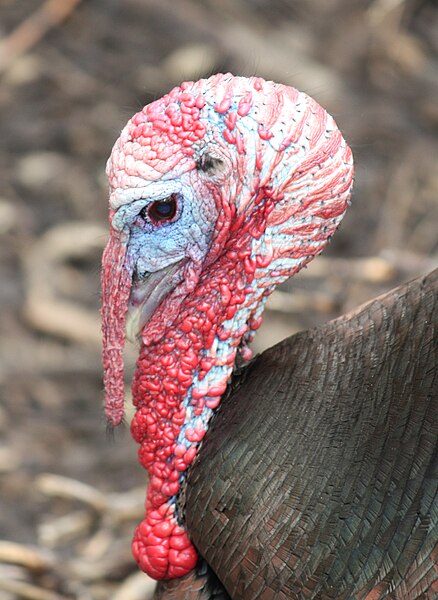
Turkeys are known for their characteristic red and/or bluish heads and the fleshy growth on their beaks, known as a "snood".
Well, to start it off, the turkey has a long legs, a feathery body, a relatively small head and beak and, on males, one of the most noticeable features – that fleshy growth on a male turkey's (or tom's) beak. That “fleshy growth” is called a snood. A tom gets up to 49 inches long and weighs 11-24 pounds. A female turkey, also called a hen, stretches 30-37 inches long and weighs 5.5-12 pounds. Toms and hens have quite a few differences between each other. As you might have guessed based on the size and weight estimates mentioned above, toms are larger than hens. Toms are also the only ones to have a snood. The turkey also has the second heaviest weight of any North American bird. Did you know that turkeys also have the amazing ability to change the color of their skin according to their mood? For instance, if the head and neck are rather white, that means that the turkey is excited. The color of a turkey's skin can range from brilliant shades of red, blue and white.

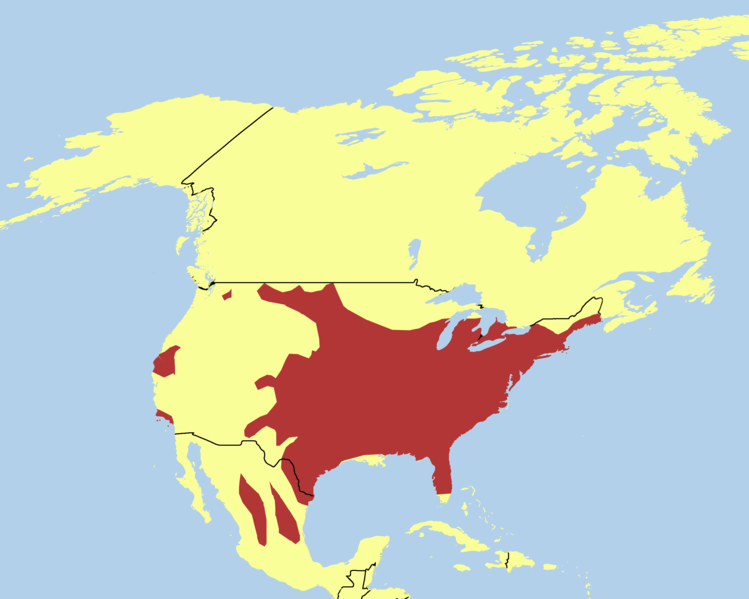
The reddish-brown color represents where wild turkeys live.
Domestic turkey's are plump birds and can't fly. Wild turkeys, however, are agile fliers. Another interesting fact you might not have known about these birds is that they're omnivores, eating a variety of things they find on the ground. Some foods they eat are nuts, seeds, berries, roots, grasses and insects. Sometimes turkeys have been known to consume amphibians and small reptiles (e.g. lizards and snakes)! That's what I call a varied diet! If you want to watch wild turkeys feeding, the best time to be on the lookout for them would be early in the morning or in the late afternoon because these are their favorite times to feed. Turkeys sometimes can be found alone, but they are generally social birds, roaming their range in relatively small flocks.

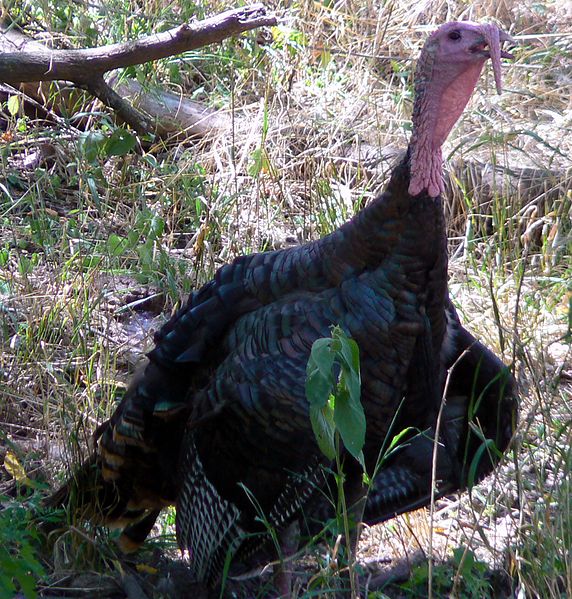
This flock of both toms and hens is foraging.
Turkeys are one of many species of animals that are polygamous. This is a fancy term that means one male will mate with as many hens as they can. Turkey courtship starts in March and April and this is when toms like to strut their stuff . . . literally! When trying to attract hens, a male turkey will puff out their feathers, drag their wings and, much like a peacock, they'll fan out their tail feathers. This sort of behavior is also known as strutting. After mating season is over, it is time for hens to build and nest and lay the next generation of turkeys. Normally laying 10-14 eggs over a period of 10-14 days (they most often lay one egg per day) in a shallow depression in the dirt covered in woody vegetation, the eggs take at least 28 days to hatch. Soon, it's time for the eggs to hatch! Baby turkey's are called poults, and even though they can leave the nest 12-24 hours after hatching, they'll continue to follow their mother around for four to five months as they mature.

In this photo, we can see a mother turkey with her poults. Aren't they cute?
It's a plain fact – turkeys are found delectable to many different species of animals at just about every stage of life! Poults and eggs are often picked off by opposums, raccoons, skunks, foxes, birds of prey, groundhogs (unbelievable, right?), other rodents and snakes . . . and those are just predators of the young! Predators of both young and adult turkeys include coyotes, bobcats, mountain lions, eagles, great horned owls, domestic dogs and (especially in the fall) humans! Humans are actually the top predators of these large birds; so much so that we've domesticated these birds to meet the demand. When faced with danger, most turkeys will run away rather than fly (though they'll fly at times for short distances), but when push comes to shove, turkeys can defend themselves. Large toms especially can be extremely aggressive toward predators; when faced with danger, they can fight with the spurs on the back of their legs, bite with their beaks and bump their large bodies against predators. Many small to mid-sized mammals are deterred by a turkey's defense methods. So long as a human doesn't have a gun, a large turkey will also occasionally fight off a human being, especially where natural habitats are rare. So if you see turkeys in the wild, it's best to give them space and let them forage, undisturbed.

The turkey really is an amazing bird!
The turkey is quite a survivor. And for good reason – they're smarter, have more complex behavior than we give them credit for and can even put up a good fight at times. So this Thanksgiving, instead of merely thinking of the main course of your Thanksgiving's Day meal as good food, but think of it as the amazing, un-dumb and beautifully designed bird God created it to be!
Disclaimer: Many (or in some cases all) of the photographs and images above are not mine. If you own one or more of them and would like them to be removed, politely let me know via one or both of the email addresses above.

Friday, October 9, 2015

Rerun Article: The History of Halloween - a Harvest Day Special

Believe it or not, the middle of October will be here next week! You know what that means? Harvest Day (aka, "Halloween")? Yes, but that's not what I had in mind. Thanksgiving's coming soon? True again, but that's still not it. Christmas? Yes, that's coming soon too, but there's two other things I've been looking forward to. One of which is the NanoWrimo challenge. Essentially, the challenge is to write a 50,000-word novel between November 1 and November 30. Last year, I succeeded at writing a good-sized novel. This year, I plan on doing the challenge again. I'm totally stoked! The other thing I'm excited about is The Good Dinosaur! That movie will be coming out soon too! A brand new trailer was released just a few days ago, so be sure to check it out in the In the Spotlight section of today's post!

Days Till:
It is: 3 days till Columbus Day
It is: 22 days till Harvest Day
It is: 47 days till The Good Dinosaur's release
It is: 48 days till Thanksgiving

In the Spotlight:
As promised, here's the new The Good Dinosaur trailer:


Finally, in this trailer not only do we get gorgeous views of the not-so-prehistoric landscape, but we also get a good look at some new dinosaurs that will be in the film. Most notably, we get to see what appears to be a pack of dromaeosaurs or raptors, perhaps Velociraptors. I was already excited about this film, but when I saw those raptors (my favorite dinosaurs by the way), I was even more excited! We also get a good look at a ceratopsian that will be in the movie named Shamaan. I am not sure what species he is, but he seems to be a hybrid of Triceratops and Styracosaurus, possessing the three horns of the former, and the horns around the frill of the latter. While we're on the subject of what the dinosaurs in this movie look like, you might notice several of the species look different from their fossilized counterparts. This is because The Good Dinosaur takes place not in the past, but the present day in an alternate reality if dinosaurs did not go extinct. Therefore, natural selection and mutation has allowed the dinosaurs to change somewhat over time. That being said, here is a list of the species of dinosaurs we've seen in the movie so far:
  • Apatosaurus
  • Parasaurolophus
  • Tyrannosaurus
  • Nyctosaurus (actually a pterosaur, not a dinosaur)
  • Triceratops/Styracosaurus hybrid
  • Velociraptor
I'm sure others will appear in the movie too, so this list will probably be added onto later on.

Topic of the Week by Christian Ryan
Many are very excited this time of year. Not about Christmas or Thanksgiving, but another “holiday” coming much sooner than that: Halloween! Stores all over the country make millions (if not billions) of dollars every year on Halloween decorations and costumes, the only holiday that makes more money is Christmas. Now only do they make money on costumes and decorations, but they also make money on candy, tons and tons of candy. They also have those creepy tours through those supposedly “haunted houses”. “The gorier the better” seems to be today’s slogan of Halloween. Over the years, costumes and decorations have become creepier and gorier. On my Dad’s way to work, he passes a house with at least . . . say, 20-40 decorations (I’m not exaggerating) ranging from eerie skeletons that appear to be rising out of the ground to a GIANT inflatable black cat, to an inflatable horse and headless rider (the rider is carrying his head under his arm). One of those big inflatable cats can be worth $40 by itself, and they have a bunch of things like that in their yard, so they probably have well over $100 of decorations in their yard.

Here are several people attending a Halloween-themed event.
Now, being a born again Christian, my family and I don’t celebrate Halloween. Some Christians do celebrate Halloween, but I really don’t condone it. When we talk something positive about this day, we call it “Harvest Day”. Should Christians really be celebrating this holiday? What is a Christian to do on October 31st? Well, that is what this post wishes to tackle. So please continue reading to learn more about this holiday you never knew (by the way, Halloween is not an official holiday, contrary to popular belief).

I firmly believe that in order to address and tackle an enemy, we must know something about it. The same applies to evil “holidays”. So let’s take a look at its history and see how not harmless some of those Halloween traditions are.

Now where did Halloween begin? Well, there are many ancient cultures that have days very similar to Halloween. These cultures range from Ireland to Mexico (the Mexican version of Halloween is called, “The Day of the Dead”). Now if there were only a few places around the world that have Halloween-like events, then it would be considered “coincidental”, but with so many different cultures around the world celebrating Halloween-like “holidays”, it’s unlikely that they all just coincidentally are similar, no, it’s way older than you think!

Some tell you that Halloween-cultures started a few thousand years ago, but really, the world’s human population was already spread apart by that time, so it is more likely that its origins are older than that. They probably route back to a time when the world’s human population was in one location. And there’s one and only one time after the Flood when the world population was together – right after Noah’s Flood and before Babel, around 4,300 years ago! That’s old! How can we even assume that? Well, the Flood of Noah killed a whole lot of people. Only eight people survived – Noah, his wife, his sons and their wives. From them, the human population came, including everyone on the planet today. Now considering Noah and his family probably lost a lot of relatives who failed to listen to God’s warning, they must have been a little sad. Perhaps the people living right after the Flood made a special event to remember those souls lost in the waters (of course this is just speculation since the Bible says nothing about this “remembrance day”). Another theory deals with Noah’s wife. Noah’s wife isn’t mentioned in the Bible a little while after the Flood. We don’t know for sure, but perhaps this is because she died soon after the Flood. We know in that portion of the Bible that people lived hundreds of years at a time, so Noah’s generation (which at this time only would have consisted of him and his wife) would have lived to see their children grow up to have children of their own, and have grandchildren and great grandchildren and great, great grandchildren and great, great, great grandchildren and so forth. So it could be that after having many great, great, great . . . grandchildren, Noah’s wife died and her grandkiddies held a special “remembrance day” for this woman.

We may never know exactly where this “holiday” began, but either way, after leaving the Tower of Babel as described in Genesis, people would have taken the “remembrance day” culture with them as they traveled the globe, but as they did so, they did some tweaking to this day as we’ll see in a minute.
Flashing to the bit more recent time of more than 2,000 years ago, the Druids, or Celtic people of Ireland, Great Britain, France had morphed this “holiday” a lot. These people had elaborate and religious pagan festivals, one of the most important was the Fire Festival called Samhain (it’s pronounced sow-en, nothing at all like it’s spelled, is it?) that was observed in harvest time. Now the Celtic people had a lot of strange beliefs, one of which was that on this particular night, the barrier between natural world and the supernatural world was removed and the spirits of the dead can roam among us in the form of ghosts. This event was nowhere near as “fun and lighthearted” as today’s Halloween, but this is where the “spooky version” of it originated.
These folks have a serious case of "Halloween-gydus"
Halloween wasn’t all paganized though. Actually, early Christians made their own “Halloween” day . . . sort of. The customs of this day were Christianized in 835 A.D. when Pope Gregory IV decided to dedicate a day to the believers who had died. This day was called “Feast of All Saints” and was originally in the spring but was moved to November 1st to replace Samhain. The day before “Feast of All Saints” was called “All Hallow’s Eve” and was a sacred vigil in church. Apparently, “All Hallow’s Eve” was too long for most, so it was shortened to “Hallow’s Eve”, then to “Hallow’en” and today most of us just write (or type in my case) “Halloween”. So we have two “holidays” that are somewhat similar: Samhain, a 100% pagan thing and “All Hallow’s Eve”, a Christian-type remembrance. Which one do you think is the one that stuck around?

If you guessed Samhain, you’re wrong! Today’s Halloween is a mixture of Samhain AND “All Hallow’s Eve”. But there’s more to the story than that. The knocking on door thing was started in the British Isles where people in masks would go from door to door putting on a simple performance to earn (what else?) food and drink! Many times these shows had Christian themes. (Keep in mind I did say, “many times”. Some of these people would simply go up and ask for something and then if they got it they’d bless the house, if they didn’t they’d curse the house) So how did we get from putting on a show to earn food to simply knocking on a door and yelling, “Trick or treat!”?

Well that story started back when Irish and Scottish folks brought Halloween customs to America in the 19th century (Halloweens much more complex than you thought, isn’t it?). On Halloween night, “some” vandals (a lot, actually) started doing “cute” pranks and mischief. These folks did things like soap windows, tipping outhouses and yanking doors off their hinges (doesn’t sound very “cute” to me!). These were said to have been the work of mischievous ghosts, goblins and witches. When we reached the 1920’s though, these jokes weren’t very humorous at all! This is why Halloween is the policeman’s least favorite day of the year, they have to always stay on their toes! The vandalism was getting worse. So community clubs such as Boy Scouts decided to help the situation. They decided it would be a good idea to have children going from door to door and yell, “Trick or Treat!” as soon as the door was opened. This would keep those vandals away. It didn’t take long to catch on, by the 1930’s it was a popular Halloween activity. So this type of Halloween wasn’t bad. It was fun, playful, and entertaining. It wasn’t bad at all . . . yet!

As we all have noticed over the years, costumes get more and more gory and horrific. And the Samhain part of Halloween has started to come out. Ghosts, goblins and witches (along with their witch craft) is creeping out and haunting like they did 2,000 years ago. However, unlike the legend, they don’t really haunt the earth, except in the form of imaginations. Today’s Halloween, a “holiday” initially supposed to be a Christian day, is a day filled with spooky, creepy paganism that deals with the souls of those who’ve died. Now you know exactly how bad Halloween really is and why my family doesn’t celebrate!

Some of you might be asking yourselves, “What’s so bad about witchcraft?” (Supposed ghost encounters is a whole other topic, I’ll talk about that later). Think my talk on this subject is cheap? Well, God’s talk is definitely not cheap! God Himself speaks against paganism and witchcraft in the books of the Law (the first five books of the Bible). Yes, witches are also not new, they were around 3,000 years ago, about the time of Moses. . . . So as you can see, God warned us not to follow paganism, as harmless as it seems, it has a much, much deeper meaning to it. It’s all in Satan’s evil plot to get people away from God. As I’ve expressed in previous posts, Satan is very real indeed! There is a Heaven and Hell.

A lot of people don’t know this, but Satan is really an expelled angel who used to live with God. In the book of Ezekiel, we read that his voice was like that of a beautiful instrument. However, when Satan got prideful, he was banished. Believe me, Satan is no joke, he’s got lots of power. However, being his Creator, God has even MORE power. Satan really wants to lure people away from God and Halloween is just one of those times he uses to do this, in the form of “harmless” witchcraft, fake devils (by the way, Satan doesn’t have horns, a pointy tail and pitchfork either), ghosts, goblins and skeletons. Even things that really aren’t bad are used a lot on this day, such as black cats, bats, spiders and crows. None of these animals are bad at all. So seriously, what’s a Christian to do on this evil “holiday”?

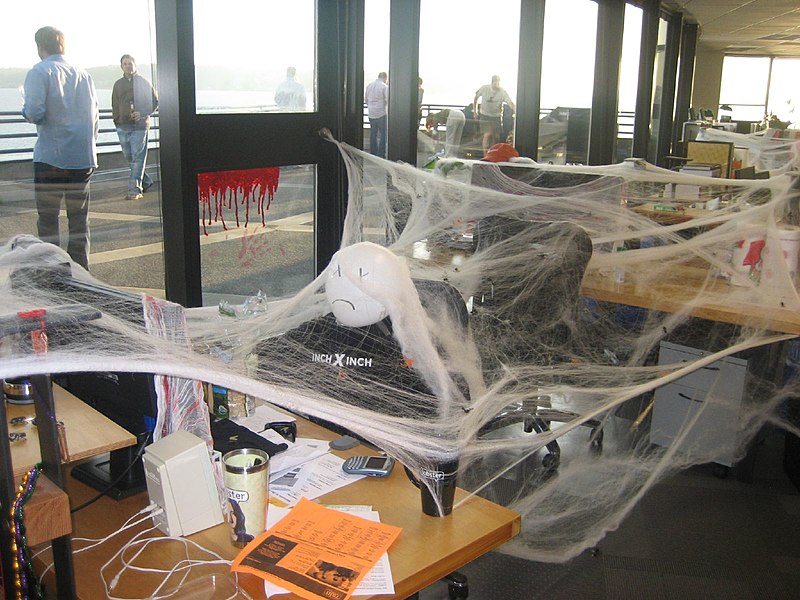
Talk about creepy!
Well, there’s lots to do! First of all, one option is to pray for all those poor lost souls engaged in this paganism. Another thing you can do is along with your candy, give out Bible tracks. Kids will take just about anything if there’s candy involved. If you don’t feel like the whole “trick-or-treaters” thing (or even if you do), you can go to your church and help out with your church’s Halloween, or rather, “Harvest Day” event. If your church doesn’t have this event planned, you should inquire about it (and if it’s too close to the date, simply suggest it for next year). Beware, Satan is out to stop all lost souls from God’s Holy Word. But together, and with God’s help, we can use this pagan “holiday” to reach more lost souls and lead them to God by telling them about Jesus’ message of salvation!