Showing posts with label birds. Show all posts

Friday, January 15, 2016

Rerun Article: Polly Want Lamb Chops?

Happy 2016, everyone! Sorry that this post is late, my grandmother died at the old age of 95 this past week and I didn't have an opportunity to post. While we'll miss her dearly, I am glad that she is a Christian, so she's in heaven now with Jesus. Hallelujah!

In addition to this news, I have finally seen Star Wars: The Force Awakens! It was so awesome! The story was great (a rare thing for sequels) and so were the special effects. The only part I didn't like was when ___________ died. (I'm not gonna spoil it for those of you who haven't seen it, but I'm sure those of you who have seen the movie know who I'm talking about.). Let's get started with our first article of the new year!

Days Till
It is: 25 days till Martin Luther King Jr. Day
It is: 18 days till Groundhog Day
It is: Valentine's Day

In the Spotlight:
Not much to share this week, except my love for the new Star Wars movie! However, I recently found out about a new Disney movie coming to theaters on March 4. It's called Zootopia. The trailers for this film were hilarious! Basically, Zootopia takes place in an alternate universe where mammals are anthropomorphic -- they live like people, wear clothes (well, most of them do), own shops and restaurants and things like that. If you haven't heard of this movie, you need to check it out. See the trailer for it below, featuring the main characters trying to obtain some information from the DMV. There's one tiny problem though: everyone working at the DMV is a sloth!
 
 
Topic of the Week by Christian Ryan
People just love birds. One of everyone’s favorite types is no doubt the parrot. Parrots are very smart birds. We can train them to talk and recent tests even prove that at least some parrots actually know what they’re saying instead of just calling out words! God made these birds for us to enjoy. Parrots come in a wide range of sizes, from small Budgerigars to the giant Kakapo. Haven’t heard of the Kakapo? Well, it’s this large green parrot that lives on New Zealand. It’s not very parrot-like at all; it can’t fly! Most parrots, as we all know, can fly very well. We often like to have them sit on our shoulders, especially pirates. But one species of parrot is bound to surprise you.
A Kea sitting on a rock.

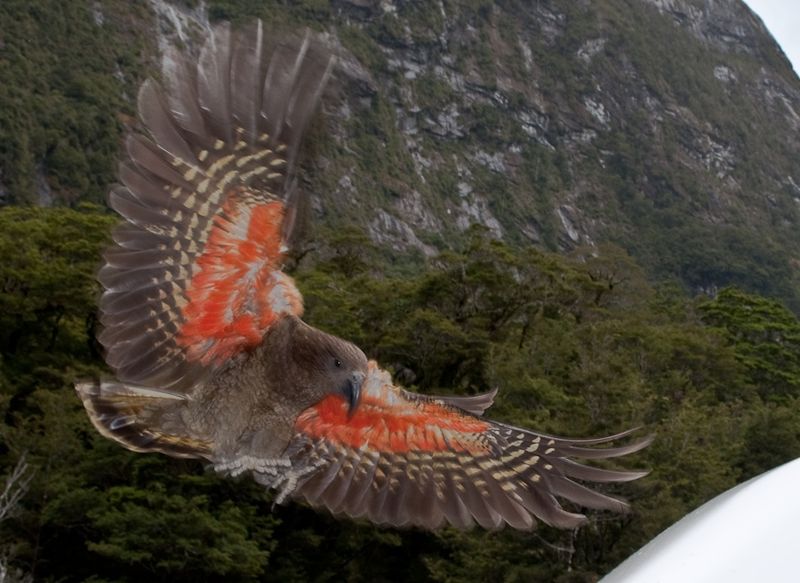
This Kea Parrot is about to land on a white car. As you can see, the undersides of its wings are a beautiful orange color.
It’s called the Kea, a small green parrot (about 19 inches long) living in New Zealand. Most parrot species are loved by millions, but not the Kea. It denies normal parrot behavior and is rather . . . “mischievous”. First of all, it likes to live in urban areas where they will tip over trash cans, break car windows, invade camping sites, and play with windshield wipers to the point of breaking them! (So they’re sort of like foxes on the wing) Another thing that makes this parrot unique is that instead of living in the lush tropical forests, it lives in the snow on the alpine slopes. Keas are the only parrots known to live in this kind of habitat.

But probably the most surprising thing about the Kea is that instead of asking it, “Polly want a cracker?” you may want to ask, “Polly want a lamb chops?” This parrot will eat fruit, but lately, they've decided to go . . . no . . . it couldn’t be . . . could these guys be turning . . . CARNIVOROUS?!? Strange but true, in the spring, summer and fall, they normally eat daisies, berries and other fruits, nectar, pollen, insects and etc. But Keas have been seen actually eating not only stuff from trash cans (which is why they tip them over in the first place), but they also will eat carrion. In winter, these foods are harder to find. The rampage began in the 1800’s when people introduced sheep to New Zealand and the Keas started to eat carrion of dead sheep. Then they really went on the rampage! Keas are believed to have actually killed 200 or so sheep in a single night (in 1884) and 15,000 sheep in a season in. Just when you saw some animals appeared to be giving meat up like the lions did in a post I wrote a couple of weeks ago, another animal switches onto meat.
How on earth do they kill sheep anyway? Well, they fly over to the sheep and start pecking at sores and I’d assume the sheep eventually died of shock and blood loss. Four main theories arose as to why the Kea transformed almost overnight to be a sheep-killer:
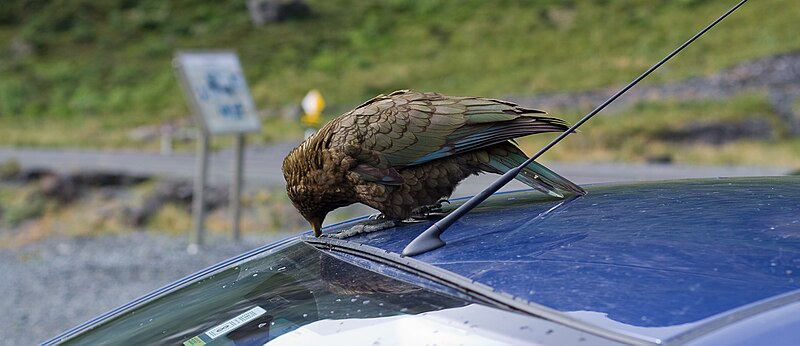
A Kea damaging a car.
  1. They just switched from eating insects to eating sheep
  2. There were maggots in the carrion they were eating so this is when they developed a taste for meat.
  3. The Vegetable Sheep theory is: Keas thought the sheep were plants when they were lying down so they just accidentally ate a sheep and thought, “Hey, this tastes pretty good! We should do this more often!”
  4. The bird’s diet changed because of theory adaptability, intelligence, curiosity and mischievousness

The last theory I mentioned is the one most scientists believe is most likely. Many scientists believe they also used to feast on Moa carrion too (Moas are giant birds that went extinct a few hundred years ago). Boy, I’m sure glad these birds don’t prey on people! If they did, we’d all be in big trouble no doubt! Because of their sheep-hunting behavior, the Kea was hunted and actually became endangered. The good news is, this bird received full protection in 1986.

Fortunately for all sheep-kind, Kea predations on livestock have gone down drastically. They are getting rarer and rarer over the past few years. However, occasional Kea attacks on sheep are still being reported, and most of these attacks are on sheep that are old, weak or sick (but some people sometimes will find healthy sheep with Kea wounds). So it seems as though the Kea is finally calming down . . . at least for the moment . . .

But don’t you start thinking this is the end of it! Kea’s aren’t the only so-called herbivores that weren’t told they are supposed to eat plants! A farmer in India lost 48 of his chickens. He suspected some dogs had done the deed, so he and his brother went out one night to catch the culprit. Boy were they in for a surprise when they saw his cow named Lal sneak into the chicken coop and started to grab and eat the chickens! How shocking in deed. So it turns out those cows promoting Chick-Fil-A aren’t only promoting the business, they’re also eating at the business!

Another example would be the was when someone took a trip to Kangaroo Island in Australia, the person dropped a BBQ steak sandwich. Then two grey kangaroos came in and devoured the sandwich, bread, meat and all.

In 1992, a wild Panda Bear killed and ate 26 goats before being captured and studied. In 2002, a British researcher got quite a shock when she saw a sheep snatch an oblivious grouse and devoured it whole! 

Another sheep was seen gobbling up nine chickens. There’s even a horse that actually will chase down chickens and eat them whole. And believe it or not, when a film crew was filming a migration of Wildebeest in Africa, they were migrating through a river where our “friendly” hippos live. Some wildebeest were killed by crocodiles who also inhabit the river, but before some of the crocodiles could eat, hippos came in and started eating the carcass!

Should I go on? Just as many carnivorous animals will have a vegetarian diet, many animals have become carnivorous herbivores. This, as horrifying as it may be, is a reminder to us that all animals were originally designed to eat plants as it says in Genesis. But after the first people rebelled against God, animals could go either ways. Most chose to go herbivorous because that was what their bodies were most designed for, but others chose to become carnivorous. Of course though, as we just learned, animals can change their diets. Fortunately most animals tend to stick with the diets that best suits their bodies (for instance, while horses can eat chickens, they must have a hard time tearing the bird apart with those dull teeth). Most animals probably would get sick if they tried to eat food that doesn’t suit their body. However, even in this fallen world we live in, God has promised us to one day, restore His beautiful creation.

Disclaimer: The images above are not my own unless otherwise indicated. If you own one of the above images and want it removed, please notify me via my email.

Monday, November 23, 2015

Rerun Article: The Gobbling Turkey - More than a Thanksgiving Food

Well, November is almost over and I am still trying hard to finish my 50,000-word novel on time. So far, I have reached about 36,468 words. Yet, I am only about halfway through the story! It will likely be much longer than 50,000 words. Lord willing, I will at least get 50,000 done on time!

What do you know, Thanksgiving is right around the corner! Don't you just love this time of year? If not, you should. So let's get started with:

Days till:
It is: 2 days till The Good Dinosaur's theatrical release!
It is: 3 days till Thanksgiving
It is: 31 days till Christmas

In the Spotlight:
Pixar has been at it for years - rumors of this company making a dinosaur movie have been around since Up. The Good Dinosaur is that movie and it is finally coming to life! So naturally, since it is coming out in theaters in a measly two days, here is a new TV spot for the film!


And in addition to that, I have also found some fossilized clips from the movie itself:


Remind me never to mess with Butch! That guy's tough! Those raptors are pretty nasty too, I can't wait to see them in the movie.

Topic of the Week by Christian Ryan
Thanksgiving is normally a time of giving thanks and eating. There's one meal item that just about everyone eats; I'm talking about, a bird loved by millions – Meleagris gallopavo, otherwise known as the turkey. This bird is a common species that is found all over the United States. When my family was living in North Carolina, Vermont and New York (yeah, my family's lived a lot of places in my time), we often saw flocks of these birds on their search for food, often just outside out house. Despite the popularity of the turkey, many myths have been made up about these birds and a lot of people don't know much about these birds except the fact that it tastes really good. So let's learn more about America's favorite bird! (Next to the bald eagle, perhaps).

The is often thought of as just Thanksgiving dinner. But there's so much about the turkey that most people don't know. Read on to learn more about the turkey!
The turkey (also known as the wild turkey) is in the Phasianid family, which also contains chickens, pheasants, partridges, junglefowls, quails and peacocks. All these birds are probably in same baramin, also called a “created kind” – one of the original created kinds of animals God made. Being a bird, God created the first member of the Phasianid family on Day 5 of the Creation week recorded in Genesis chapter one (remember that it says “every winged fowl”). It might also be handy to know that the domestic turkey is a descendant of their wild ancestors. However, we're mainly going to talk about the wild turkey today. There's a lot more to these simple-looking birds than what meets the eye. (For instance, did you know that it's a myth that turkeys hold their heads up when its raining so that they drown?) So what makes a turkey a turkey?

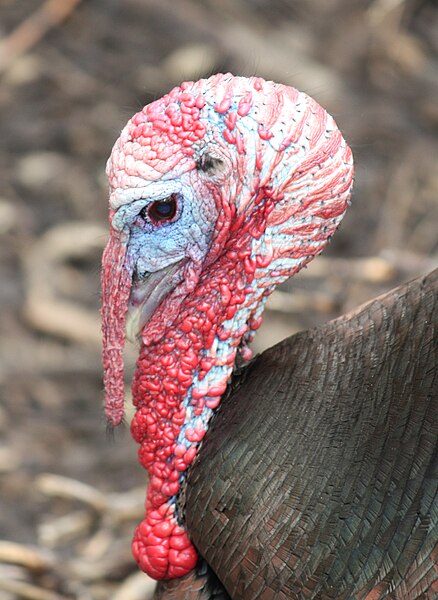
Turkeys are known for their characteristic red and/or bluish heads and the fleshy growth on their beaks, known as a "snood".
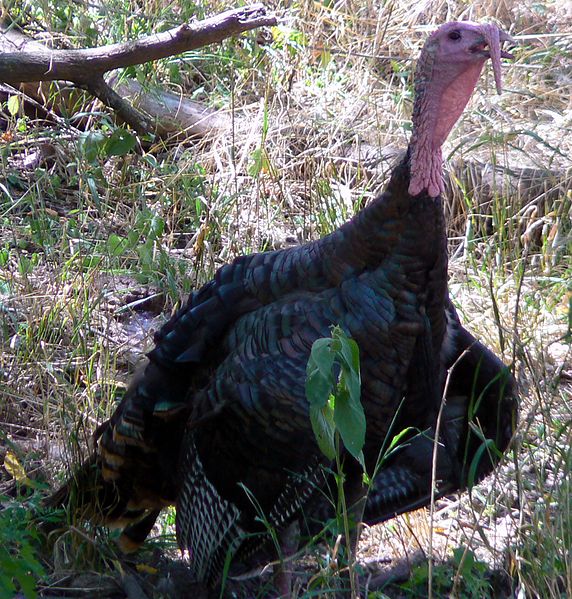
Well, to start it off, the turkey has a long legs, a feathery body, a relatively small head and beak and, on males, one of the most noticeable features – that fleshy growth on a male turkey's (or tom's) beak. That “fleshy growth” is called a snood. A tom gets up to 49 inches long and weighs 11-24 pounds. A female turkey, also called a hen, stretches 30-37 inches long and weighs 5.5-12 pounds. Toms and hens have quite a few differences between each other. As you might have guessed based on the size and weight estimates mentioned above, toms are larger than hens. Toms are also the only ones to have a snood. The turkey also has the second heaviest weight of any North American bird. Did you know that turkeys also have the amazing ability to change the color of their skin according to their mood? For instance, if the head and neck are rather white, that means that the turkey is excited. The color of a turkey's skin can range from brilliant shades of red, blue and white.

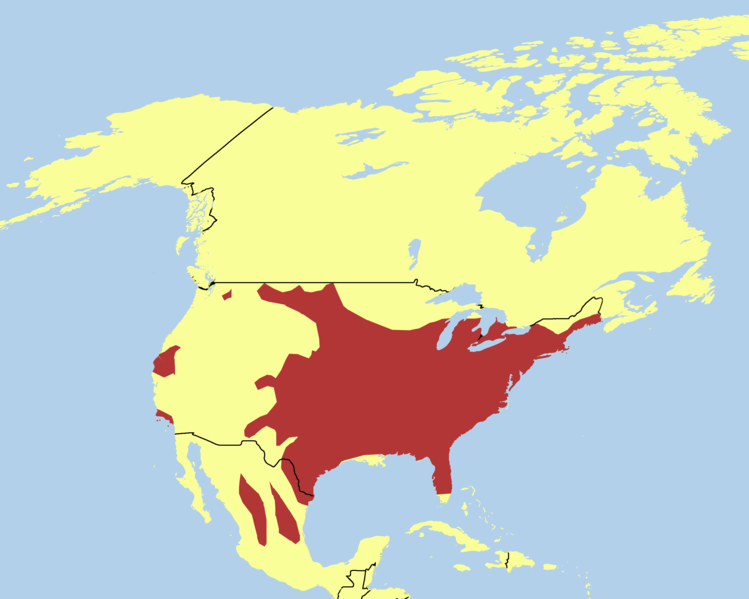
The reddish-brown color represents where wild turkeys live.
Domestic turkey's are plump birds and can't fly. Wild turkeys, however, are agile fliers. Another interesting fact you might not have known about these birds is that they're omnivores, eating a variety of things they find on the ground. Some foods they eat are nuts, seeds, berries, roots, grasses and insects. Sometimes turkeys have been known to consume amphibians and small reptiles (e.g. lizards and snakes)! That's what I call a varied diet! If you want to watch wild turkeys feeding, the best time to be on the lookout for them would be early in the morning or in the late afternoon because these are their favorite times to feed. Turkeys sometimes can be found alone, but they are generally social birds, roaming their range in relatively small flocks.

This flock of both toms and hens is foraging.
Turkeys are one of many species of animals that are polygamous. This is a fancy term that means one male will mate with as many hens as they can. Turkey courtship starts in March and April and this is when toms like to strut their stuff . . . literally! When trying to attract hens, a male turkey will puff out their feathers, drag their wings and, much like a peacock, they'll fan out their tail feathers. This sort of behavior is also known as strutting. After mating season is over, it is time for hens to build and nest and lay the next generation of turkeys. Normally laying 10-14 eggs over a period of 10-14 days (they most often lay one egg per day) in a shallow depression in the dirt covered in woody vegetation, the eggs take at least 28 days to hatch. Soon, it's time for the eggs to hatch! Baby turkey's are called poults, and even though they can leave the nest 12-24 hours after hatching, they'll continue to follow their mother around for four to five months as they mature.

In this photo, we can see a mother turkey with her poults. Aren't they cute?
It's a plain fact – turkeys are found delectable to many different species of animals at just about every stage of life! Poults and eggs are often picked off by opposums, raccoons, skunks, foxes, birds of prey, groundhogs (unbelievable, right?), other rodents and snakes . . . and those are just predators of the young! Predators of both young and adult turkeys include coyotes, bobcats, mountain lions, eagles, great horned owls, domestic dogs and (especially in the fall) humans! Humans are actually the top predators of these large birds; so much so that we've domesticated these birds to meet the demand. When faced with danger, most turkeys will run away rather than fly (though they'll fly at times for short distances), but when push comes to shove, turkeys can defend themselves. Large toms especially can be extremely aggressive toward predators; when faced with danger, they can fight with the spurs on the back of their legs, bite with their beaks and bump their large bodies against predators. Many small to mid-sized mammals are deterred by a turkey's defense methods. So long as a human doesn't have a gun, a large turkey will also occasionally fight off a human being, especially where natural habitats are rare. So if you see turkeys in the wild, it's best to give them space and let them forage, undisturbed.

The turkey really is an amazing bird!
The turkey is quite a survivor. And for good reason – they're smarter, have more complex behavior than we give them credit for and can even put up a good fight at times. So this Thanksgiving, instead of merely thinking of the main course of your Thanksgiving's Day meal as good food, but think of it as the amazing, un-dumb and beautifully designed bird God created it to be!
Disclaimer: Many (or in some cases all) of the photographs and images above are not mine. If you own one or more of them and would like them to be removed, politely let me know via one or both of the email addresses above.