Showing posts with label creation. Show all posts

Friday, January 15, 2016

Rerun Article: Polly Want Lamb Chops?

Happy 2016, everyone! Sorry that this post is late, my grandmother died at the old age of 95 this past week and I didn't have an opportunity to post. While we'll miss her dearly, I am glad that she is a Christian, so she's in heaven now with Jesus. Hallelujah!

In addition to this news, I have finally seen Star Wars: The Force Awakens! It was so awesome! The story was great (a rare thing for sequels) and so were the special effects. The only part I didn't like was when ___________ died. (I'm not gonna spoil it for those of you who haven't seen it, but I'm sure those of you who have seen the movie know who I'm talking about.). Let's get started with our first article of the new year!

Days Till
It is: 25 days till Martin Luther King Jr. Day
It is: 18 days till Groundhog Day
It is: Valentine's Day

In the Spotlight:
Not much to share this week, except my love for the new Star Wars movie! However, I recently found out about a new Disney movie coming to theaters on March 4. It's called Zootopia. The trailers for this film were hilarious! Basically, Zootopia takes place in an alternate universe where mammals are anthropomorphic -- they live like people, wear clothes (well, most of them do), own shops and restaurants and things like that. If you haven't heard of this movie, you need to check it out. See the trailer for it below, featuring the main characters trying to obtain some information from the DMV. There's one tiny problem though: everyone working at the DMV is a sloth!
 
 
Topic of the Week by Christian Ryan
People just love birds. One of everyone’s favorite types is no doubt the parrot. Parrots are very smart birds. We can train them to talk and recent tests even prove that at least some parrots actually know what they’re saying instead of just calling out words! God made these birds for us to enjoy. Parrots come in a wide range of sizes, from small Budgerigars to the giant Kakapo. Haven’t heard of the Kakapo? Well, it’s this large green parrot that lives on New Zealand. It’s not very parrot-like at all; it can’t fly! Most parrots, as we all know, can fly very well. We often like to have them sit on our shoulders, especially pirates. But one species of parrot is bound to surprise you.
A Kea sitting on a rock.

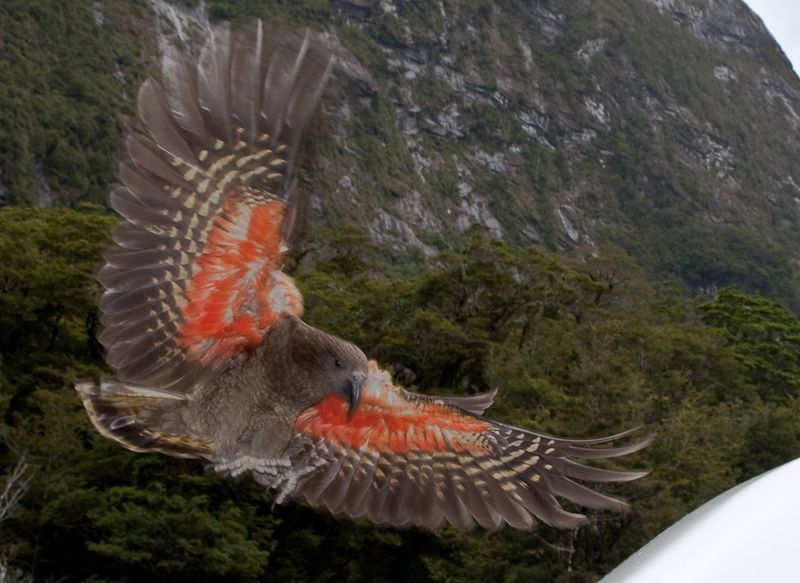
This Kea Parrot is about to land on a white car. As you can see, the undersides of its wings are a beautiful orange color.
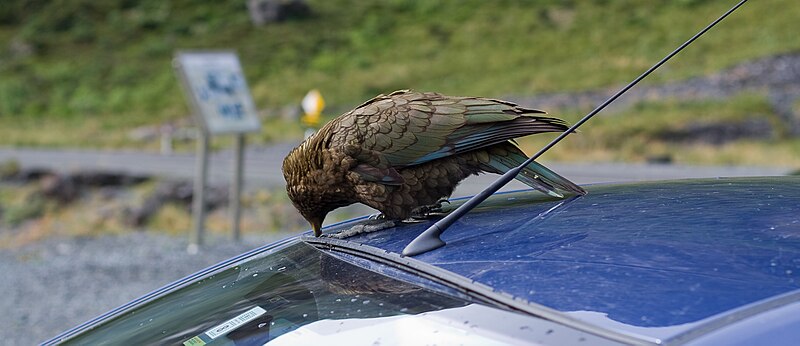
It’s called the Kea, a small green parrot (about 19 inches long) living in New Zealand. Most parrot species are loved by millions, but not the Kea. It denies normal parrot behavior and is rather . . . “mischievous”. First of all, it likes to live in urban areas where they will tip over trash cans, break car windows, invade camping sites, and play with windshield wipers to the point of breaking them! (So they’re sort of like foxes on the wing) Another thing that makes this parrot unique is that instead of living in the lush tropical forests, it lives in the snow on the alpine slopes. Keas are the only parrots known to live in this kind of habitat.

But probably the most surprising thing about the Kea is that instead of asking it, “Polly want a cracker?” you may want to ask, “Polly want a lamb chops?” This parrot will eat fruit, but lately, they've decided to go . . . no . . . it couldn’t be . . . could these guys be turning . . . CARNIVOROUS?!? Strange but true, in the spring, summer and fall, they normally eat daisies, berries and other fruits, nectar, pollen, insects and etc. But Keas have been seen actually eating not only stuff from trash cans (which is why they tip them over in the first place), but they also will eat carrion. In winter, these foods are harder to find. The rampage began in the 1800’s when people introduced sheep to New Zealand and the Keas started to eat carrion of dead sheep. Then they really went on the rampage! Keas are believed to have actually killed 200 or so sheep in a single night (in 1884) and 15,000 sheep in a season in. Just when you saw some animals appeared to be giving meat up like the lions did in a post I wrote a couple of weeks ago, another animal switches onto meat.
How on earth do they kill sheep anyway? Well, they fly over to the sheep and start pecking at sores and I’d assume the sheep eventually died of shock and blood loss. Four main theories arose as to why the Kea transformed almost overnight to be a sheep-killer:
A Kea damaging a car.
  1. They just switched from eating insects to eating sheep
  2. There were maggots in the carrion they were eating so this is when they developed a taste for meat.
  3. The Vegetable Sheep theory is: Keas thought the sheep were plants when they were lying down so they just accidentally ate a sheep and thought, “Hey, this tastes pretty good! We should do this more often!”
  4. The bird’s diet changed because of theory adaptability, intelligence, curiosity and mischievousness

The last theory I mentioned is the one most scientists believe is most likely. Many scientists believe they also used to feast on Moa carrion too (Moas are giant birds that went extinct a few hundred years ago). Boy, I’m sure glad these birds don’t prey on people! If they did, we’d all be in big trouble no doubt! Because of their sheep-hunting behavior, the Kea was hunted and actually became endangered. The good news is, this bird received full protection in 1986.

Fortunately for all sheep-kind, Kea predations on livestock have gone down drastically. They are getting rarer and rarer over the past few years. However, occasional Kea attacks on sheep are still being reported, and most of these attacks are on sheep that are old, weak or sick (but some people sometimes will find healthy sheep with Kea wounds). So it seems as though the Kea is finally calming down . . . at least for the moment . . .

But don’t you start thinking this is the end of it! Kea’s aren’t the only so-called herbivores that weren’t told they are supposed to eat plants! A farmer in India lost 48 of his chickens. He suspected some dogs had done the deed, so he and his brother went out one night to catch the culprit. Boy were they in for a surprise when they saw his cow named Lal sneak into the chicken coop and started to grab and eat the chickens! How shocking in deed. So it turns out those cows promoting Chick-Fil-A aren’t only promoting the business, they’re also eating at the business!

Another example would be the was when someone took a trip to Kangaroo Island in Australia, the person dropped a BBQ steak sandwich. Then two grey kangaroos came in and devoured the sandwich, bread, meat and all.

In 1992, a wild Panda Bear killed and ate 26 goats before being captured and studied. In 2002, a British researcher got quite a shock when she saw a sheep snatch an oblivious grouse and devoured it whole! 

Another sheep was seen gobbling up nine chickens. There’s even a horse that actually will chase down chickens and eat them whole. And believe it or not, when a film crew was filming a migration of Wildebeest in Africa, they were migrating through a river where our “friendly” hippos live. Some wildebeest were killed by crocodiles who also inhabit the river, but before some of the crocodiles could eat, hippos came in and started eating the carcass!

Should I go on? Just as many carnivorous animals will have a vegetarian diet, many animals have become carnivorous herbivores. This, as horrifying as it may be, is a reminder to us that all animals were originally designed to eat plants as it says in Genesis. But after the first people rebelled against God, animals could go either ways. Most chose to go herbivorous because that was what their bodies were most designed for, but others chose to become carnivorous. Of course though, as we just learned, animals can change their diets. Fortunately most animals tend to stick with the diets that best suits their bodies (for instance, while horses can eat chickens, they must have a hard time tearing the bird apart with those dull teeth). Most animals probably would get sick if they tried to eat food that doesn’t suit their body. However, even in this fallen world we live in, God has promised us to one day, restore His beautiful creation.

Disclaimer: The images above are not my own unless otherwise indicated. If you own one of the above images and want it removed, please notify me via my email.

Wednesday, December 30, 2015

The New Dinosaurs of 2015

I can't believe it, but we're already approaching the end of 2015, which I think has been my best year of life so far. Not all of 2015 was easy, but this year made for a great life experience for me. So much great stuff happened over the course of this year. 2016 will soon be upon us, and we'll have new adventures to partake in. I can't wait to see what they are!

Once again, it's time to look at the past year's dinosaur discoveries!
Days Till:
It is: 2 days till New Year's
It is: 6 days till My Birthday
It is: 19 days till Martin Luther King Jr. Day

In the Spotlight:
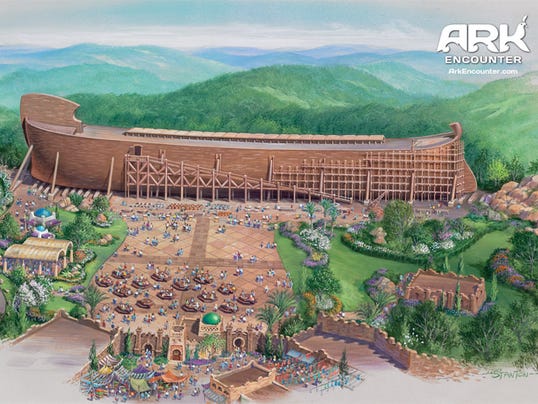
The Ark Encounter, opening July 7th, 2016. (Property of Answers in Genesis)

In addition to the many other things we have to look forward to next year, I'd like to draw your attention to a new “theme park” opening on July 7th, 2016 called “Ark Encounter”. In case you're one of the individuals who's unaware, the Ark Encounter is a subdivision of the creationist company Answers in Genesis (I'm a BIG fan of their work...in case you somehow haven't noticed); not too long ago they opened the Creation Museum in Kentucky. Now, not far from the Creation Museum, AiG is constructing a life-size wooden ark, modeled after the one Noah built in Genesis 6-7. It's going to be 510 feet long, 51 feet tall and 84 feet wide when complete! While the real Noah's ark was technically a floating zoo, perfectly designed to stay afloat on the high global seas, the Ark Encounter vessel will be so much more. The best I can describe it is as a museum inside of an ark, it's going to feature many different kinds of animals depicted as they might have looked on Noah's ark, and several dioramas and exhibits talking about how we know the global Flood of Noah's time happened, the Ice Age, the wickedness of the pre-Flood world and so on. But don't take my word for it, check out a video they recently released talking about what kinds of exhibits they'll have inside the ark:


When you're finished with that video, please go to their newly-designed website talking all about the Ark Encounter, and even a little bit about what kinds of animals they'll feature and so much more: www.arkencounter.org.

Topic of the Week
by Christian Ryan2015 has been a great year for dinosaur lovers. We've had more dinosaur movies/documentaries than you can shake a stick at (e.g. T. rex Autopsy, Dino Death Match, Dinosaur Britain, The Good Dinosaur and, the biggest of them all, Jurassic World). But not only have there been a multitude of dinosaur documentaries/movies, we've also had a great year for dinosaur discoveries. Below is a list of just a few of the newest species of dinosaurs discovered and new research on dinosaurs discovered in previous years.

New Dinosaur Species of 2015

Carnufex

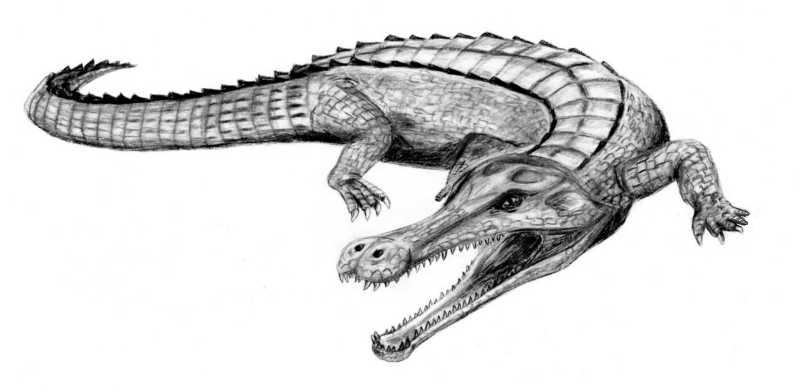
Carnufex could swim after you in the water, and run after you on land! (Image Credits)
 OK, so Carnufex carolinensis is by no means a dinosaur, it's discovery is still quite fascinating. It was a species of crocodile-like reptile (a crocodylomorph to be more specific) that was discovered in North Carolina. Carnufex was about nine feet long from snout to tail. What makes it unique is that it probably could walk on its hind legs, like a theropod dinosaur. It inhabited the Triassic ecosystem of the pre-Flood world until 4,350 years ago when it and countless other animals were wiped out in the global Flood of Noah's time. Armored reptiles and so-called "mammal-like reptiles" would have likely served as prey for this creature.

Chilesaurus
Chilesaurus was an herbivorous theropod. (Image Credit: Gabriel Lio)
Theropod – the word often conjures up images of large predators like Tyrannosaurus and Allosaurus, or perhaps fast and deadly smaller predators like Velociraptor and Coelophysis. So imagine paleontologists' surprise when seven-year old Diego Suárez discovered Chilesaurus, a theropod from Chile, in 2004. However, it wasn't scientifically described until 2015. It had an overall body shape of a theropod, but it had a small head with a beak and leaf-shaped teeth akin to stegosaurs, a hip structure like an ornithopod, hind feet like a prosauropod and two-fingered hands like a T. rex! It's no wonder scientists nicknamed it the “platypus dinosaur”. Despite being a theropod, 10-foot long Chilesaurus' leaf-shaped teeth, beak and large gut tell us that it was an herbivore.

Dakotaraptor

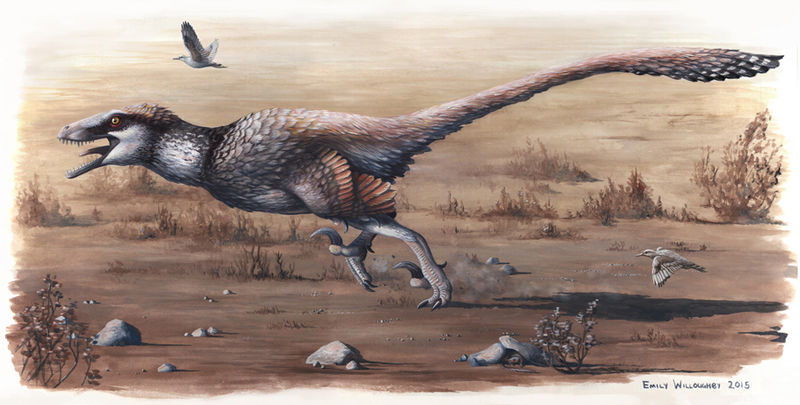
Dakotaraptor was one of the most dangerous dinosaurs ever to walk the earth. (Image Credit: Emily Willoughby)
Up until 2015, the only apex carnivores known from the Hell Creek Formation (which spans Montana and the Dakotas) were the turkey-sized, Velociraptor-like Acheroraptor, and of course, Tyrannosaurus rex. This all changed this year, when scientists studied and described fossils of a large raptor uncovered in South Dakota in 2005. Meet Dakotaraptor! This dromaeosaur was 18 feet long, six to nine feet tall, weighed over 500 pounds and could run at speeds of 30-40 mph. As if this weren't dangerous enough, Dakotaraptor may have hunted in packs like its cousins, like Deinonychus and Utahraptor. In addition to blade-like teeth and incredibly strong arms, it had a nine-inch sickle-shaped claw on each foot for dismembering prey. If you're ever exploring the pre-Flood ecosystem of Hell Creek, beware of this dinosaur!

To read more about Dakotaraptor, please see my full article.

Hualianceratops
Hualianceratops was a smaller relative of Triceratops. (Image Credits:PortiaSloanRollings)

Triceratops is the most popular member of the ceratopsian baramin (“created kind”), but cousins of this 10-ton herbivore come in all shapes and sizes, from another 2015 discovery, the extra-frilled Regaliceratops which grew over 15 feet long, to the spaniel-sized Hualianceratops. This ceratopsian made its home in what is now China's Gobi Desert; at the time, the area was certainly much more forested than it is today. This Jurassic ecosystem boasted a wide range of dinosaurs, from long-necked sauropods, to the predatory Guanlong, a small raptor-like tyrannosaur described in 2006. Unlike its larger relatives, Hualianceratops lacked horns and an elaborate frill and it walked on two legs rather than four.

Kunbarrasaurus
Kunbarrasaurus was thought to belong to the genus Minmi until very recently. (Image Credits: Australian Geographic)

Ankylosaurs are a group of dinosaurs known for being covered in tough armor plates. These plates cover the entire upper half of the animal – even the eyelids are hardened! Some ankylosaurs even had clubs on the ends of their tails. Kunbarrasaurus is a newly discovered ankylosaur from Queensland, Australia. Actually, Kunbarrasaurus was officially dug out of the ground in 1989, but it was thought to be a genus of ankylosaur already discovered, called Minmi (a previous record-holder for the shortest dinosaur name). But recently, scientists found that Kunbarrasaurus' fossils have enough distinctions to make it a different genus.

Qijanglong
Qijanglong had a neck half as long as its entire body! (Image Credits: Lida Xing)
Dinosaurs like Guanlong and  Hualianceratops roamed in the shadows of giants, like the newly discovered Qijanglong, emphasis on “looong”! This dinosaur was a member of the sauropod group, a group of dinosaurs known for having long necks. However, Qijanglong and its closest kin, members of the mamenchisaurid family, had necks long even for sauropods. The necks of most sauropods are a third the length of their bodies, but in the 45-50-foot Qijanglong, its neck was almost half the length of its body! How did sauropods carry such long necks without toppling over? Well, the ultimate Designer (the God of the Bible) made sauropods with neck vertebrae that were filled with pockets of air, making them both strong and lightweight. Interestingly, Qijanglong's skull was discovered attached to its neck; usually sauropod skeletons lack skulls because they easily become detached after the animal dies.

Morelladon
Morelladon was a sail-backed relative of Iguanodon. (Image Credits: Carlos de Miguel Chaves)

Dinosaurs just get weirder and weirder, don't they? (And we're not even to the weirdest one on the list yet!) Morelladon was an iguanodont dinosaur with a sail on its back. Scientists aren't sure why this Spanish herbivore had this feature; it's likely however that the sail was used for display purposes. Morelladon wasn't the only dinosaur to possess a sail: the fish-eating spinosaurs and another iguanodont called Ouranosaurus also had sails. However, perhaps the most elaborate sail of all the dinosaurs belonged to Spinosaurus – its sail stood over six feet tall!

Phosphorosaurus
Phosphorosaurus is not a dinosaur, but a marine lizard of the mosasaur family. (Image Credits: Tatsuya Shinmuru)

Mosasaurs were marine lizards that were very similar to modern monitor lizards. They got a burst of popularity when Mosasaurus (the type species of the mosasaur family) ate Jaws for lunch in the Mosasaurus Feeding Show. Unlike the monster, 60-foot long Mosasaurus, the newly-discovered Phosphorosaurus was not an apex predator of the pre-Flood seas. It was only 10 feet long and fed on fish and squid-like animals. Paleontologists believe Phosphorosaurus may have hunted at night because it had large, forward-facing eyes, unlike other mosasaurs. This means it probably would have been capable of night-vision. Phosphorosaurus was discovered in Japan.

Ugrunaaluk
Ugrunaaluk was misidentified as Edmontosaurus for decades. (Image Credits: James Havens)

Diplodocus. Stegosaurus. Parasaurolophus. You thought those names were hard to pronounce! But you haven't seen a hard-to-pronounce dinosaur name until you've tried to say Ugrunaaluk (Ug-ru-naa-luk). It took me forever to learn how to pronounce this one! This dinosaur was a member of the hadrosaur (duck-billed dinosaur) family and if its name sounds rather unusual for a dinosaur, that's because it isn't derived from the Greek or Latin like most dinosaur names are, but the Inupiat language reflecting where the dinosaur was found – northern Alaska; Ugrunaaluk means “ancient grazer”. Pretty much since the 1980's, scientists have unearthed over six thousand hadrosaur fossils from Alaska. At first, they were believed to belong to a type of lambeosaurine hadrosaur (a hadrosaur with a bony crest). But after more examination, the fossils were classified as Edmontosaurus fossils. However, in 2014 scientists continued to study the fossils and found out something shocking – they weren't Edmontosaurus fossils, or the fossils from any other known hadrosaur, but a new species! As if this weren't surprising enough, many of Ungrunaaluk bones aren't actually fossilized – these are “fresh” dinosaur bones! You would think that this would be a revolutionary discovery, but alas it has been ignored by most of the media or “shoved under the rug”. This is likely because it would further jeopardize the idea that the dinosaur bones are millions of years old and make the biblical view that these dinosaurs were buried in the waters of the Genesis Flood the only logical explanation.

Yi
Yi qi and similar weirdos are from the strange family scansoriopterygidae. (Image Credits: Dinostar)

Dinosaur names are known to be long, tongue-twisty and hard to pronounce, especially names like Ugrunaaluk. So try this one for size: Yi. Yes, that's actually the name of a dinosaur, and it was almost as weird as its name. Its full name (genus and species name) is Yi qi (pronounced “ee-chee”) and it means “strange wing”. So what makes Yi qi stand out? Firstly, this Chinese dinosaur is small, about the size of a pigeon. It also boasts the smallest name of any dinosaur (beating previous record-holders, Mei and Minmi). The most amazing thing about Yi qi though is that it possessed a special membrane supported by a bony rod protruding from its wrist. It was the first, and so far only, dinosaur discovered with bat-like wings! Now it couldn't fly like bats or pterosaurs (flying reptiles with similar wing membranes); instead it was probably a glider, moving from tree to tree, using its “wings” to glide long distances between them. Evolutionists call an instance where a creature has similar features to another unrelated creature “convergent evolution” (strangely, when the same finds occur in creatures they claim are related, it is presented as evidence that the creatures evolved). Instead, Yi qi's bat-like wings point to a Designer who created both Yi qi's baramin and bats. Another interesting thing about Yi qi's discovery is that scientists found melanosomes, which contain pigment cells. By looking at these, scientists were able to tell that Yi qi glided through the forest in a shade of black, with yellow-brown coloration on its head and wing membranes.

Zhenyuanlong
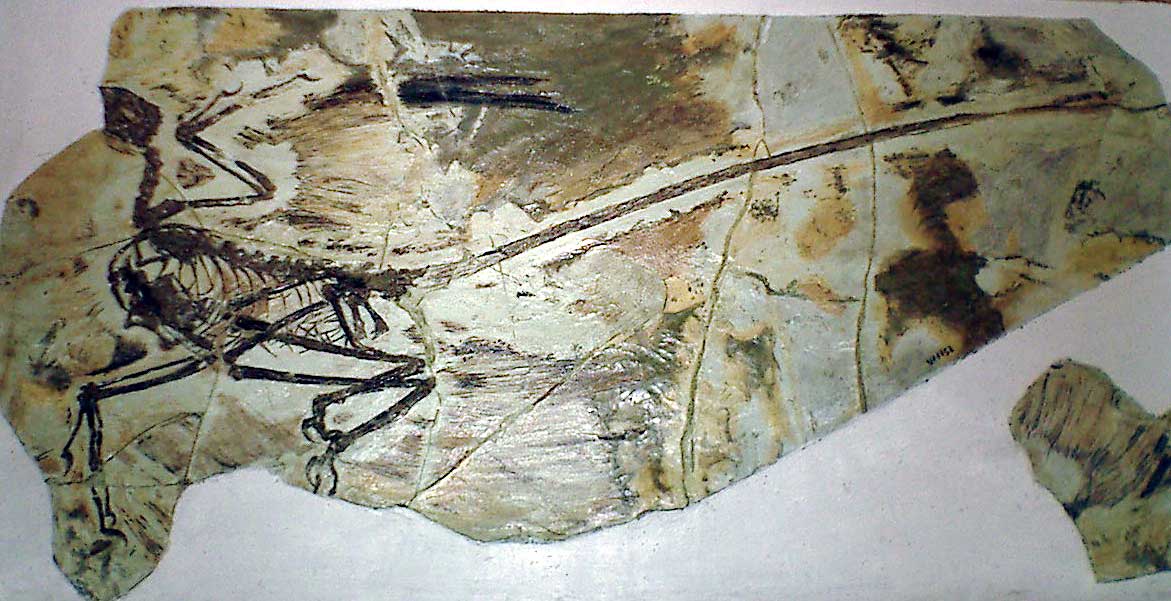
Zhenyuanlong is from the same ecosystem as many other well-known so-called "feathered dinosaurs", including Microraptor, Sinosauropteryx and Sinornithosaurus.

While being touted as positive proof that it's supposed cousin Velociraptor was a feathery feign, Zhenyuanlong is hardly the proof dino-to-bird theorists are looking for. What was actually discovered in China's Liaoning Province? Well, scientists recently described a five-foot-long, nearly complete skeleton complete with fossilized feathers. Contrary to popular opinion, aside from the tremendous evidence against the idea that theropod dinosaurs evolved into birds, Zhenyuanlong cannot act as an aid to the theory, as it has several features that identify this creature as a bird, and not a dinosaur; certainly no cousin to Velociraptor. To see why, please see this article by Answers in Genesis. So what of Zhenyuanlong's clawed wings, long bony tail and sharp dinosaur-like teeth? Well, like many other now-extinct birds, like Alexornis, Archaeopteryx, Microraptor, Hesperornis and Ichthyornis, Zhenyuanlong was a species of predatory bird, unique to the pre-Flood world. Zhenyuanlong must have been a terror to smaller creatures in the forest it lived in.

To read more about why dinosaurs could not evolve into birds, please see this article.

New Research of 2015

Brontosaurus
Brontosaurus, once considered synonymous to Apatosaurus, might make a comeback! (Photo Credits: Davide Bonadonna)

Since the early 20th century, scientists have thought that sauropod Brontosaurus was the same species as the closely related Apatosaurus. Therefore, the name invented first – Apatosaurus – was kept and Brontosaurus was dropped, until a 2014-2015 study, that is. A group of scientists was able to conclude that after reevaluating the fossils of both dinosaurs, that Brontosaurus was distinct enough to return as its own species. See an article about the discovery here.

Cave Lion
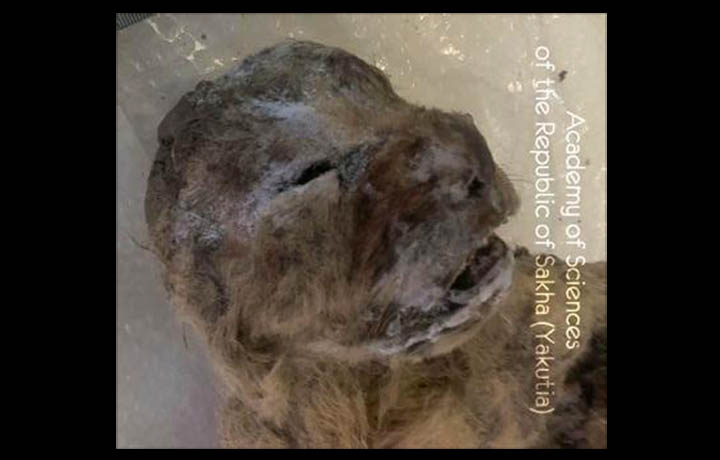
This cave lion cub is one of the best preserved extinct cats ever found. (Image Credits: Academy of Sciences in Yakutia)

While clearly not a dinosaur discovery, I thought this was worthy to bring up. A few months ago, scientists reported on the discovery of two cave lion cubs that were found frozen in Russian permafrost. Cave lions were a subspecies of the modern lion that lived throughout Europe and Asia during the Ice Age. This discovery is rather amazing because the cubs are the best preserved extinct cats ever found. Until now, we have only had cave lion skeletons and paintings of these cats by Ice Age people to know what they looked like.

For more on this discovery, go here.

Well, that wraps up my blogging until next year. To everyone out there:
HAVE A HAPPY NEW YEAR!
See you in 2016!

Disclaimer: The images above are not my own unless otherwise indicated. If you own one of the above images and want it removed, please notify me via my email.

References:
www.sci-news.com/paleontology/science-carnufex-carolinensis-new-prehistoric-crocodile-north-carolina-02617
www.birmingham.ac.uk/news/latest/2015/04/Chilesaurus
www.icr.org/article/new-fossil-dubbed-platypus-dinosaur
www.livescience.com/53039-new-jurassic-horned-dinosaur
www.sci-news.com/paleontology/kunbarrasaurus-ieversi-new-armored-dinosaur-species-03507
www.earthsky.org/earth/long-necked-dinosaur-roamed-china-160-million-years-ago
www.sci-news.com/paleontology/phosphorosaurus-ponpetelegans-new-mosasaur-species-03498.html
www.news.discovery.com/animals/dinosaurs/new-dinosaur-had-a-sail-on-its-back-151216
www.wikipedia.org/wiki/Ugrunaaluk
www.prehistoric-wildlife.com/species/u/ugrunaaluk
www.creation.com/unpermineralized
www.prehistoric-wildlife.com/species/y/yi
www.phenomena.nationalgeographic.com/2015/04/29/chinese-dinosaur-had-bat-like-wings-and-feathers
www.answersingenesis.org/dinosaurs/feathers/what-if-dinosaurs-really-had-feathers

Monday, November 9, 2015

Rerun Article: Did Dinosaurs REALLY Evolve Into Birds?

I hope everyone had a terrific Harvest Day! As you might recall, last year I took part in the Nanowrimo (National Novel Writing Month) challenge, which requires me to write a 50,000-word novel during the month of November. I am doing this challenge again this year, so I will be posting quite a few rerun articles this month. Don't worry though, I'll pick articles from a little ways back.

Anyway, Thanksgiving will soon be upon us? Do you have any Thanksgiving traditions? If so, leave them in a comment below.

Days till:
It is: 16 days till The Good Dinosaur's theatrical release
It is: 17 days till Thanksgiving
It is: 45 days till Christmas

In the Spotlight:
Again, nothing of note to share this week.

Topic of the Week by Christian Ryan
Did dinosaurs really evolve into birds? What does the fossil record actually reveal?
Every Thanksgiving, people all over the United States cook and serve the American turkey. Despite not  being part of the first Thanksgiving, the turkey is a symbol for this holiday. But for many Americans, they aren't merely eating a bird – they're actually eating a dinosaur! Evolutionists believe that all birds, including the turkey, descended from small, feathered theropod dinosaurs; to be more accurate, they actually believe that birds are dinosaurs. Such a claim, if true, would be a major problem for creationists. How should a creationist respond to such this idea? What's the truth behind this belief?

Is this delicious Thanksgiving entree the descendant of dinosaurs?
The idea that reptiles evolved into birds isn't new. Not long after renowned naturalist Charles Darwin published his book in 1859 called On the Origin of Species by Means of Natural Selection, or the Preservation of Favored Races in the Struggle for Life . . . it's easy to see why most people just call it The Origin of  Species. In 1860, a feather was discovered fossilized in Germany and the species of which the feather belonged to was called Archaeopteryx. In 1863, Sir Richard Owen (the inventor of the name “dinosaur” and a creationist) described an entire skeleton of the creature; the fossils revealed a relatively small creature, with feathered and clawed wings, teeth and a long bony tail. In 1869, biologist Thomas Henry Huxley, often considered “Darwin's Bulldog” declared the animal as the missing link between reptiles – specifically dinosaurs – and birds. Ever since, most evolutionary scientists cling to the idea that theropod dinosaurs evolved into birds.

The similarities between dinosaurs like Compsognathus and birds led Huxley to believe that dinosaurs evolved into birds.
Before we go any farther, we must understand both perspectives of the origin of birds: the creation perspective and the evolutionary perspective. Let's look at them both now. Most evolutionists believe that sometime between the early to late Jurassic Period, about 201-145 million years ago, the scales of small theropod dinosaurs began evolving into fur-like proto-feathers for warmth. After millions of years of evolution, these proto-feathers evolved to be firmer and longer; dinosaurs began using their longer feathers for display purposes, perhaps to attract mates. Evolutionists are unsure as to how the power of flight came about. Some evolutionists believe these feathered dinosaurs were tree-climbers and began using their feathered limbs to glide through the trees; others believe they developed the power of flight from the ground up, using their proto-wings to increase their leaps into the air, perhaps after prey. Either way, these dinosaurs eventually were able to get airborne and were now technically birds.
An early conception of "proto-birds" from 1916.
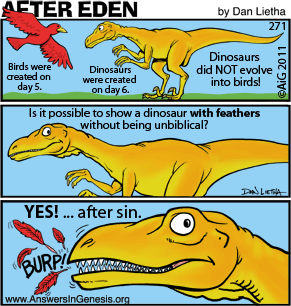
What does the Bible say about the evolution of birds? Well, it says God created all the flying creatures on the Fifth day of the Creation week, 6,000 years ago, the day before He created dinosaurs.
“And God created...every winged fowl after his kind: and God saw that it was good...And the evening and the morning were the fifth day.” Genesis 1:21-23.
This is a major contradiction to the evolution story, which states that dinosaurs came about before birds. Meanwhile the Bible states that land animals – dinosaurs included – came after birds! And instead of evolving through the processes of natural selection and mutation like evolution teaches, birds appeared on earth fully-formed and ready for action.

Evolutionists commonly point to Archaeopteryx as being a transitional form between dinosaurs and birds.
Many evolutionists (specifically atheists) believe that there is too much evidence for evolution for creation to be true. I find it rather interesting how many evolutionists refuse to even consider creation an option; in fact, many will go as far as to say that creationists don't know science. I was browsing the internet and came across an article entitled Feathered Dinosaurs Drive Creationists Crazy by Brian Switek. “Oh, really?” I thought upon seeing this article; I was rather unimpressed by this evolutionist's attempt to denounce creationists. Curious, I read the article, expecting to find much criticism aimed at creationists. Much of the article was devoted to how our view of dinosaurs has changed over the years, but perhaps a quarter into the material, he talked about creationists and the “overwhelming evidence” that dinosaurs evolved into birds, in addition to his other criticisms about dinosaurs living with humans and dinosaurs living 6,000 years ago etc. He also spent a great deal of time talking about Answers in Genesis CEO Ken Ham and the Creation Museum. Here's an excerpt below:
“...dinosaurs with feathers are not welcome at Ham's amusement park [speaking of the Creation Museum]. Even though paleontologists have uncovered numerous dinosaurs with everything from bristles and fuzz to full-flight feathers—which document the evolution of plumage from fluff to aerodynamic structures that allowed dinosaurs to take to the air—creationists deny the clear fossil record.”
He had much more to say of course, some of which I'll get to in a minute. I must say that while reading the article, I was troubled how many misconceptions Switek has about creationism. What really ticks me off is when evolutionists try to make a case for themselves without actually doing the research. I find Switek's ignorance of what we creationists believe appalling. If only he continued to research and find answers to why creationists don't believe dinosaurs evolved into birds, then perhaps he would not have been so bold in his statements. Like any other fossils in the fossil record, even though the observable evidence – dinosaur and bird fossils – can point to or suggest a certain conclusion, they do not speak for themselves and are left to the interpretation of the individual based upon observable evidence. Evolutionists like to claim that creationists start from a presupposition and use that to base their opinions on, while they base their opinions on scientific facts. Now, it is true that we have presumptions, but so do evolutionists! They fail to realize is that they do the exact same thing. In this article, I plan to talk about the evidence for and against the dino-to-bird hypothesis and see what the evidence best suggests.


So what is the “evidence” for this belief in dinosaurs evolving into birds? Switek claims there is a “mountain of evidence that birds are living dinosaurs” and that we creationists deny the clear fossil record. Let's at the so-called evidence now and see whether we're the ones rejecting the clear fossil record. Before we go on though, let me explain that evolutionists do not believe all dinosaurs evolved into birds; they believe the ancestors of birds are maniraptorans, small theropod (meat-eating) dinosaurs. Some of these dinosaurs include Deinonychus, Troodon and the famous Velociraptor.

Dromaeosaurs, such as this Velociraptor, are commonly seen as relatives of modern birds.

Bird-hipped and Lizard-hipped Dinosaurs
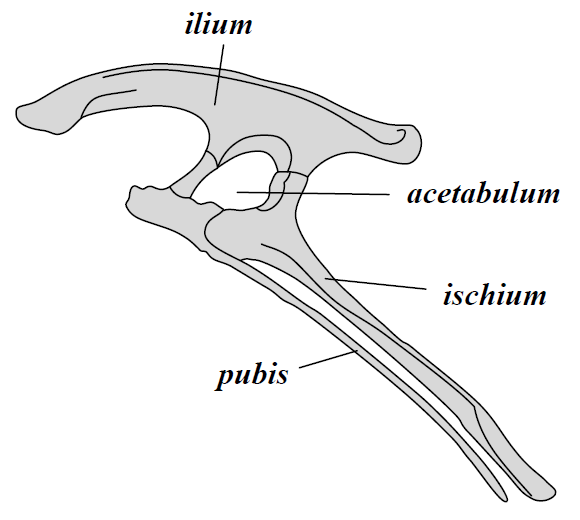
Evolutionists are quick to mention that maniraptorans are very similar to modern birds anatomically. This is true. In fact there are over 100 skeletal features that dinosaurs share with birds; some dinosaurs such as Velociraptor even had a wishbone. But what is often not mentioned are the often quite significant differences between the two. Within the order Dinosauria there are two subcategories in which dinosaurs are divided, saurischians (lizard-hipped dinosaurs) and ornithiscians (bird-hipped dinosaurs). The dinosaurs in these two categories are divided based upon their hip shape. The difference between the two hip shapes is the pubis bone; the pubis bone in birds and bird-hipped dinosaurs points toward the rear instead of to the front as in lizard-hipped dinosaurs, modern reptiles and mammals.

Saurischian or lizard-like hip structure.

Ornithischian or bird-like hip structure.

Problem with dino-to-bird evolution? All the dinosaurs that evolutionists believe are related to birds (e.g. Velociraptor, Troodon, Sinornithosaurus) are lizard-hipped! Dinosaurs that are bird-hipped include Stegosaurus, Triceratops and Parasaurolophus. These dinosaurs bear very few bird-like features and are not believed to have evolved into birds. Yet the few times this is ever mentioned in secular literature, documentaries and etc. this problem is never presented any emphasis. And why would they? 
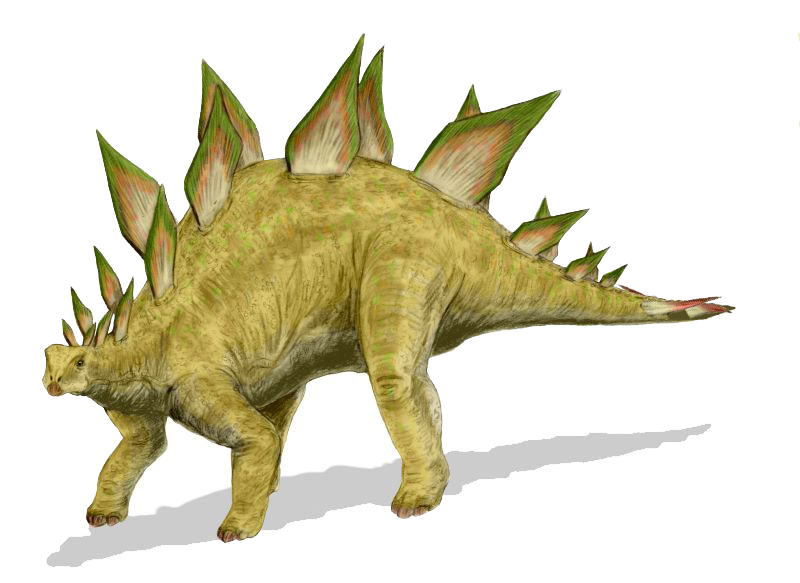
The lumbering 4-ton Stegosaurus is a bird-hipped dinosaur, meaning it must have evolved into birds! Right? Of course not!

Three-Fingered Hands

The hand bones of Dienonychus (left) and Archaeopteryx (right) are quite similar.
Evolutionists absolutely love to talk about how both theropods and birds have three-fingered hand bones. Evidence of a dino-bird relationship? Hardly. As birds supposedly evolved from theropods, you'd expect that the digits represented in the hand bones would be the same in both dinosaurs and birds. However, dinosaurs have the 1st, 2nd, and 3rd digits (the first being the thumb); birds have the 2nd, 3rd, and 4th digits in their hand. What happened?

Avian vs. Reptilian Lungs
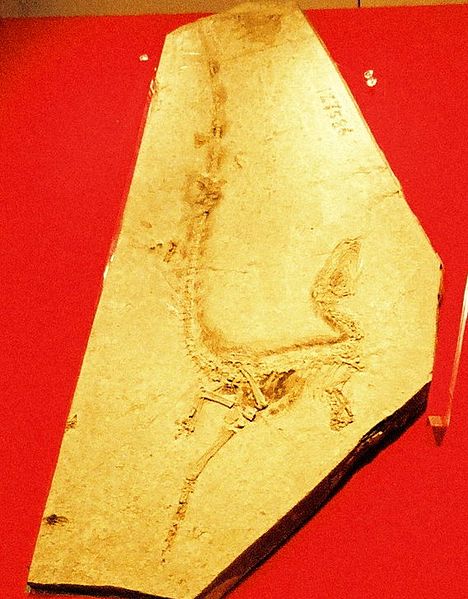
The dinosaur Sinosauropteryx was so well preserved, that the reptilian-like lungs have also been fossilized.
If theropods are the ancestors of birds, you should find avian-like lungs in theropods. Of course, as most dinosaur remains are fossil bones, we can't know too much about their lungs and respiratory system. However, paleontologists have discovered the fossilized remains of a Sinosauropteryx, a small bird-like theropod from China, related to Compsognathus. This Sinosauropteryx specimen retains the outline of the visceral cavity, and it is very well preserved. Much to the dismay of evolutionists, they reveal that the lung is very much like that of a crocodile.

In Switek's article, he mentions how the Creation Museum didn't display feathered dinosaurs, nor does Answers in Genesis portray dinosaurs with feathers in books and DVD's. And he's right. But what if there's actually a scientifically good reason for this? Of course, failing to do his research to see why creationists don't portray feathered dinosaurs, he just scoffs and claims that “they take pride in promoting out-of-date, monstrous dinosaurs that more easily fit their contention that these animals were created separately from all other forms of life.” I'm very sorry Switek, but maybe you are the one who's trying to go against the fossil evidence. Like just about every other evolutionist out there, he claims that creationists just believe in non-feathered dinosaurs because we believe they didn't evolve into birds and then points to so-called “feathered” dinosaurs; no further explanation is given. He would have only had to read a few articles on the Answers in Genesis website to find their true opinion, which I will get to in a minute.

Is there actually evidence to support the belief that dinosaurs, like this Troodon, had feathers?
There are two types of “feathered dinosaurs” you'll hear about: dinosaurs with bird-like flight feathers and dinosaurs with proto-feathers. First let's look at the dinosaurs with “proto-feathers”. In 1996, evolutionists thought they found the amazing proof for their theory upon the discovery of Sinosauropteryx. This small carnivorous dinosaur is associated with the outline of what many believe to be fur-like proto-feathers. But upon looking at the “proto-feathers” closely, you can see that they really aren't that feather-like. They are much more similar to hair in appearence. In fact, it seems to some creationists that seems that these features are actually connective tissue fibers (collagen); this is found in the deeper dermal layers of the skin. These features have been found not only on other dinosaurs, but also ichthyosaurs, dolphin-like marine reptiles! Yet no one suggests these creatures were feathered. Another thing about the "fluffy-looking" structures  that creation scientists have noticed is that many of these structures appear almost fur-like. Perhaps some of these dinosaurs were covered in something similar to pcynofibers, fur-like structures found on pterosaurs that are very similar to mammalian hair.
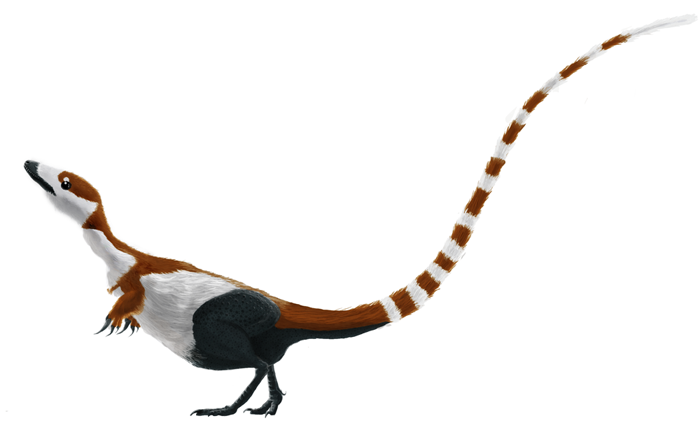
Dinosaurs like Sinosauropteryx might have been covered in a type of "fur".
In this article, Switek mentions this fossil discovery:
“Put feathers on a Velociraptor—we know it had feathers thanks to quill knobs preserved along its arm bones—and you get something disturbingly birdlike, revealing the dinosaur's kinship to the ancestors of Archaeopteryx and other early birds.”
In 2007, scientists published the find of a fossil arm bone of a Velociraptor. Along the forearm are six bumps that they claimed were very similar to those found on the bones of some modern birds. In modern birds the bumps are the quill knobs where feathers were once supposedly rooted. Is this proof of a feathered dinosaur? Perhaps, but sources that talk about this find give no details as to why the quill knobs don't extend further along this bone or if there were other fossils were also examined or how complete the find was. Who's to say this is even the arm bone of a Velociraptor? There are many uncertainties with this fossil. Keep in mind that I'm not doubting the validity of the scientists who studied the fossil, but we should also remember that we should be cautious about such claims based on scant evidence and the claims made by scientists with evolutionary presuppositions.
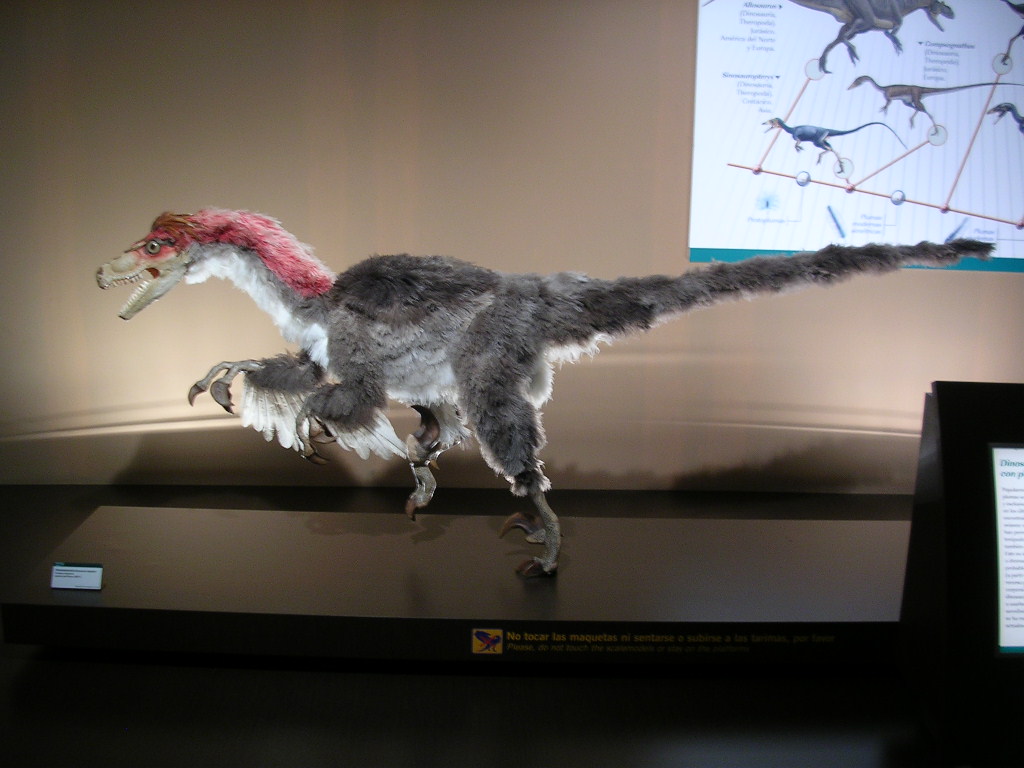
No feathers seem to have been present on Velociraptor, but pcynofiber-like fuzz is still a possibility.
What about “dinosaurs” that actually have fully-functional actual feathers? Archaeopteryx and Microraptor are two such creatures. Both of these animals bear toothy snouts, clawed and feathery wings and bony tails. They also both have a pair of enlarged retractable toe claws like those of raptor dinosaurs, such as Deinonychus and Velociraptor. Surely this is proof that these animals are the missing links between dinosaurs and birds.

Microraptor is a very unique creature with four fully-functional feathered wings.
First of all the feathers on the bodies of Archaeopteryx and Microraptor are actual feathers and not collagen fibers or fur-like structures. They also have the same digits configuration of modern birds (like modern birds they bear the 2nd, 3rd and 4th digits). Undoubtedly, these animals are birds. The fact that they have reptilian features does not make them half reptile/half bird. In fact, there are several actual birds that have reptilian features: ostriches and baby hoatzins also have clawed wings, and no one questions that these animals are birds; the extinct bird Hesperornis possesses teeth in its beak; and the seriema of today even has an enlarged second toe claw, similar to the ones seen in raptors. If you don't need a missing link between dinosaurs and birds (which creationists don't) then there's no need to call Microraptor and Archaeopteryx anything other than 100% birds.

The seriema is a medium-sized bird living today with an enlarged toe claw, similar to the ones found on dromaeosaurs.
If you look in dinosaur books, you've likely seen diagrams similar to the one below:

This is a typical chart showing the evolution of dinosaurs to birds.
This picture suggests that the fossil record wonderfully displays the evolution from dinosaurs to birds; with more dinosaur-like creatures in lower geologic rock layers and more bird-like creatures in higher layers, slowly evolving more complex feathers. Isn't it strange that we creationists reject the plain evidence in the fossil record as Switek states we do?

Unfortunately, this isn't what the fossil record represents at all! Despite this being portrayed in just about every secular dinosaur book, the “clear fossil record” (as Switek puts it) tells a different story. Archaeopteryx, the famed transitional between dinosaurs and birds is believed to have existed 150-148 million years ago, during the Late Jurassic Period. The problem? Most bird-like dinosaurs that are commonly said to be closely related to birds, according to this worldview, lived before Archaeopteryx! Sinosauropteryx, a dinosaur with “proto-feathers” is claimed to have lived 124-122 million years ago! In fact, most dinosaurs with so-called “proto-feathers” are found above rock layers with more bird-like animals! The only dinosaur with "proto-feathers" that evolutionists have that didn't live after Archaeopteryx is Juravenator. But according to evolutionists, Juravenator lived at the same time as Archaeopteryx! In addition to this, we find birds very similar to the ones we see today living with "dino-birds". A Microraptor skeleton described in 2011 was discovered with tree-perching bird fossils (more bird-like than Microraptor) inside of its abdomen! This animal didn't only live with modern-like birds – it ate them! Even Velociraptor, a very bird-like dinosaur, is usually dated to live about 80 million years ago, long after birds has supposedly been flying through the skies for millions of years. These creatures were hardly ancestors to the birds. I for think the fossil record clearly demonstrates that dinosaurs evolved into birds, don't you? (That was sarcastic by the way).

Of course, I am not at all saying we should find all the transitional forms between dinosaurs and birds if this transition really did occur, but we should find a few. Evolution on this scale would take tens of millions of years and millions of generations between dinosaurs and birds. Where are these fossils? Surely some should have popped up if the "clear fossil record" suggests dinosaurs evolved into birds.

And to make matters even worse for evolutionists, extinct birds such as Anchiornis, Xiaotingia, Aurornis and potentially Protoavis are buried in sediment “older” than Archaeopteryx!
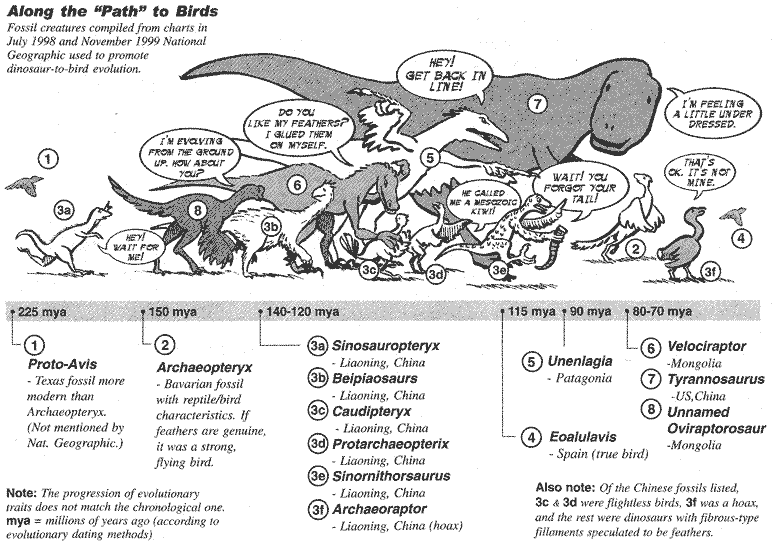
So, Switek, you believe the "clear fossil record" portrays dinosaurs evolving into birds? Hm...

Earlier, I mentioned how Switek claimed creationists don't like feathered dinosaurs. What if a feathered dinosaur with actual feathers were discovered? Would this prove that dinosaurs evolved into birds and that the Bible is untrue? Nope! In fact, nothing in the Bible goes against the idea that dinosaurs might have had feathers. Not only that, but I happen to like the look of feathered dinosaurs; I am not against the notion of feathered dinosaurs in the slightest, just the idea that they evolved into birds. Finding a feathered dinosaur would be no different than finding a mammal that lays eggs. which we actually have! The duck-billed platypus and porcupine-like echidna are monotreme mammals that lay eggs instead of giving birth to live young like all other mammals. Yet they aren't half mammals/half reptiles; they're mammals that lay eggs. We creationists aren't against the idea of feathered dinosaurs at all, it's just that so far, the evidence for feathered dinosaurs is missing in action.

Like Microraptor, the platypus bears characteristics of many different creatures, including the ability to lay eggs, a duck-like bill, a beaver-like tail and webbed feet, a mammal's fur, the ability to use a form of sonar and even a venomous spur. Yet it is not some evolutionary missing link, but a mosaic.
In order to prove that dinosaurs evolved into birds, one would need to find evidence of a transition between the two in the fossil record (like reptile scales evolving into feathers) and the fossil record would need to show dinosaurs and birds evolving in the right order. This is not what we find!

Why haven't evolutionists who love to talk badly about creationists bring up the points I made in this article? An even better question is why would they do such a thing? Never in Switek's article does he even mention these problems with the dino-bird theory (or solutions to them)! Like many other evolutionists out there, he decided to pick on the claim made by creationists rather than the evidence that backs up the claim in order to make creationists sound like unprofessional idiots. What he wrote in this article shows just how utterly and willingly ignorant he is of creationism and what we believe to be true (and more importantly why we believe it to be true).


As I hope to have made clear throughout this article, if one looks at the fossil record from an evolutionary perspective, we don't really learn about the origin of birds. It's really sad how little research Switek did on the truth about creationism, Answers in Genesis, dinosaurs, birds and the fossil record as a whole. I doubt hearing the truth would have actually change his mind, but at least he would have been more informed. Until he decides to learn what creationists actually have to say and only talking about evidence from his own side of the argument, he should avoid talking about creationism altogether. (Unlike him, I used information from both sides).

I do however hope that this article has enlightened you, my readers, and helped you understand that the fossil record doesn't support the belief that birds and dinosaurs didn't share the same lineage, but that they do share the same wonderful Creator God.


You can relax, dinosaur lovers! The turkey you'll have for Thanksgiving this year isn't the descendant of this Velociraptor!

References:
wikipedia.org/wiki/Origin_of_birds
answersingenesis.org/dinosaurs/feathers/did-dinosaurs-turn-into-birds
answersingenesis.org/dinosaurs/feathers/feathered-raptors-not-the-birds
wikipedia.org/wiki/Archaeopteryx
wikipedia.org/wiki/Microraptor
wikipedia.org/wiki/Sinosauropteryx
Feathered Dinosaurs Drive Creationists Crazy

Disclaimer: Many (or in some cases all) of the photographs and images above are not mine. If you own one or more of them and would like them to be removed, politely let me know via one or both of the email addresses above.

Disclaimer 2: I know I've been talking negatively a lot about Brian Switek article, but this isn't because I don't like the guy. I have read much of his other material and admire his writing style; even though I don't agree with everything he believes.

Friday, October 16, 2015

Pumpkins and Pompions


As usual, October is moving through mighty quick! Yesterday marked the half-way point toward the end of the month. Here in Utah, the weather is not too cold yet. However, it is still pretty nippy sometimes in the mornings. I can't wait till the hot days are officially over.

Days Till
It is: 15 days till Harvest Day
It is: 40 days till The Good Dinosaur's release
It is: 41 days till Thanksgiving
It is: 70 days till Christmas

In the Spotlight
Unfortunately, I really have nothing interesting to share this week.

Topic of the Week by Christian Ryan
Boy, do we have pumpkins or what? (Wikimedia Commons)
Fall is now upon us and that is a time we commonly shift our thoughts to a plant that produces large orange objects; yes, I'm talking about the pumpkin! Pumpkins are commonly grown, and carved into Jack-o-lantern's in October before being chopped up and made into pumpkin pie by Thanksgiving. We all know that, but if you continue to read, you may come across some things about the pumpkin you never knew before.

What is a pumpkin? If you said a vegetable, you're wrong – the pumpkin is actually a fruit, but more specifically, a berry. Pumpkin we typically associate with the word “pumpkin”, grow and consume derives from the species Cucurbita pepo. As they are in the family cucurbitaceae (which is Latin for “gourd”), they are close cousins of other squashes, gourds, melon (e.g. watermelon) and cucumbers. But these fruits didn't all evolve from a common ancestor (that is, progressively become more advanced through the process of evolution), rather, they all descended from the original member of the “gourd baramin” (or kind) God created on Day 3 of the creation week, in addition to the other plants He made. What sets pumpkins apart from other gourds is their round shape and lightly ribbed skin. Usually pumpkins are orange, but they also come in yellow, red, white or even green. They also come in a wide range of sizes, from the diminutive 6-pound ball and the average-sized 13-pounder, to the massive 2,323.7-pound monster presented by Beni Meier that broke records and claimed the title of world's heaviest pumpkin in Germany last year. Just imagine how much pumpkin pie that would have made!

Pumpkins can grow to be over a ton in weight, making them the world's biggest berry! Yes, pumpkins are berrys. (Wikimedia Commons)

Pumpkins are native to North America and were unknown to the Old World until Columbus. In fact, these orange fruits have been grown in Central America for thousands of years by the Native Americans. Pumpkins gained notice among Europeans starting In 1584 when the French Explorer Jacques Cartier was exploring North America's St. Lawrence region. The word pumpkin was derived from his own description of these large fruits, “gros melons”, which was translated into English as “pompions”. Overtime, “pompions” became pronounced as “pumpkins”.

This picture was made in 1874, but pumpkins have been loved by people for much longer than that! (Wikimedia Commons)
Ever since their discovery, pumpkins have revolutionized the world. As I mentioned before, pumpkins have a myriad of different uses. During the month of October, we like to carve them into jack-o-lantern's. Interestingly, these face-carved fruits get their name from an Irish legend featuring a man by the name of Stingy Jack who's mischief had disallowed him to enter Heaven after he died, but the Devil didn't want him in Hell either and was sent out into the night. So, according to the story, Stingy Jack put a burning coal into a carved out turnip and has forced to wonder the earth ever since. To keep Stingy Jack at bay, people in olde Ireland and Scotland made their own versions of Jack's turnip lantern by carving scary faces into large turnips or sometimes potatoes. Eventually, this tradition was brought to America by the Irish, and pumpkins began to be used for carving instead.


Jack-o-lantern's were originally made out of turnips and potatoes!
Pumpkin pies are another common use for pumpkins nowadays, but this delicious dessert has been consumed for far longer than you might think. The Pilgrims were introduced to pumpkins by the Native Americans when they set sail for the New World in 1620 and it wasn't long before people began to use the fruit to make pies. Through much of the mid-1600's, chefs had many different ways to make pumpkin pie. According to the History Channel,
“A 1653 French cookbook instructed chefs to boil the pumpkin in milk and strain it before putting it in a crust. English writer Hannah Woolley's 1670 'Gentlewoman's Companion' advocated a pie filled with alternating layers of pumpkin and apple, spiced rosemary, sweet marjoram and handful of thyme. Sometimes a crust was unnecessary; an early New England recipe involved filling a hollowed-out pumpkin with spiced, sweetened milk and cooking it directly in a fire” – History Channel's The History of Pumpkin Pie

Who doesn't want a little pumpkin pie for Thanksgiving? (Wikimedia Commons)
Yes, pumpkin can be used in a variety of ways and fashions: in the kitchen, it is baked, roasted, steamed or boiled or even made into soups. Sometimes we chunk them – we throw pumpkins are hoisted onto mechanical devices designed to lunge the pumpkin as far away as possible, usually resulting in a huge splat! Sometimes we have contests to see who can grow the biggest pumpkins. Pumpkins have even made it into our folklore and fiction, from “Jack's Lantern” to the pumpkin Fairy Godmother turned into a carriage for Cinderella and the Great Pumpkin that Peanut's Linus van Pelt insists “rises out of the pumpkin patch and gives toys to all the good little children”.

A world without pumpkins would surely be very different place.


Enjoy your pumpkins this year!
Disclaimer: The images above are not my own unless otherwise indicated. If you own one of the above images and want it removed, please notify me via my email.

References:
www.sciencekids.co.nz/sciencefacts/food/pumpkins
www.pumpkinfarm.com/fun_facts
www.history.com/topics/halloween/pumpkin-facts
www.thepumpkinfarm.com/faq
www.pbs.org/food/the-history-kitchen/history-pumpkin-recipes
www.history.com/topics/halloween/jack-olantern-history
www.history.com/news/hungry-history/the-history-of-pumpkin-pie
www.wikipedia.org/wiki/pumpkin
www.wikipedia.org/wiki/Cucurbitaceae

Friday, October 2, 2015

Sarcosuchus: Pharaoh of the Crocodiles

Another frigid morning! I can't believe that October is here already. This month year has flown so fast! I've literally started singing Christmas songs already and I'll probably start watching Christmas movies very soon. (I start early because it takes me literally three months to watch all the Christmas movies I have and the ones I get on Netflix.) This week's topic isn't fall-related, but next week's will be. How exciting!

Days Till:
It is: 10 days till Colombus Day
It is: 29 days till Harvest Day
It is: 54 days till The Good Dinosaur's release


In the Spotlight:
I found several cool TV spots for The Good Dinosaur to share this week, so please enjoy!


Topic of the Week by Christian Ryan
Contrary to popular belief, dinosaurs weren't always the rulers of their domain! (Wikimedia Commons)
Dinosaurs are often thought of as being the terrors of the world they inhabited, and indeed, the pre-Flood world's single supercontinent – Rodinia – was infested with them. But dinosaurs weren't the only danger of the antediluvian world – swimming in the lakes, ponds and rivers of this ancient world were crocodilians, many a lot like the ones we have today. But there was one crocodilian that dwarfed them all: Sarcosuchus imperator, also known as SuperCroc! In life, it must have been an impressive beast...a beast so big, it didn't merely coexist with dinosaurs, it ate them!

Why are you just standing there waving, dude? Run! (Wikimedia Commons)
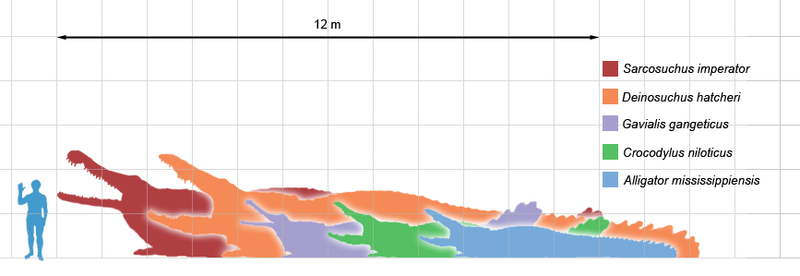
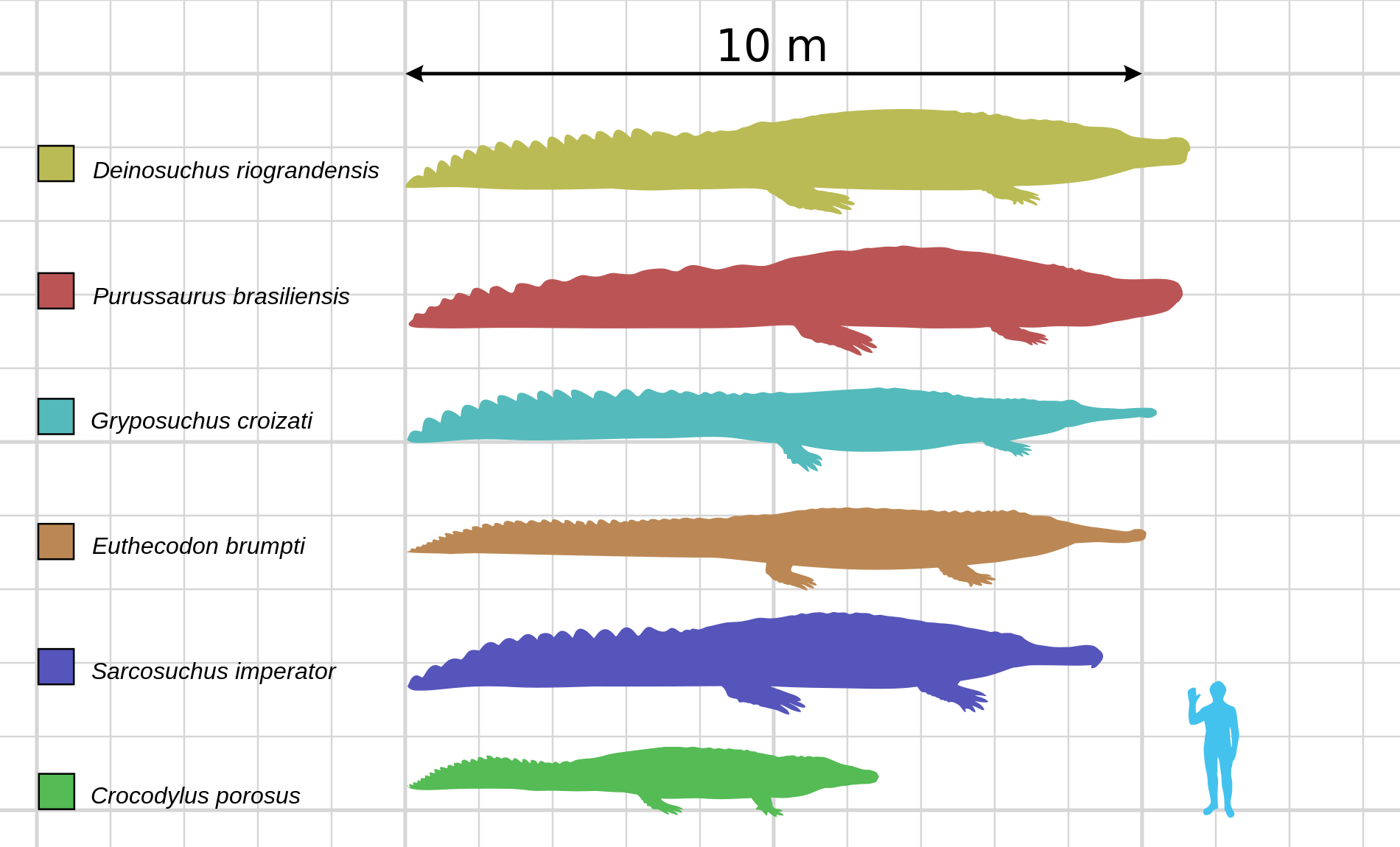
The largest reptile alive today, the saltwater crocodile, grows up to 23 feet long and weighs a maximum of around 2,200 pounds. This is nothing compared to the mighty SuperCroc, which fossils prove could grow over 40 feet long. Its weight? Eight to nine tons*. This was a croc that even the Crocodile Hunter (R.I.P Steve Irwin) and Crocodile Dundee might have done best to avoid! SuperCroc's scientific name, Sarcosuchus imperator even means “flesh crocodile emperor”.


Scientists are as of yet undecided as to what the largest crocodilian was. (Wikimedia Commons)
* There is debate among paleontologists as to what the largest species of crocodile was, as there are several candidates. One is the North American Deinosuchus, an alligator-like crocodilian, another Purrasaurus (not to be confused with the Triassic phytosaur Parasuchus) which was a giant caiman, and of course, Sarcosuchus. Based on fragmentary fossil remains, we can't be sure which was the largest, but evidence suggests that all three species were between 33 and 40 feet in length.

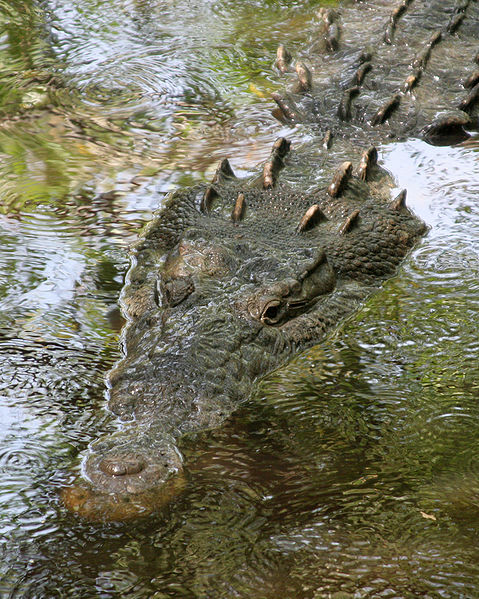
Sarcosuchus shared many similarities to its modern cousins, such as this crocodile. (Wikimedia Commons)


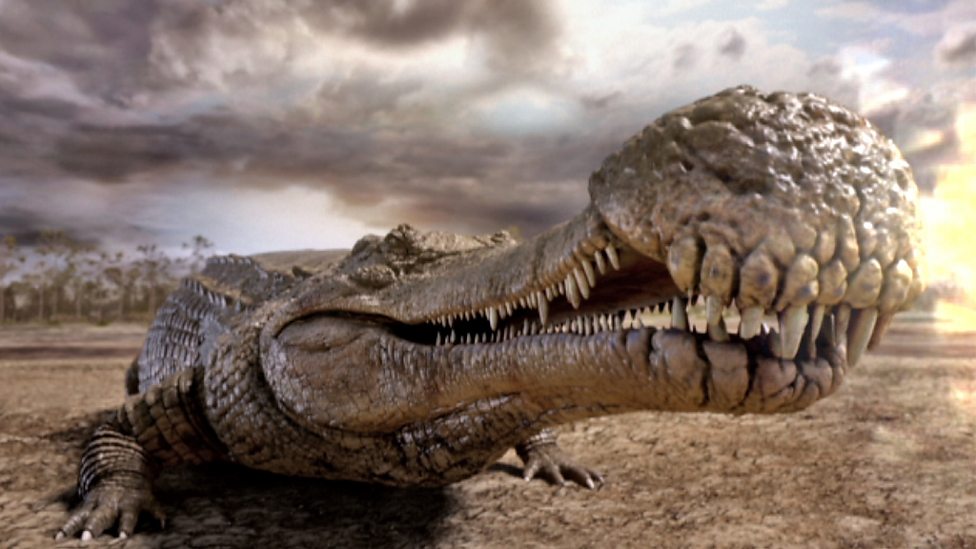
Despite being far larger than any modern crocodile, Sarcosuchus nevertheless shared several survival traits with them; many of these For traits help the animals live semi-aquatic lives. For example, Sarcosuchus and modern crocs have their eyes and nostrils placed at the tops of their heads (actually, Sarcosuchus' eyes are slightly elevated above the rest of the skull). This means that they can remain these predators can remain almost completely submerged in water and still see and smell. We don't know how good Sarcosuchus' senses of sight, hearing and smell were, but in modern crocodiles, these senses are excellent. They even are relatively intelligent creatures. It's more than likely Sarcosuchus possessed these attributes as well. Sarcosuchus' skull alone was over six feet long and every inch of it was lined with sharp teeth. There were over 100 teeth in its mouth. SuperCroc's back was covered in rows of overlapping shield-like armor plating called scutes. These “shields” could be over a foot long and were situated kind of like roofing tiles. One gazing at the skull of Sarcosuchus wouldn't fail to notice the large bulge at the end of its six-foot snout. This bulge is known as a bulla and is similar to the ones seen in modern gharials, except its hollow and bowl-shaped. Scientists are unsure of its use, but many believe it was for making bizarre calls or improving its sense of smell.
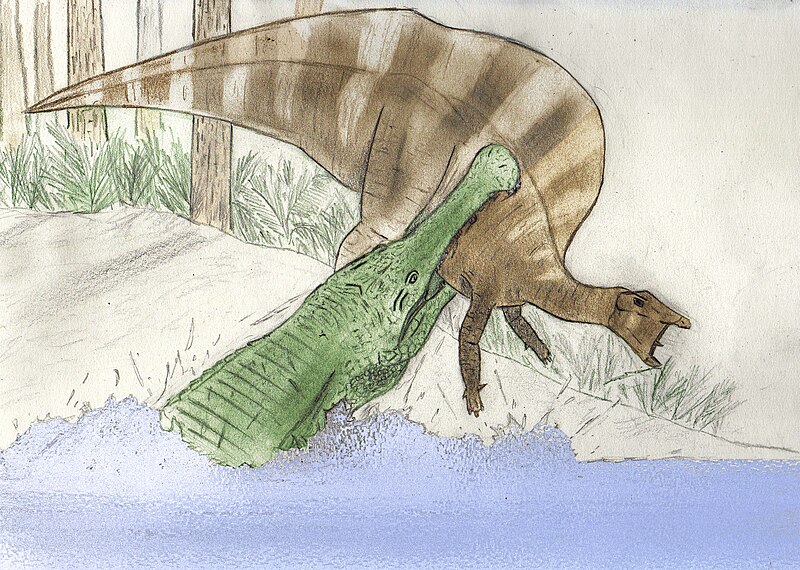
Sarcosuchus was the true king of the waterways it inhabited. (Wikimedia Commons)
The fossils of Sarcosuchus have been uncovered in South America and more commonly in Northern Africa. The regions bearing fossils of this beast are deserts now, but the fossils in these rocks represent a long-gone ecosystem that once existed in the pre-Flood world. Fossilized plants and animals of North Africa reveal the land was once a vibrant, tropical swamp-like environment with plentiful plant life for herbivorous dinosaurs to chow on, and lots of large fish in the waters. This was the home of Sarcosuchus.

Pre-Flood Egypt might have looked a lot like the modern day Everglades. (Wikimedia Commons)
This brings us to another important question: what did SuperCroc eat? Well, like its modern counterparts, Sarcosuchus was a carnivore, and there was plenty of prey in pre-Flood North Africa. You might imagine that fish were too small to sustain a nine-ton crocodile, but the fish SuperCroc lived with weren't all minnow-sized. Fossils reveal nine-foot lungfish, giant six-foot coelocanths and 20-foot sawfish swam in the waters the giant crocodile called home. Though many parallells are drawn between Sarcosuchus and the fish-eating gharial, the two have a different tooth design – while the gharial has interlocking teeth (as do most crocodiles) to capture fish, Sarcosuchus' teeth do not interlock. Interestingly, its discoverers compared this crocodile's teeth to railroad spikes. Sarcosuchus was certainly large enough to prey on something other than fish; it was probably a dinosaur killer. What dinosaurs were on this reptile's menu? 30-foot ornithopods like Ouranosaurus and Lurdusaurus and even juvenile long-necked sauropods such as Nigersaurus might have been prey for Sarcosuchus.

Like a modern croc, Sarcosuchus would lunge from the water's edge and grab prey, in this case an Ouranosaurus, with its long jaws. (Wikimedia Commons)
Just like the modern crocodile, Sarcosuchus was an ambush predator. It lied in wait near the water's edge for prey to approach, with only its eyes and nostrils above the water. Then, when prey like an ornithopod got close, it would lunge out of the water and catch the hapless prey in its jaws, holding it in place with its 100+ teeth. Sarcosuchus didn't have a weak bite either. Recently scientists determined that SuperCroc could bite down with the force of nine tons! That's nastier than the bite of Tyrannosaurus, with its 3-ton bite by comparison. Unfortunately for this crocodile, it didn't have the water's edge all to itself, as SuperCroc often had to share the territory with semi-aquatic dinosaurs like the spinosaurs Suchomimus and the 20-ton Spinosaurus itself. Perhaps these animals occasionally fought each other over food or territory.

Who would win in a fight between Suchomimus and Sarcosuchus? (Raul Martin)

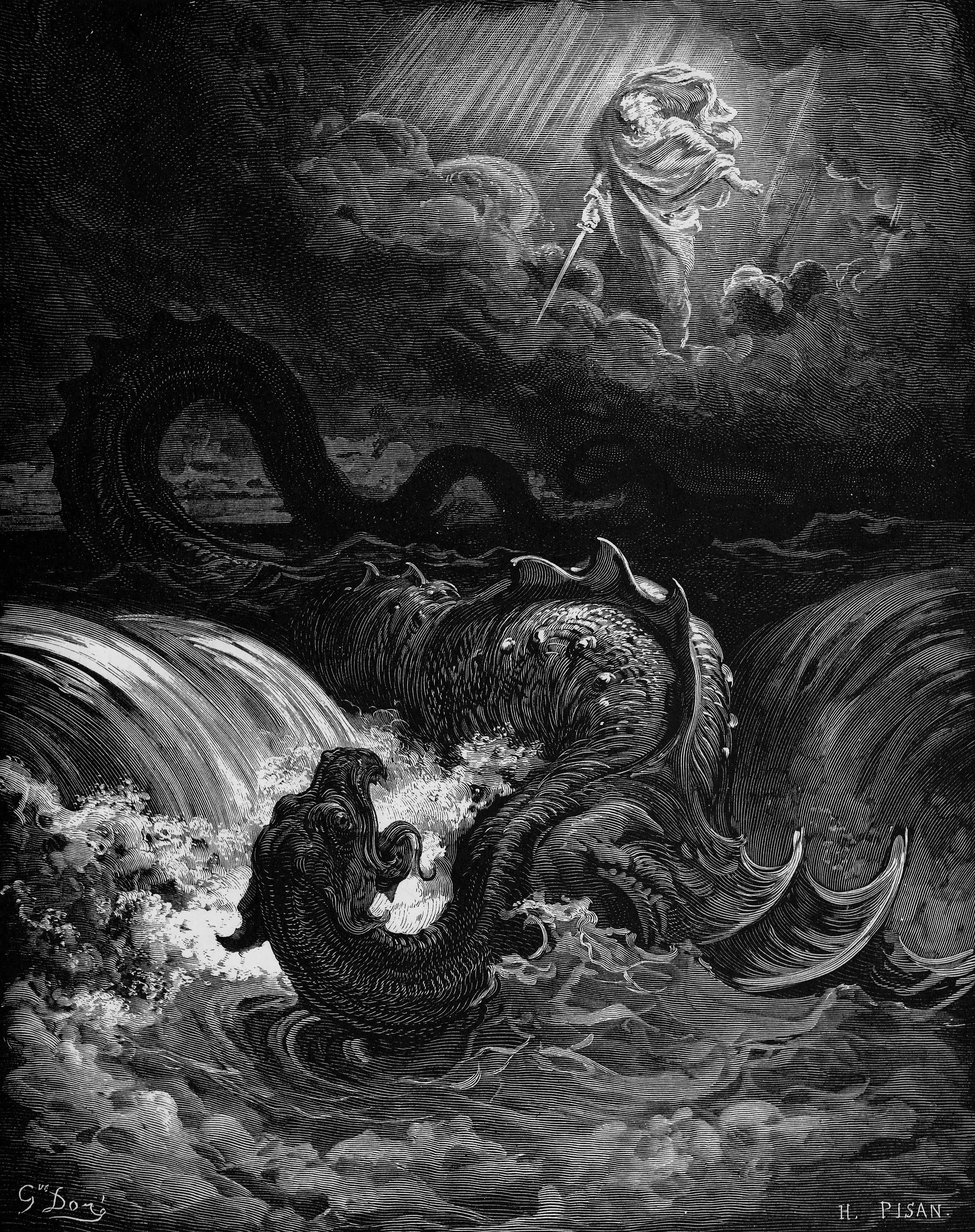
A creature like Sarcosuchus was certainly an awe-inspiring reptile. This is why some creation scientists have begun to notice many parallels between it and a creature mentioned in the book of Job in the Bible. In Job 41, God talks about a colossal creature called Leviathan. It's said to have terrified even the mightiest of men. Its jaws were lined with many teeth, its form was quite graceful and spent most of its time in the water. The Bible says its scales are so tough that they repel swords and spears. But what was very unique about this creature is that it could actually breathe fire and smoke. Just another ancient myth?

We may not know what Leviathan looked like, but it certainly didn't look like this monster that doesn't match the creature described in Job 41 at all!
Not in the slightest. Based on the context of the verse, we can see that God was speaking of a real animal. Some have pointed to the crocodile as the prime candidate for Leviathan; however, Leviathan clearly was not a crocodile (a modern one, anyway), because crocs not only are unable to breathe fire, but, with skill and determination, can be killed (Leviathan was described as being a creature that couldn't be killed by human weapons of the time). For years, creationists have scratched their heads, trying to find an extinct creature that fit Leviathan's description, suggesting anything from the aquatic Kronosaurus, which, unlike Leviathan, was unable to clamber onto land, to the terrestrial Tyrannosaurus rex, which wasn't in its element in the water like Leviathan was. However, many creation scientists feel that Sarcosuchus best fits the description of the biblical Leviathan. Remember the foot-long roof tile-like scales on its back? They certainly bring to mind the tough scales Leviathan is described to have. (“Its back has rows of shields tightly sealed together;” Job 41:15, NIV.) Sarcosuchus might even possess a fire-creating feature: its bulbous snout. Perhaps Sarcosuchus was capable of mixing chemicals in this bowl-shaped bulge to create streaming flames which it cast from its mouth; a similar ability is seen in the modern bombardier beetle which expels noxious chemicals that explode and burn at over 200 degrees. We may not know for sure whether or not Sarcosuchus was the Leviathan of the Bible, but it sure is the best candidate we have at the time of publishing.

Just imagine a blast of fire coming from this Sarcosuchus' mouth and it perfectly fits the description of Job 41's Leviathan! (SOURCE)


Sarcosuchus, SuperCroc...possibly the legendary Leviathan. This beast was certainly one of the most powerful and dangerous animals God made. The very same words used in Job 41:33-34 could also be used to describe Sarcosuchus: “Nothing on earth is its equal—a creature without fear. It looks down on all that are haughty; it is king over all that are proud.” What more can be said about Sarcosuchus imperator, pharaoh of the crocodiles!


Wouldn't it be awesome to come face to face with a living Sarcosuchus imperator...on the other hand, maybe not! (Planet Dinosaur)

References:
news.nationalgeographic.com/news/2001/10/1025_supercroc
articles.chicagotribune.com/2001-10-26/news/0110260187_2_sarcosuchus-super-croc-chicago-paleontologist-paul-sereno
www.prehistoric-wildlife.com/species/s/sarcosuchus
www.wikipedia.org/wiki/sarcosuchus
Brooker, P., A New Candidate for Leviathan? Journal of Creation 19(2): 14–16, 2005; <creation.com/leviathan2>.
www.creation.com/a-fearsome-reptile

Disclaimer: Many (or in some cases all) of the photographs and images above are not mine. If you own one or more of them and would like them to be removed, politely let me know via my email address.