Showing posts with label dinosaurs. Show all posts

Thursday, February 11, 2016

Love in the Time of the Dinosaurs

Hey, everyone! Sorry for being late with this post, but I've had yet another busy week. I think the busyness period is mostly over, so I should be able to post weekly now. Anyway...Valentines Day is right around the corner! The good news is that I have the perfect article for the occasion...I mean, even dinosaurs need a little love in their lives, right?

Days Till
It is: 1 day till President's Day
It is: 3 days till Valentine's Day
It is: 35 days till St. Patrick's Day
It is: 50 days till April Fool's Day

In the Spotlight:
About a month or so ago, I talked about the band Girl and the Dreamcatcher's, featuring Dove Cameron and Ryan Mccartan, previously-latest songs. Well, as of one or two weeks ago, they released a new song called Glowing in the Dark. It's a little sad, but it sounds awesome. Check it out:


Topic of the Week by Christian Ryan
Warning: The topic in this article is intended for adults and teens, not young children. You will find no inappropriate pictures of dinosaur sexuality (no private parts!), crude comments or adult jokes about certain body parts here, but the content is frank and not appropriate for younger audiences.


We know the height, length and diet of huge dinosaurs like Giraffatitan...but how did this 50-ton beast reproduce? By Axel Mauruszat - Own work


Valentine's Day is in just a couple of days. Couples show their affection for each other in various ways. However, love isn't just for humans, and it certainly isn't new. Every year, all animals must reproduce, and this was true with dinosaurs as well. How did dinosaurs attract members of the opposite sex, mate and reproduce?

What color were the dinosaurs? What was the biggest dinosaur? How did they go extinct? These are the types of questions most people ask about dinosaurs. Very few spare a thought for questions like: how did dinosaurs attract a mate? How did dinosaurs mate with all those spines, scutes, spikes and long tails? Since they relate to the behavior of dinosaurs, they are much harder to answer. However, fossils still give us clues that allow us to hypothesize how dinosaurs reproduced after their own kind, as God commanded them in Genesis 1:24.

♂ or ♀
How did dinosaurs, like T. rex, tell each other apart? By user:Eqdoktor - Own work, CC BY 3.0

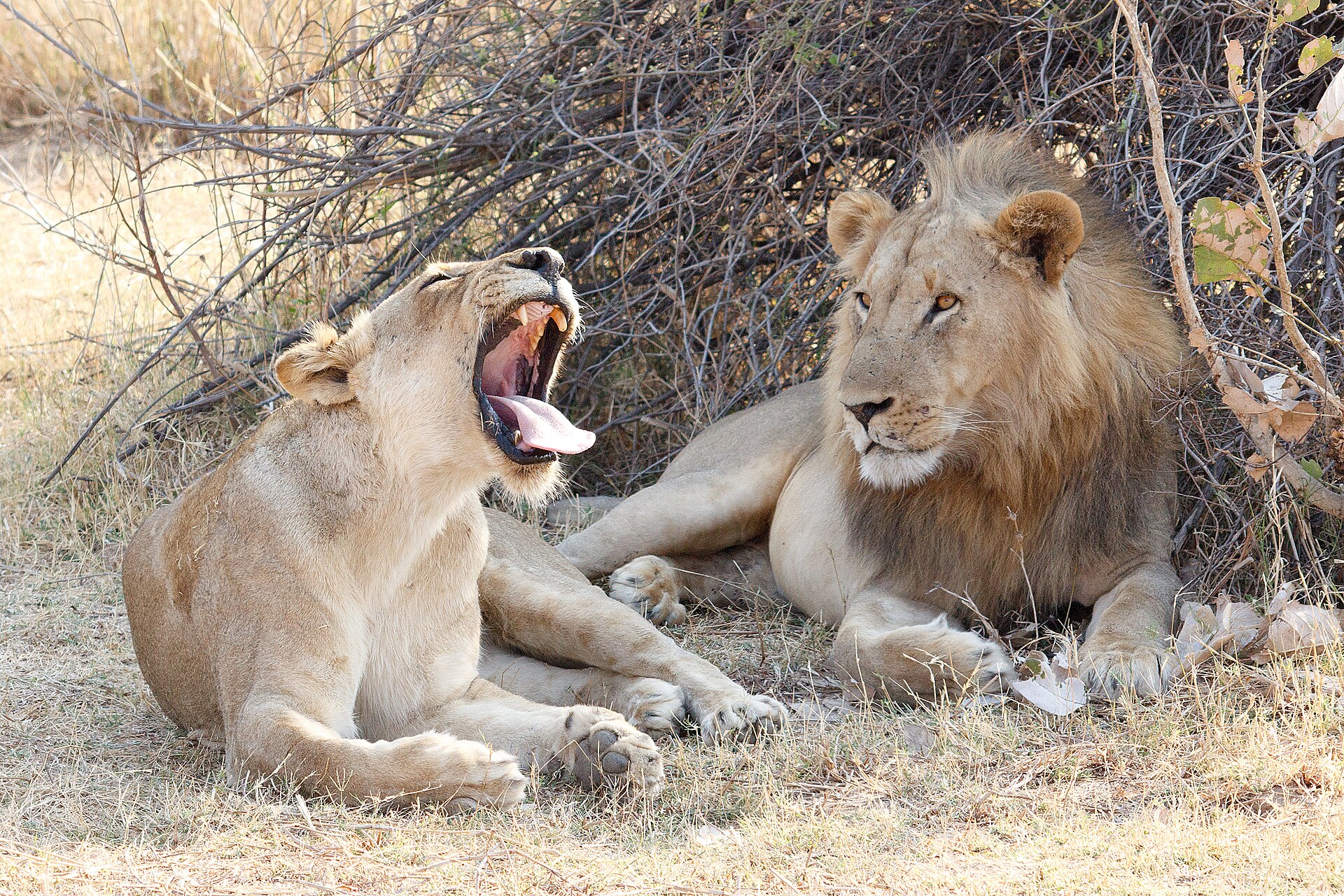
Before we get into how dinosaurs reproduced, perhaps we need to figure out how on earth we tell the difference between a male and a female dinosaur. The answer is: we don't know for sure. Today, animals of different sexes are often visually different: for example, male lions have manes, deer have antlers (exception: reindeer, as both sexes have antlers), peacocks have that elaborate tail and roosters are larger and have a larger comb (that's the fleshy organ on top of their heads) than the females. This is called sexual dimorphism. As most evidences of sexual dimorphism would have been fleshy, and dinosaurs are mostly known of by the fossils we find of them, we can't really know for sure which ones are males or females. But this hasn't stopped scientists from trying to figure it out.


While male lions have manes, lionesses lack them. By Prabir K Bhattacharyya - Own work, CC BY-SA 3.0, https://commons.wikimedia.org/w/index.php?curid=17038978
However, paleontologists have noticed that some dinosaur species come in two different morphs, or versions. A gracile version and a robust version. Maybe these represent different genders, but without finding a fossilized genitalia, it's hard to say which is which. Scientists once thought that they could tell the sex of a Tyrannosaurus by examining the absence of a chevron (a bone that protrudes downward from the tail vertebrae) between the first and second caudal vertebra in robust Tyrannosaurus. This was thought to be the case in female crocodiles, indicating that robust tyrannosaurs were females. But recently, scientists have discovered that this doesn't always hold true in crocodiles, rendering this piece of evidence as weak.


Is it impossible then, to sex a dinosaur? It once was. But inside the leg of a tyrannosaur specimen called B-rex, Dr. Mary Schweitzer identified finding medullary bone. Medullary bone is known to form in the bones of female birds when they are just about to ovulate so that they are able to store up calcium for their developing eggs. Finding medullary bone proved that B-rex was a female. B-rex was also gracile morph, indicating that perhaps the gracile morphs were females and the robust morphs were males. Another attempt to tell dinosaur genders apart occurred in a study published in 2015. A master's student of the University of Bristol named Evan Saitta took notice of the two morphs of a species of Stegosaurus called S. mjosi. One of the morphs had oval-shaped plates, while the other had narrow plates. Saitta hypothesized that the oval-plated morph represented the males of this species since they would have been the largest of the two plate types and therefore might have been used to attract females. Other scientists aren't yet convinced that this is the case, but the possibility remains open.

Scientists might be able to tell the difference between male and female Stegosaurus mjosi by looking at their plates. Photo: Evan Saitta
Sexual dimorphism was almost certainly present in dinosaurs. How sexual dimorphism was exhibited in these creatures – whether it be that one gender grew larger than the other, different crest, frill or horn shapes, different scent and definitely their genitalia – is still unknown. However, that doesn't prevent us from coming up with intriguing possibilities.

Getting Her Attention
Dilophosaurus' head crest was probably brightly-colored. This would have helped the males of this species to attract mates.
With a few rare exceptions, in the animal kingdom, it is the male's job to attract a female with which to mate. Modern animals have a wide array of features and methods to get the job done. Some animals use a visual display approach; the frigate bird is an example of this. When a female frigate bird flies overhead, the males of the species inflate a red-colored throat sac and call out, hoping the female will take notice. Deer on the other hand flaunt their branch-like antlers. Other animals use sound to attract a mate. Male alligators will make deep bellowing sounds during the mating season at the surface of the water, causing water droplets to literally “sprinkle” or “dance” on their backs. Could dinosaurs use similar tactics?

Look at the dewlap (that fleshy appendage hanging from the bottom of the head) on this iguana. Dinosaurs may have had similar fleshy appendages as well, but we don't know for sure (exception: Edmontosaurus regilis). By Eric Kilby from Somerville, MA, USA - Iguana Closeup, CC BY-SA 2.0, https://commons.wikimedia.org/w/index.php?curid=44425921
While the colors of most dinosaurs are a mystery, the species found with melanosomes (cells responsible for producing color), including Sinosauropteryx, seem to have been very colorful animals. Sinosauropteryx was reddish-orange in color and had ginger-stripes on its tail. Maybe male Sinosauropteryx could show off their tails to impress potential mates.

Most fleshy appendages dinosaurs may have had to woo mates, if they had them, would have rotted away, but what didn't decay with time are the plates, spikes, horns and frills displayed on some species of dinosaurs. Initially, these features like the crests of hadrosaurs such as Corythosaurus, the frill and horns of ceratopsians like Chasmosaurus and the crest-like horns adorning Ceratosaurus' head were believed to be strictly weapons for combat. However, features like these were often too fragile to be used for fighting; instead, they were likely brightly colored and used for display. In fact, paleontologists have noticed ceratopsian frills and stegosaur plates would have been loaded with blood vessels in life. This could mean these dinosaurs could flush their frills and plates with blood, making them turn red. Wouldn't that impress the ladies? Remember when I said most fleshy appendages dinosaurs may have had rotted away after the animal died? Well, a few years back, scientists discovered that a duckbilled hadrosaur, called Edmontosaurus regillis, had a crest made of flesh rather than bone as in most hadrosaurs. This was probably brightly colored. What other fleshy appendages may dinosaurs have had?

Edmontosaurus had a fleshy crest on its head for display.
After attracting a mate, modern animals often conduct elaborate dances as a form of courtship. Since behavior generally doesn't fossilize, we can only speculate as to what dinosaurs may have done.

Love in the Time of the Dinosaurs
Now for the million-dollar question: how did T. rex mate? By Usuario:NeGRa - Tomada por Noemy García García usando una cámara Nikon E3200., CC BY-SA 2.5 es, https://commons.wikimedia.org/w/index.php?curid=1789845
It's time for dinosaur reproduction 101! How did dinosaurs mate? This is a question that has kept paleontologists awake at night for centuries. I mean, it's not easy to envision a 75-ton Argentinosaurus or a plate-backed Stegosaurus getting into a comfortable position to mate.

This question of dinosaur reproduction is made even trickier by the lack of a fossilized genitalia. However, if modern reptiles are any indication, we can get a significant clue about what their genitals were like. Like modern reptiles, dinosaurs had a cloaca. This was a slit in the base of the tail through which waste would exit the body and where sexual organs resided. Unlike (unfortunate) male mammals, the testicles and penis of male dinosaurs would have been inside the body. The penis would have only protruded when the animal was ready to mate with a female. And how big were these genitals on the biggest sauropods? Of course, we can't know for sure, but scientists speculate that those of sauropods could have been over 12 feet long! Like the cloaca of a female reptile today, the cloaca of a female dinosaur would have also functioned as the vagina.
Tyrannosaurus might have also used its tiny, but strong, arms to cling to its mate during copulation. By No machine-readable author provided. Fastfission~commonswiki assumed (based on copyright claims). - No machine-readable source provided. Own work assumed (based on copyright claims)., CC BY-SA 3.0, https://commons.wikimedia.org/w/index.php?curid=1027353
How would female sauropods hold the tremendous weight of their partner? Surely, their Creator must have designed their backbones to be strengthened to cope with the weight of the male. How did other dinosaurs mate? Well, in order to deal with the lengthy tails, one way paleontologists think dinosaurs like T. rex and Triceratops might have mated by mounting the female along the side the equivalent of her rump. This way, the lengthy, likely prehensile, penis could maneuver underneath the female, find the cloaca, and insert sperm.

Sauropods, like these titanosaurs, must have had a strong skeleton to support the weight of the mating partner. PHOTO CREDIT


What about stegosaurs? While some members of the family, like Stegosaurus had plates on its back, some stegosaurs like Kentrosaurus had spikes instead! This must have made things especially difficult for the male. Instead of mounting the female in traditional dinosaur fashion, Kentrosaurus males may have allowed the female to lay down on her side. This would make it possible for the male to rear up and rest his torso over her hindquarters.
How did these spiky-tailed Kentrosaurus mate? With GREAT care!


We don't know for sure how dinosaurs reproduced, but we know they must have done so...somehow!

What Happens Next?
What happened after mating? Who can say? Did the male T. rex stick beside his mate to protect her from rivals and help rear her young? Did sauropods split up after mating like many modern herd animals? We just don't know. With a little help from new technology and new fossil discoveries, we can hope that one day, the truth about dinosaur reproduction will finally be revealed for our curious minds.
Maybe it wasn't convenient, but dinosaurs needed to reproduce to propagate their species. Jose Antonio Penas/Science Photo Library
References:
www.scientificamerican.com/article/how-did-dinosaurs-have-sex
www.iflscience.com/plants-and-animals/how-sex-dinosaur
www.smithsonianmag.com/science-nature/how-did-the-biggest-dinosaurs-get-it-on
news.discovery.com/animals/dinosaurs-gender-males-females-110602

Wednesday, December 30, 2015

The New Dinosaurs of 2015

I can't believe it, but we're already approaching the end of 2015, which I think has been my best year of life so far. Not all of 2015 was easy, but this year made for a great life experience for me. So much great stuff happened over the course of this year. 2016 will soon be upon us, and we'll have new adventures to partake in. I can't wait to see what they are!

Once again, it's time to look at the past year's dinosaur discoveries!
Days Till:
It is: 2 days till New Year's
It is: 6 days till My Birthday
It is: 19 days till Martin Luther King Jr. Day

In the Spotlight:
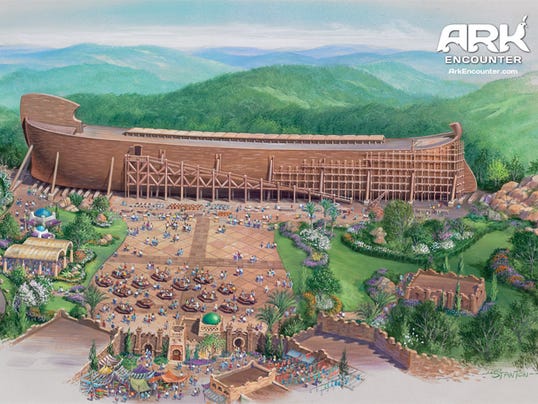
The Ark Encounter, opening July 7th, 2016. (Property of Answers in Genesis)

In addition to the many other things we have to look forward to next year, I'd like to draw your attention to a new “theme park” opening on July 7th, 2016 called “Ark Encounter”. In case you're one of the individuals who's unaware, the Ark Encounter is a subdivision of the creationist company Answers in Genesis (I'm a BIG fan of their work...in case you somehow haven't noticed); not too long ago they opened the Creation Museum in Kentucky. Now, not far from the Creation Museum, AiG is constructing a life-size wooden ark, modeled after the one Noah built in Genesis 6-7. It's going to be 510 feet long, 51 feet tall and 84 feet wide when complete! While the real Noah's ark was technically a floating zoo, perfectly designed to stay afloat on the high global seas, the Ark Encounter vessel will be so much more. The best I can describe it is as a museum inside of an ark, it's going to feature many different kinds of animals depicted as they might have looked on Noah's ark, and several dioramas and exhibits talking about how we know the global Flood of Noah's time happened, the Ice Age, the wickedness of the pre-Flood world and so on. But don't take my word for it, check out a video they recently released talking about what kinds of exhibits they'll have inside the ark:


When you're finished with that video, please go to their newly-designed website talking all about the Ark Encounter, and even a little bit about what kinds of animals they'll feature and so much more: www.arkencounter.org.

Topic of the Week
by Christian Ryan2015 has been a great year for dinosaur lovers. We've had more dinosaur movies/documentaries than you can shake a stick at (e.g. T. rex Autopsy, Dino Death Match, Dinosaur Britain, The Good Dinosaur and, the biggest of them all, Jurassic World). But not only have there been a multitude of dinosaur documentaries/movies, we've also had a great year for dinosaur discoveries. Below is a list of just a few of the newest species of dinosaurs discovered and new research on dinosaurs discovered in previous years.

New Dinosaur Species of 2015

Carnufex

Carnufex could swim after you in the water, and run after you on land! (Image Credits)
 OK, so Carnufex carolinensis is by no means a dinosaur, it's discovery is still quite fascinating. It was a species of crocodile-like reptile (a crocodylomorph to be more specific) that was discovered in North Carolina. Carnufex was about nine feet long from snout to tail. What makes it unique is that it probably could walk on its hind legs, like a theropod dinosaur. It inhabited the Triassic ecosystem of the pre-Flood world until 4,350 years ago when it and countless other animals were wiped out in the global Flood of Noah's time. Armored reptiles and so-called "mammal-like reptiles" would have likely served as prey for this creature.

Chilesaurus
Chilesaurus was an herbivorous theropod. (Image Credit: Gabriel Lio)
Theropod – the word often conjures up images of large predators like Tyrannosaurus and Allosaurus, or perhaps fast and deadly smaller predators like Velociraptor and Coelophysis. So imagine paleontologists' surprise when seven-year old Diego Suárez discovered Chilesaurus, a theropod from Chile, in 2004. However, it wasn't scientifically described until 2015. It had an overall body shape of a theropod, but it had a small head with a beak and leaf-shaped teeth akin to stegosaurs, a hip structure like an ornithopod, hind feet like a prosauropod and two-fingered hands like a T. rex! It's no wonder scientists nicknamed it the “platypus dinosaur”. Despite being a theropod, 10-foot long Chilesaurus' leaf-shaped teeth, beak and large gut tell us that it was an herbivore.

Dakotaraptor

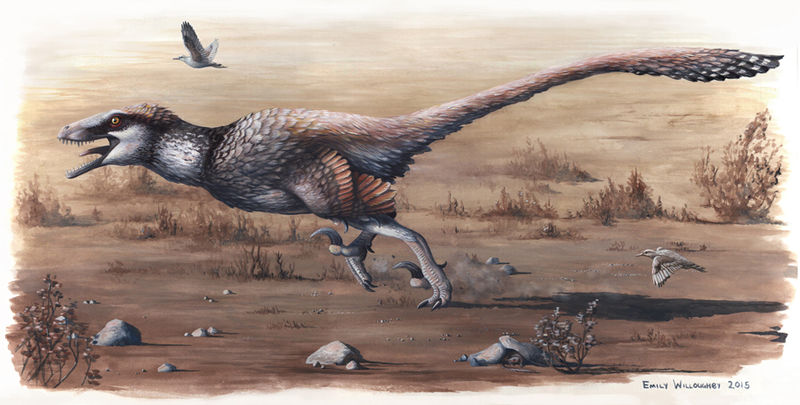
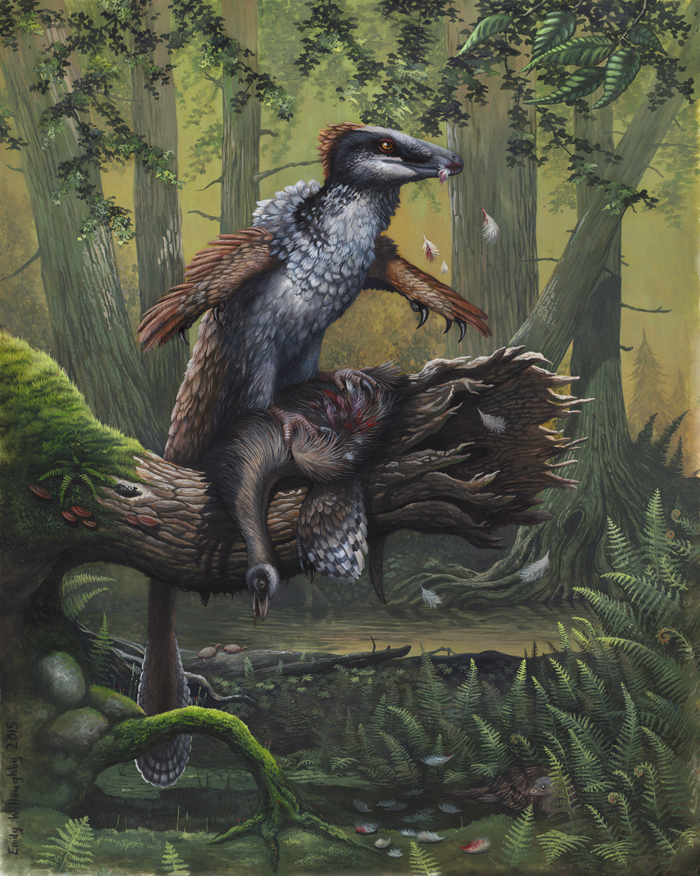
Dakotaraptor was one of the most dangerous dinosaurs ever to walk the earth. (Image Credit: Emily Willoughby)
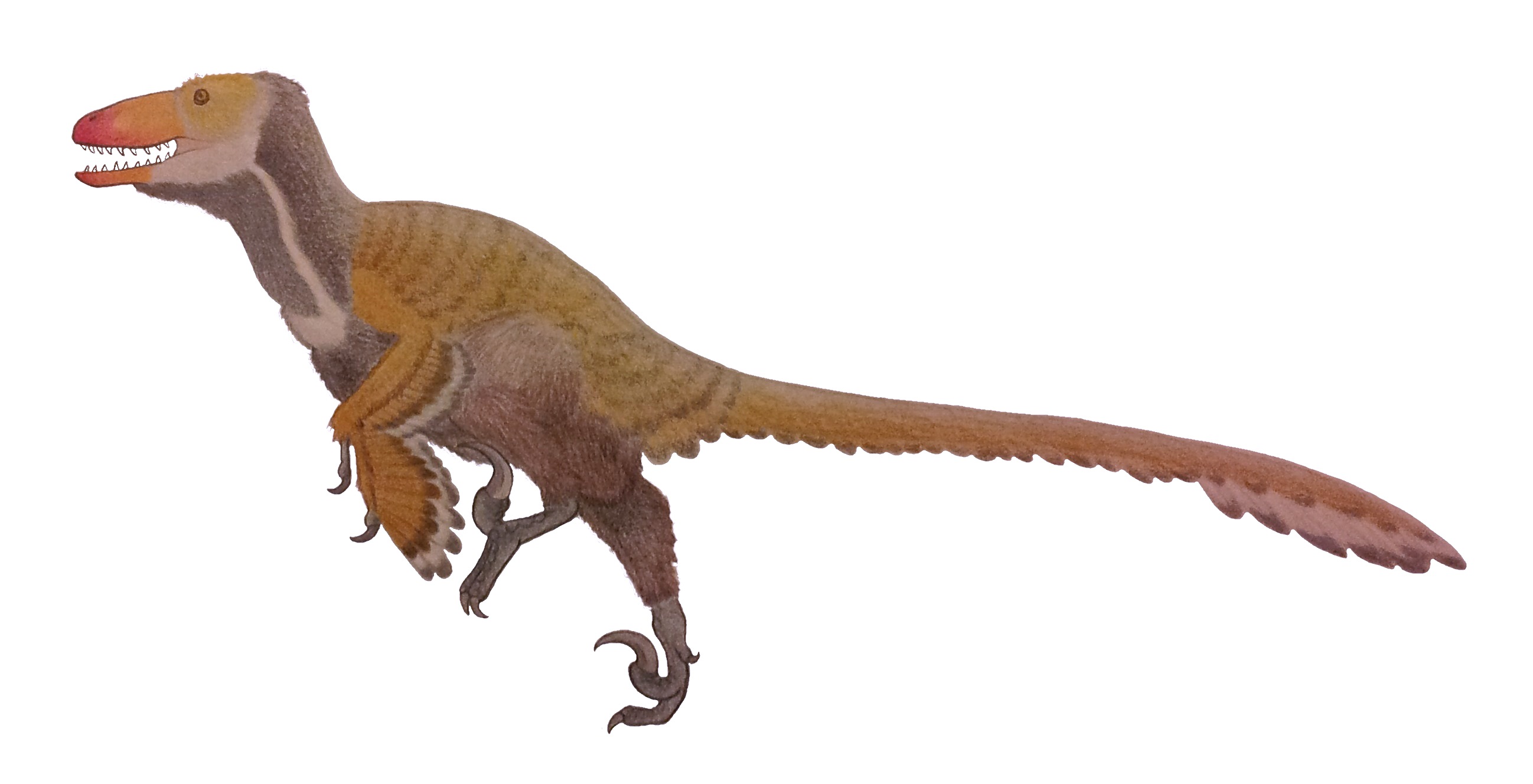
Up until 2015, the only apex carnivores known from the Hell Creek Formation (which spans Montana and the Dakotas) were the turkey-sized, Velociraptor-like Acheroraptor, and of course, Tyrannosaurus rex. This all changed this year, when scientists studied and described fossils of a large raptor uncovered in South Dakota in 2005. Meet Dakotaraptor! This dromaeosaur was 18 feet long, six to nine feet tall, weighed over 500 pounds and could run at speeds of 30-40 mph. As if this weren't dangerous enough, Dakotaraptor may have hunted in packs like its cousins, like Deinonychus and Utahraptor. In addition to blade-like teeth and incredibly strong arms, it had a nine-inch sickle-shaped claw on each foot for dismembering prey. If you're ever exploring the pre-Flood ecosystem of Hell Creek, beware of this dinosaur!

To read more about Dakotaraptor, please see my full article.

Hualianceratops
Hualianceratops was a smaller relative of Triceratops. (Image Credits:PortiaSloanRollings)

Triceratops is the most popular member of the ceratopsian baramin (“created kind”), but cousins of this 10-ton herbivore come in all shapes and sizes, from another 2015 discovery, the extra-frilled Regaliceratops which grew over 15 feet long, to the spaniel-sized Hualianceratops. This ceratopsian made its home in what is now China's Gobi Desert; at the time, the area was certainly much more forested than it is today. This Jurassic ecosystem boasted a wide range of dinosaurs, from long-necked sauropods, to the predatory Guanlong, a small raptor-like tyrannosaur described in 2006. Unlike its larger relatives, Hualianceratops lacked horns and an elaborate frill and it walked on two legs rather than four.

Kunbarrasaurus
Kunbarrasaurus was thought to belong to the genus Minmi until very recently. (Image Credits: Australian Geographic)

Ankylosaurs are a group of dinosaurs known for being covered in tough armor plates. These plates cover the entire upper half of the animal – even the eyelids are hardened! Some ankylosaurs even had clubs on the ends of their tails. Kunbarrasaurus is a newly discovered ankylosaur from Queensland, Australia. Actually, Kunbarrasaurus was officially dug out of the ground in 1989, but it was thought to be a genus of ankylosaur already discovered, called Minmi (a previous record-holder for the shortest dinosaur name). But recently, scientists found that Kunbarrasaurus' fossils have enough distinctions to make it a different genus.

Qijanglong
Qijanglong had a neck half as long as its entire body! (Image Credits: Lida Xing)
Dinosaurs like Guanlong and  Hualianceratops roamed in the shadows of giants, like the newly discovered Qijanglong, emphasis on “looong”! This dinosaur was a member of the sauropod group, a group of dinosaurs known for having long necks. However, Qijanglong and its closest kin, members of the mamenchisaurid family, had necks long even for sauropods. The necks of most sauropods are a third the length of their bodies, but in the 45-50-foot Qijanglong, its neck was almost half the length of its body! How did sauropods carry such long necks without toppling over? Well, the ultimate Designer (the God of the Bible) made sauropods with neck vertebrae that were filled with pockets of air, making them both strong and lightweight. Interestingly, Qijanglong's skull was discovered attached to its neck; usually sauropod skeletons lack skulls because they easily become detached after the animal dies.

Morelladon
Morelladon was a sail-backed relative of Iguanodon. (Image Credits: Carlos de Miguel Chaves)

Dinosaurs just get weirder and weirder, don't they? (And we're not even to the weirdest one on the list yet!) Morelladon was an iguanodont dinosaur with a sail on its back. Scientists aren't sure why this Spanish herbivore had this feature; it's likely however that the sail was used for display purposes. Morelladon wasn't the only dinosaur to possess a sail: the fish-eating spinosaurs and another iguanodont called Ouranosaurus also had sails. However, perhaps the most elaborate sail of all the dinosaurs belonged to Spinosaurus – its sail stood over six feet tall!

Phosphorosaurus
Phosphorosaurus is not a dinosaur, but a marine lizard of the mosasaur family. (Image Credits: Tatsuya Shinmuru)

Mosasaurs were marine lizards that were very similar to modern monitor lizards. They got a burst of popularity when Mosasaurus (the type species of the mosasaur family) ate Jaws for lunch in the Mosasaurus Feeding Show. Unlike the monster, 60-foot long Mosasaurus, the newly-discovered Phosphorosaurus was not an apex predator of the pre-Flood seas. It was only 10 feet long and fed on fish and squid-like animals. Paleontologists believe Phosphorosaurus may have hunted at night because it had large, forward-facing eyes, unlike other mosasaurs. This means it probably would have been capable of night-vision. Phosphorosaurus was discovered in Japan.

Ugrunaaluk
Ugrunaaluk was misidentified as Edmontosaurus for decades. (Image Credits: James Havens)

Diplodocus. Stegosaurus. Parasaurolophus. You thought those names were hard to pronounce! But you haven't seen a hard-to-pronounce dinosaur name until you've tried to say Ugrunaaluk (Ug-ru-naa-luk). It took me forever to learn how to pronounce this one! This dinosaur was a member of the hadrosaur (duck-billed dinosaur) family and if its name sounds rather unusual for a dinosaur, that's because it isn't derived from the Greek or Latin like most dinosaur names are, but the Inupiat language reflecting where the dinosaur was found – northern Alaska; Ugrunaaluk means “ancient grazer”. Pretty much since the 1980's, scientists have unearthed over six thousand hadrosaur fossils from Alaska. At first, they were believed to belong to a type of lambeosaurine hadrosaur (a hadrosaur with a bony crest). But after more examination, the fossils were classified as Edmontosaurus fossils. However, in 2014 scientists continued to study the fossils and found out something shocking – they weren't Edmontosaurus fossils, or the fossils from any other known hadrosaur, but a new species! As if this weren't surprising enough, many of Ungrunaaluk bones aren't actually fossilized – these are “fresh” dinosaur bones! You would think that this would be a revolutionary discovery, but alas it has been ignored by most of the media or “shoved under the rug”. This is likely because it would further jeopardize the idea that the dinosaur bones are millions of years old and make the biblical view that these dinosaurs were buried in the waters of the Genesis Flood the only logical explanation.

Yi
Yi qi and similar weirdos are from the strange family scansoriopterygidae. (Image Credits: Dinostar)

Dinosaur names are known to be long, tongue-twisty and hard to pronounce, especially names like Ugrunaaluk. So try this one for size: Yi. Yes, that's actually the name of a dinosaur, and it was almost as weird as its name. Its full name (genus and species name) is Yi qi (pronounced “ee-chee”) and it means “strange wing”. So what makes Yi qi stand out? Firstly, this Chinese dinosaur is small, about the size of a pigeon. It also boasts the smallest name of any dinosaur (beating previous record-holders, Mei and Minmi). The most amazing thing about Yi qi though is that it possessed a special membrane supported by a bony rod protruding from its wrist. It was the first, and so far only, dinosaur discovered with bat-like wings! Now it couldn't fly like bats or pterosaurs (flying reptiles with similar wing membranes); instead it was probably a glider, moving from tree to tree, using its “wings” to glide long distances between them. Evolutionists call an instance where a creature has similar features to another unrelated creature “convergent evolution” (strangely, when the same finds occur in creatures they claim are related, it is presented as evidence that the creatures evolved). Instead, Yi qi's bat-like wings point to a Designer who created both Yi qi's baramin and bats. Another interesting thing about Yi qi's discovery is that scientists found melanosomes, which contain pigment cells. By looking at these, scientists were able to tell that Yi qi glided through the forest in a shade of black, with yellow-brown coloration on its head and wing membranes.

Zhenyuanlong
Zhenyuanlong is from the same ecosystem as many other well-known so-called "feathered dinosaurs", including Microraptor, Sinosauropteryx and Sinornithosaurus.

While being touted as positive proof that it's supposed cousin Velociraptor was a feathery feign, Zhenyuanlong is hardly the proof dino-to-bird theorists are looking for. What was actually discovered in China's Liaoning Province? Well, scientists recently described a five-foot-long, nearly complete skeleton complete with fossilized feathers. Contrary to popular opinion, aside from the tremendous evidence against the idea that theropod dinosaurs evolved into birds, Zhenyuanlong cannot act as an aid to the theory, as it has several features that identify this creature as a bird, and not a dinosaur; certainly no cousin to Velociraptor. To see why, please see this article by Answers in Genesis. So what of Zhenyuanlong's clawed wings, long bony tail and sharp dinosaur-like teeth? Well, like many other now-extinct birds, like Alexornis, Archaeopteryx, Microraptor, Hesperornis and Ichthyornis, Zhenyuanlong was a species of predatory bird, unique to the pre-Flood world. Zhenyuanlong must have been a terror to smaller creatures in the forest it lived in.

To read more about why dinosaurs could not evolve into birds, please see this article.

New Research of 2015

Brontosaurus
Brontosaurus, once considered synonymous to Apatosaurus, might make a comeback! (Photo Credits: Davide Bonadonna)

Since the early 20th century, scientists have thought that sauropod Brontosaurus was the same species as the closely related Apatosaurus. Therefore, the name invented first – Apatosaurus – was kept and Brontosaurus was dropped, until a 2014-2015 study, that is. A group of scientists was able to conclude that after reevaluating the fossils of both dinosaurs, that Brontosaurus was distinct enough to return as its own species. See an article about the discovery here.

Cave Lion
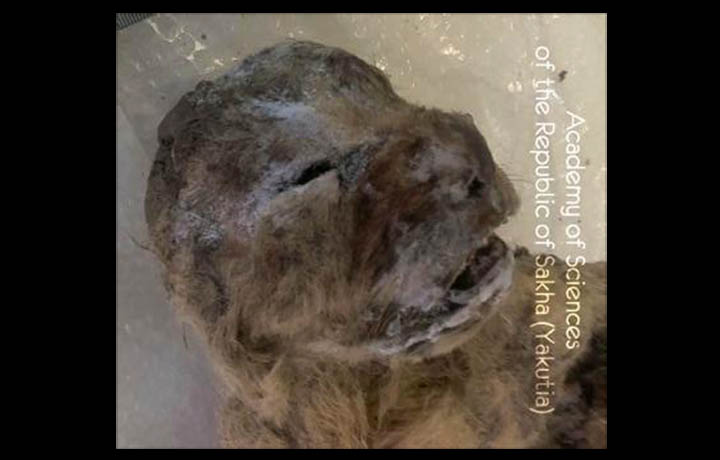
This cave lion cub is one of the best preserved extinct cats ever found. (Image Credits: Academy of Sciences in Yakutia)

While clearly not a dinosaur discovery, I thought this was worthy to bring up. A few months ago, scientists reported on the discovery of two cave lion cubs that were found frozen in Russian permafrost. Cave lions were a subspecies of the modern lion that lived throughout Europe and Asia during the Ice Age. This discovery is rather amazing because the cubs are the best preserved extinct cats ever found. Until now, we have only had cave lion skeletons and paintings of these cats by Ice Age people to know what they looked like.

For more on this discovery, go here.

Well, that wraps up my blogging until next year. To everyone out there:
HAVE A HAPPY NEW YEAR!
See you in 2016!

Disclaimer: The images above are not my own unless otherwise indicated. If you own one of the above images and want it removed, please notify me via my email.

References:
www.sci-news.com/paleontology/science-carnufex-carolinensis-new-prehistoric-crocodile-north-carolina-02617
www.birmingham.ac.uk/news/latest/2015/04/Chilesaurus
www.icr.org/article/new-fossil-dubbed-platypus-dinosaur
www.livescience.com/53039-new-jurassic-horned-dinosaur
www.sci-news.com/paleontology/kunbarrasaurus-ieversi-new-armored-dinosaur-species-03507
www.earthsky.org/earth/long-necked-dinosaur-roamed-china-160-million-years-ago
www.sci-news.com/paleontology/phosphorosaurus-ponpetelegans-new-mosasaur-species-03498.html
www.news.discovery.com/animals/dinosaurs/new-dinosaur-had-a-sail-on-its-back-151216
www.wikipedia.org/wiki/Ugrunaaluk
www.prehistoric-wildlife.com/species/u/ugrunaaluk
www.creation.com/unpermineralized
www.prehistoric-wildlife.com/species/y/yi
www.phenomena.nationalgeographic.com/2015/04/29/chinese-dinosaur-had-bat-like-wings-and-feathers
www.answersingenesis.org/dinosaurs/feathers/what-if-dinosaurs-really-had-feathers

Wednesday, December 16, 2015

Dakotaraptor: Terror of the Hell Creek Forest

Can you believe it? We've only got just over a week till Christmas! I've been busying myself with trying to get all the Christmas movies on my “watch-list” watched and decorating around the house. Have you guys started decorating yet? Or do you prefer to start decorating later in the month...like two nights before Christmas? Let me know in the comments below.

As you might have noticed (if you're a dinosaur nut-case like me, anyway), that 2015 has been a great year for dinosaur-lovers! We've had more fascinating discoveries than you can shake a stick at, lots of dinosaur documentaries were aired, The Good Dinosaur is in theaters now AND last but not least, Jurassic World finally came out in theaters this past summer! I'll cover all the details of our dinosaur-filled 2015 in an upcoming article, but for now, I'd like to highlight one recent discovery that was released to us this past November. But first...

Days Till:
It is: 9 days till Christmas
It is: 16 days till New Year's
It is: 20 days till My Birthday
It is: 33 days till Martin Luther King Jr. Day

In the Spotlight:
As I'm sure many of you know, Star Wars: The Force Awakens is coming out this Friday. Unlike Jurassic World, we haven't had to wait 13 years for a sequel, but it should still be a pretty cool movie. I look forward to watching. When you see it, be sure to leave a comment down below and express how you liked the movie. In the meantime, here's the trailer:


Topic of the Week by Christian Ryan
 
The newly discovered Dakotaraptor (seen here as a skeleton) is truly an impressive find! (Wikimedia Commons)


The Hell Creek Formation, located in the badlands of Montana, North and South Dakota and Wyoming, represents a once-thriving ecosystem of the world before the Genesis Flood around 4,350 years ago, when the entire environment was inundated by floodwaters that swept away and buried countless animals and plants and preserved them. Today, the Hell Creek Formation yields a number of the more popular dinosaurs that lived in this environment, such as Triceratops, Ornithomimus and Edmontosaurus. And of course, these dinosaurs were hunted by the most famous dinosaur of all, Tyrannosaurus rex! For almost a century, T. rex was the sole apex predator that dominated the Hell Creek ecosystem, but this soon changed upon the discovery of an all-new dinosaur: a raptor, called Dakotaraptor steini.
The Hell Creek ecosystem would have been a lush, floodplain-like environment. (Wikimedia Commons)

Uncovered in northwestern South Dakota in 2005, Dakotaraptor's discovery is a unique one. Before, the 40-foot long, 7-9 ton T. rex was the only other apex predator found in the region. This seemed strange to paleontologists, because in both modern ecosystems and ecosystems of the pre-Flood world, there are always large, medium and small-sized predators. While T. rex fossils have been found in Hell Creek since the late 1800's (though the dinosaur wasn't officially named until 1905) in relatively great abundance, all scientists knew of other Hell Creek predators came from scattered and broken teeth. No bones, claws or skulls. Just the teeth. It was only in 2013 that these teeth were found to belong to a turkey-sized, recently discovered dromaeosaur called Acheroraptor. Why were there no medium-sized predators in this ecosystem? This all changed in 2015 when paleontologist Robert Depalma, curator of vertebrate paleontology at the Palm Beach Museum of Natural History, and his research team, and several other paleontologists including Dr. Peter Larson, Dr. Larry Dean Martin, and Dr. Robert Bakker, finished and published their study on October 30th on the raptor leg and arm bones, tail vertebrae, teeth and wishbone unearthed in 2005. They realized they had found a new species of raptor.

Dakotaraptor steini was 16-18 feet long, stood up to nine feet tall and weighed about 500 pounds. (Wikimedia Commons)
 They named the new species of raptor Dakotaraptor steini; the genus name means “Dakotan Plunderer”, in reference to South Dakota, while the species name is a reference to paleontologist Walter W. Stein.


Dakotaraptor was about the size of the raptors in Jurassic World. ("Dakota raptor scale mmartyniuk" by Matthew Martyniuk - Own work)
The word “raptor” is properly used to refer to all members of the dromaeosauridae family. Dromaeosaurs were a family of relatively small predatory dinosaurs found throughout Cretaceous Flood deposits. They come in a wide range of sizes and lived in a vast array of habitats. While most raptors are smaller than a domestic turkey, Utahraptor is by far the largest, weighing up to 1,100 lbs and reaching 23 feet long; however the most famous is undoubtedly the turkey-sized Velociraptor, the intelligent pack-hunting assassin from the Jurassic Park franchise. Dakotaraptor measures in at about six to nine feet tall (depending on body posture) and 16-17 feet from nose to tail, making it about the size of the genetically-engineered, man-sized versions of Velociraptor seen in Jurassic World. This means it was almost the size of its cousin Utahraptor, making it the second-largest raptor we have discovered so far. According to Dr. Thomas Hotlz, “That is what is important about this find. In fact, it was rather bigger than most of us expected, almost the size of the largest known dromaeosaurid, the...Utahraptor.” Like other members of the dromaeosaur family, Dakotaraptor would have possessed dozens of needle-sharp teeth, forward-facing eyes, a long, stiff tail for balance and sharp claws on its hand and feet, things that were essential for an agile predator. Like modern birds, Dakotaraptor (as did other raptors, like Velociraptor) had a wishbone that gave extra strength to its arms. Raptors are famous for having large, sickle-shaped claws on the second toe of each foot, and Dakotaraptor was certainly no exception! Its claw was 9 ½-inches long and unusually large, even for a dromaeosaur. Dr. DePalma described Dakotaraptor as “the most lethal thing you can possibly throw into the Hell Creek ecosystem.”

Dakotaraptor had a huge, sickle-shaped claw on each foot for making devastating wounds in its prey. (Wikimedia Commons)

Evolutionary scientists are especially excited by the discovery of Dakotaraptor because they found tiny bumps that they interpreted to be quill knobs on one of the creature's forearms. In birds, quill knobs are the attachment points for flight feathers. A similar claim was made in 2007 when scientists allegedly identified quill knobs on a Velociraptor forearm. Evolutionists are eager to use evidence like this to try and prove the theory that dinosaurs evolved into bird. There are several problems with this idea, however, many of which we have covered before. In addition to these problems, these bumps are not necessarily quill knobs and may in fact be attachment points, not for feathers, but connective tissues, as evolutionary paleontologist Darren Naish pointed out in his 2010 blog post regarding another theropod called Concavenator. In his blog article, he also brought up the fact that quill knob-like bumps have been found on the bones of mammals too, and mammals clearly do not sprout feathers. This of course doe not mean Dakotaraptor and other dinosaurs like it weren't feathered; the concept of feathered dinosaurs is not unbiblical, though it is unscientific until actual dinosaurs, with actual feathers are discovered. They would merely be dinosaurs that God created with feathers, like He created all the other land animals on Day 6 as described in Genesis chapter 1.

Was Dakotaraptor a feathered dinosaur? While feathered dinosaurs aren't unbiblical, there is not enough evidence to support this claim. (Wikimedia Commons)
As I mentioned earlier, ecosystems, both modern and extinct, generally have predators that come in small, medium and large sizes. Dakotaraptor helps paleontologists fill in the ecological gap between smaller predators from Hell Creek (e.g. recall Acheroraptor, known only from isolated teeth and pieces of the skull) and the monstrous Tyrannosaurus. Did Dakotaraptor fight with T. rex for food? Perhaps on occasion, but they probably more often gave each other their space and specialized in eating certain species of herbivorous dinosaurs. This is the case in modern ecosystems. What would have been on the menu? Well, Dakotaraptor had many species to choose from, such as the duck-billed Edmontosaurus and the three-horned Triceratops. They could have also hunted down faster dinosaurs, such as Ornithomimus and Struthiomimus, creatures adult T. rex were too slow to catch.

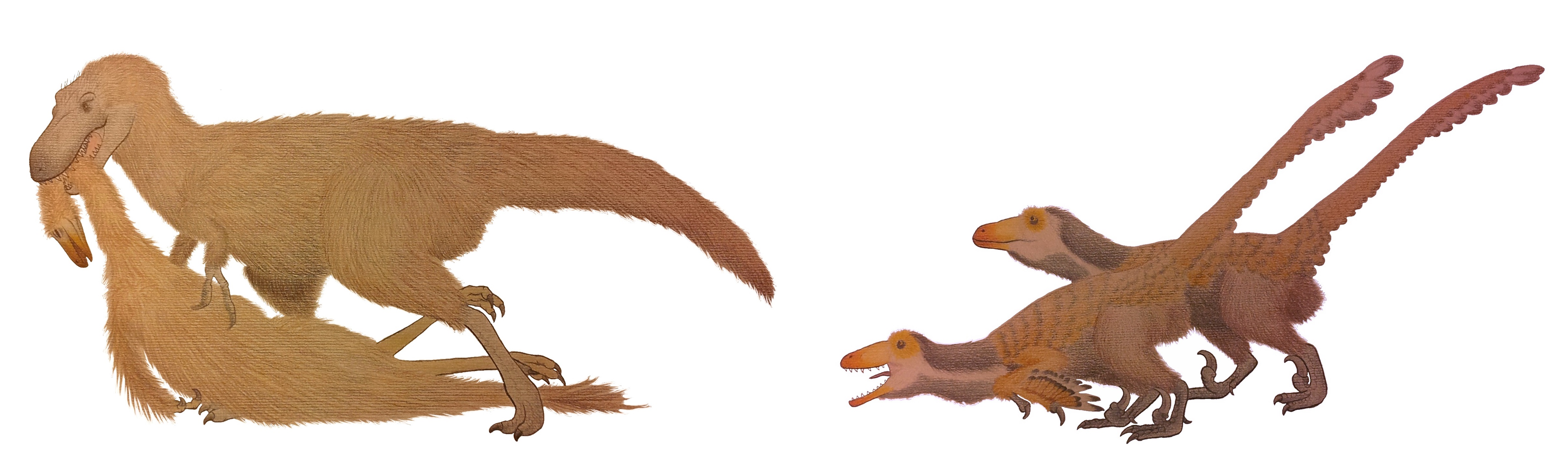
Perhaps Dakotaraptor fought with juvenile T. rex for food. (Wikimedia Commons)
Even though Dakotaraptor looked an awful lot like its cousin Utahraptor, there were plenty of differences between the two which would have affected how the dinosaurs hunted prey. At around 1,000 pounds, Utahraptor was more heavily-built; it probably had a top speed of about 20-30 mph. While no doubt quick and agile, it didn't need to be especially fast because it was more specialized for taking down larger animals. It would probably lie in ambush until it was close enough to the prey to strike and take down the prey relatively quickly. Dakotaraptor was different; it was a much more lightly-built animal, weighing about 500 pounds, akin to its smaller relatives like Deinonychus and Dromaeosaurus. It was likely an attack-and-dash kind of hunter and was probably capable of running after prey at 30-40 mph, making it more of a long-distance runner; this would come in handy if it chose to chase down an ornithomimid. Many paleontologists believe that Dakotaraptor would have hunted in packs, enabling them to bring down animals far larger than themselves. Evidence for this idea comes from fossil sites holding several individual dromaeosaur skeletons near an herbivorous ornithopod that bears the bite marks and broken teeth in and around the herbivore's bones, and fossil trackways that were made all at the same time by a small group of dromaeosaurs. Then, when Dakotaraptor reached its prey, it would attack with its claws and teeth. That nine-inch sickle-claw on each foot could slice deadly lacerations into the sides of Dakotaraptor's prey. “It had one of the strongest killing strokes in that slashing claw of any raptor known,” DePalma boasted. I don't know if I'd like to be present when a pack of these raptors attacked and mercilessly brought down a hapless hadrosaur!

Dakotaraptor was a lethal predator! (Wikimedia Commons)
Fast. Agile. Aggressive. Relatively intelligent. Lethal. Pack-hunting. Dakotaraptor – the new kid in T. rex's neighborhood – was one of the most deadly predators to roam the Hell Creek forests and floodplains more than 4,350 years ago.

Dakotaraptor was one of the most deadly predators ever to roam the Hell Creek ecosystem. (Wikimedia Commons)


Disclaimer: The images above are not my own unless otherwise indicated. If you own one of the above images and want it removed, please notify me via my email.

References:
www.phys.org/news/2015-11-dakotaraptor-hell-creek-formation-lethal.html
www.prehistoric-wildlife.com/species/d/dakotaraptor
www.icr.org/article/9024
www.phenomena.nationalgeographic.com/2015/11/25/did-dakotaraptor-really-face-off-against-tyrannosaurus
Jurassic Fight Club: ep. 8 Raptor's Last Stand
www.wikipedia.org/wiki/dakotaraptor

Wednesday, December 2, 2015

Catch Up To Media

Hi, guys! I hope everyone had a great Thanksgiving! It's December, and while I have successfully reached 50,000 words for my Nanowrimo novel so far, the novel itself is not complete. So while I work on that, I obviously cannot write new blog articles like I normally do if I want to finish it before January, which is my goal. So today, I decided to focus on the media, because some cool stuff has actually come to my attention over the past week or two that's really interesting. So let's start with:

Days till:
It is: 20 days till Winter Solstice
It is: 23 days till Christmas
It is: 30 days till 2016
It is: 34 days till My Birthday
It is: 47 days till Martin Luther King Jr. Day

In the Spotlight:
So, first off, we were at the theater buying tickets for The Good Dinosaur, when we saw this trailer playing:

It's awesome! Am I right? I love the original Jungle Book film (I have yet to read the book), so it is nice to see a proper remake. If you spotted the giant ape King Louis in this trailer, you might think that it is an over-sized orangutan. Nope! It is actually Gigantopithecus, a now-extinct species of ape larger than the modern gorilla. It was the biggest ape that ever existed, and if it were to stand on two legs, it would stand ten feet tall! Needless to say, I love when movies slip in little-known extinct species like this. The only other time I have seen Gigantopithecus in a movie was in Ice Age: Continental Drift; Captain Gutt belonged to the Gigantopithecus genus. Also, I can't help but say that I love the special effects for this film. I cannot wait for it to come out!

Dakotaraptor was a walking nightmare!
Also, during the month of November, the discovery of a brand new species of dromaeosaur (raptor) was announced. Hailing from South Dakota's Hell Creek Formation, the creature has been aptly-named Dakotaraptor. This raptor's discovery is really awesome because it is only the second raptor to have been found in the Hell Creek Formation, and it is huge compared to most of its kin. Dakotaraptor was approximately 16 feet long, six feet tall and weighed 500 lbs, making it about the size of the genetically-altered Velociraptors of Jurassic Park/World fame. It also was endowed with a nine-inch sickle-shaped claw that was perfect for disemboweling prey! Expect an article on this raptor very soon!

That's all for now, folks! Enjoy this Christmas season that has just begun!

Disclaimer: Many (or in some cases all) of the photographs and images above are not mine. If you own one or more of them and would like them to be removed, politely let me know via my email address.


Monday, November 9, 2015

Rerun Article: Did Dinosaurs REALLY Evolve Into Birds?

I hope everyone had a terrific Harvest Day! As you might recall, last year I took part in the Nanowrimo (National Novel Writing Month) challenge, which requires me to write a 50,000-word novel during the month of November. I am doing this challenge again this year, so I will be posting quite a few rerun articles this month. Don't worry though, I'll pick articles from a little ways back.

Anyway, Thanksgiving will soon be upon us? Do you have any Thanksgiving traditions? If so, leave them in a comment below.

Days till:
It is: 16 days till The Good Dinosaur's theatrical release
It is: 17 days till Thanksgiving
It is: 45 days till Christmas

In the Spotlight:
Again, nothing of note to share this week.

Topic of the Week by Christian Ryan
Did dinosaurs really evolve into birds? What does the fossil record actually reveal?
Every Thanksgiving, people all over the United States cook and serve the American turkey. Despite not  being part of the first Thanksgiving, the turkey is a symbol for this holiday. But for many Americans, they aren't merely eating a bird – they're actually eating a dinosaur! Evolutionists believe that all birds, including the turkey, descended from small, feathered theropod dinosaurs; to be more accurate, they actually believe that birds are dinosaurs. Such a claim, if true, would be a major problem for creationists. How should a creationist respond to such this idea? What's the truth behind this belief?

Is this delicious Thanksgiving entree the descendant of dinosaurs?
The idea that reptiles evolved into birds isn't new. Not long after renowned naturalist Charles Darwin published his book in 1859 called On the Origin of Species by Means of Natural Selection, or the Preservation of Favored Races in the Struggle for Life . . . it's easy to see why most people just call it The Origin of  Species. In 1860, a feather was discovered fossilized in Germany and the species of which the feather belonged to was called Archaeopteryx. In 1863, Sir Richard Owen (the inventor of the name “dinosaur” and a creationist) described an entire skeleton of the creature; the fossils revealed a relatively small creature, with feathered and clawed wings, teeth and a long bony tail. In 1869, biologist Thomas Henry Huxley, often considered “Darwin's Bulldog” declared the animal as the missing link between reptiles – specifically dinosaurs – and birds. Ever since, most evolutionary scientists cling to the idea that theropod dinosaurs evolved into birds.

The similarities between dinosaurs like Compsognathus and birds led Huxley to believe that dinosaurs evolved into birds.
Before we go any farther, we must understand both perspectives of the origin of birds: the creation perspective and the evolutionary perspective. Let's look at them both now. Most evolutionists believe that sometime between the early to late Jurassic Period, about 201-145 million years ago, the scales of small theropod dinosaurs began evolving into fur-like proto-feathers for warmth. After millions of years of evolution, these proto-feathers evolved to be firmer and longer; dinosaurs began using their longer feathers for display purposes, perhaps to attract mates. Evolutionists are unsure as to how the power of flight came about. Some evolutionists believe these feathered dinosaurs were tree-climbers and began using their feathered limbs to glide through the trees; others believe they developed the power of flight from the ground up, using their proto-wings to increase their leaps into the air, perhaps after prey. Either way, these dinosaurs eventually were able to get airborne and were now technically birds.
An early conception of "proto-birds" from 1916.
What does the Bible say about the evolution of birds? Well, it says God created all the flying creatures on the Fifth day of the Creation week, 6,000 years ago, the day before He created dinosaurs.
“And God created...every winged fowl after his kind: and God saw that it was good...And the evening and the morning were the fifth day.” Genesis 1:21-23.
This is a major contradiction to the evolution story, which states that dinosaurs came about before birds. Meanwhile the Bible states that land animals – dinosaurs included – came after birds! And instead of evolving through the processes of natural selection and mutation like evolution teaches, birds appeared on earth fully-formed and ready for action.

Evolutionists commonly point to Archaeopteryx as being a transitional form between dinosaurs and birds.
Many evolutionists (specifically atheists) believe that there is too much evidence for evolution for creation to be true. I find it rather interesting how many evolutionists refuse to even consider creation an option; in fact, many will go as far as to say that creationists don't know science. I was browsing the internet and came across an article entitled Feathered Dinosaurs Drive Creationists Crazy by Brian Switek. “Oh, really?” I thought upon seeing this article; I was rather unimpressed by this evolutionist's attempt to denounce creationists. Curious, I read the article, expecting to find much criticism aimed at creationists. Much of the article was devoted to how our view of dinosaurs has changed over the years, but perhaps a quarter into the material, he talked about creationists and the “overwhelming evidence” that dinosaurs evolved into birds, in addition to his other criticisms about dinosaurs living with humans and dinosaurs living 6,000 years ago etc. He also spent a great deal of time talking about Answers in Genesis CEO Ken Ham and the Creation Museum. Here's an excerpt below:
“...dinosaurs with feathers are not welcome at Ham's amusement park [speaking of the Creation Museum]. Even though paleontologists have uncovered numerous dinosaurs with everything from bristles and fuzz to full-flight feathers—which document the evolution of plumage from fluff to aerodynamic structures that allowed dinosaurs to take to the air—creationists deny the clear fossil record.”
He had much more to say of course, some of which I'll get to in a minute. I must say that while reading the article, I was troubled how many misconceptions Switek has about creationism. What really ticks me off is when evolutionists try to make a case for themselves without actually doing the research. I find Switek's ignorance of what we creationists believe appalling. If only he continued to research and find answers to why creationists don't believe dinosaurs evolved into birds, then perhaps he would not have been so bold in his statements. Like any other fossils in the fossil record, even though the observable evidence – dinosaur and bird fossils – can point to or suggest a certain conclusion, they do not speak for themselves and are left to the interpretation of the individual based upon observable evidence. Evolutionists like to claim that creationists start from a presupposition and use that to base their opinions on, while they base their opinions on scientific facts. Now, it is true that we have presumptions, but so do evolutionists! They fail to realize is that they do the exact same thing. In this article, I plan to talk about the evidence for and against the dino-to-bird hypothesis and see what the evidence best suggests.


So what is the “evidence” for this belief in dinosaurs evolving into birds? Switek claims there is a “mountain of evidence that birds are living dinosaurs” and that we creationists deny the clear fossil record. Let's at the so-called evidence now and see whether we're the ones rejecting the clear fossil record. Before we go on though, let me explain that evolutionists do not believe all dinosaurs evolved into birds; they believe the ancestors of birds are maniraptorans, small theropod (meat-eating) dinosaurs. Some of these dinosaurs include Deinonychus, Troodon and the famous Velociraptor.

Dromaeosaurs, such as this Velociraptor, are commonly seen as relatives of modern birds.

Bird-hipped and Lizard-hipped Dinosaurs
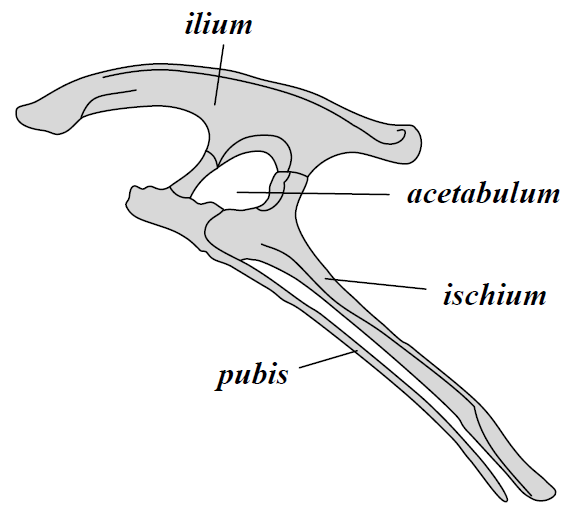
Evolutionists are quick to mention that maniraptorans are very similar to modern birds anatomically. This is true. In fact there are over 100 skeletal features that dinosaurs share with birds; some dinosaurs such as Velociraptor even had a wishbone. But what is often not mentioned are the often quite significant differences between the two. Within the order Dinosauria there are two subcategories in which dinosaurs are divided, saurischians (lizard-hipped dinosaurs) and ornithiscians (bird-hipped dinosaurs). The dinosaurs in these two categories are divided based upon their hip shape. The difference between the two hip shapes is the pubis bone; the pubis bone in birds and bird-hipped dinosaurs points toward the rear instead of to the front as in lizard-hipped dinosaurs, modern reptiles and mammals.

Saurischian or lizard-like hip structure.

Ornithischian or bird-like hip structure.

Problem with dino-to-bird evolution? All the dinosaurs that evolutionists believe are related to birds (e.g. Velociraptor, Troodon, Sinornithosaurus) are lizard-hipped! Dinosaurs that are bird-hipped include Stegosaurus, Triceratops and Parasaurolophus. These dinosaurs bear very few bird-like features and are not believed to have evolved into birds. Yet the few times this is ever mentioned in secular literature, documentaries and etc. this problem is never presented any emphasis. And why would they? 
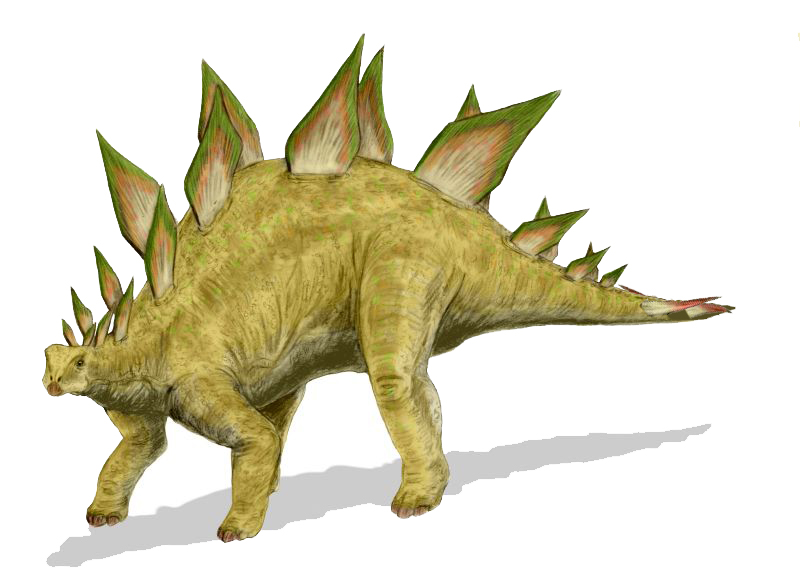
The lumbering 4-ton Stegosaurus is a bird-hipped dinosaur, meaning it must have evolved into birds! Right? Of course not!

Three-Fingered Hands

The hand bones of Dienonychus (left) and Archaeopteryx (right) are quite similar.
Evolutionists absolutely love to talk about how both theropods and birds have three-fingered hand bones. Evidence of a dino-bird relationship? Hardly. As birds supposedly evolved from theropods, you'd expect that the digits represented in the hand bones would be the same in both dinosaurs and birds. However, dinosaurs have the 1st, 2nd, and 3rd digits (the first being the thumb); birds have the 2nd, 3rd, and 4th digits in their hand. What happened?

Avian vs. Reptilian Lungs
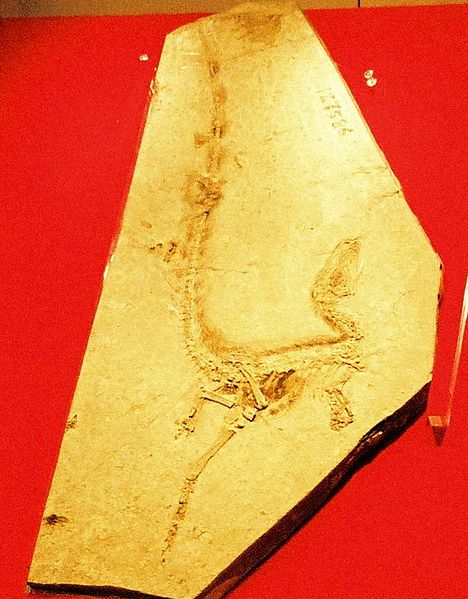
The dinosaur Sinosauropteryx was so well preserved, that the reptilian-like lungs have also been fossilized.
If theropods are the ancestors of birds, you should find avian-like lungs in theropods. Of course, as most dinosaur remains are fossil bones, we can't know too much about their lungs and respiratory system. However, paleontologists have discovered the fossilized remains of a Sinosauropteryx, a small bird-like theropod from China, related to Compsognathus. This Sinosauropteryx specimen retains the outline of the visceral cavity, and it is very well preserved. Much to the dismay of evolutionists, they reveal that the lung is very much like that of a crocodile.

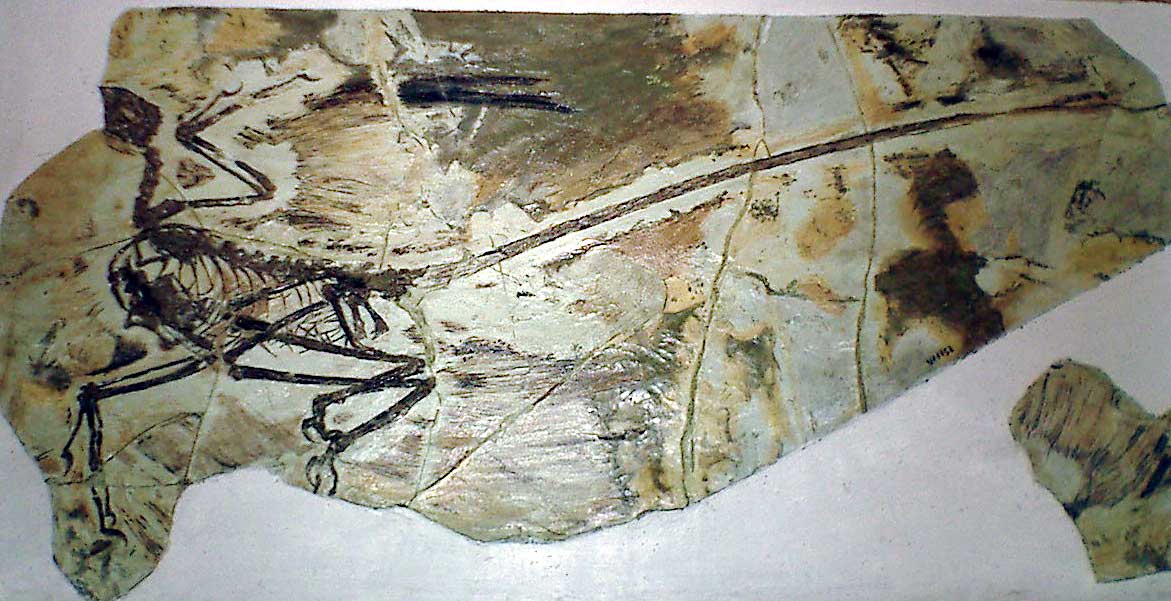
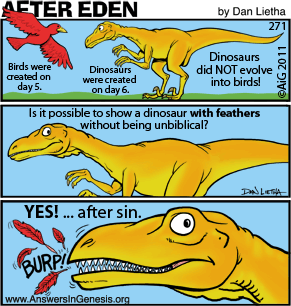
In Switek's article, he mentions how the Creation Museum didn't display feathered dinosaurs, nor does Answers in Genesis portray dinosaurs with feathers in books and DVD's. And he's right. But what if there's actually a scientifically good reason for this? Of course, failing to do his research to see why creationists don't portray feathered dinosaurs, he just scoffs and claims that “they take pride in promoting out-of-date, monstrous dinosaurs that more easily fit their contention that these animals were created separately from all other forms of life.” I'm very sorry Switek, but maybe you are the one who's trying to go against the fossil evidence. Like just about every other evolutionist out there, he claims that creationists just believe in non-feathered dinosaurs because we believe they didn't evolve into birds and then points to so-called “feathered” dinosaurs; no further explanation is given. He would have only had to read a few articles on the Answers in Genesis website to find their true opinion, which I will get to in a minute.

Is there actually evidence to support the belief that dinosaurs, like this Troodon, had feathers?
There are two types of “feathered dinosaurs” you'll hear about: dinosaurs with bird-like flight feathers and dinosaurs with proto-feathers. First let's look at the dinosaurs with “proto-feathers”. In 1996, evolutionists thought they found the amazing proof for their theory upon the discovery of Sinosauropteryx. This small carnivorous dinosaur is associated with the outline of what many believe to be fur-like proto-feathers. But upon looking at the “proto-feathers” closely, you can see that they really aren't that feather-like. They are much more similar to hair in appearence. In fact, it seems to some creationists that seems that these features are actually connective tissue fibers (collagen); this is found in the deeper dermal layers of the skin. These features have been found not only on other dinosaurs, but also ichthyosaurs, dolphin-like marine reptiles! Yet no one suggests these creatures were feathered. Another thing about the "fluffy-looking" structures  that creation scientists have noticed is that many of these structures appear almost fur-like. Perhaps some of these dinosaurs were covered in something similar to pcynofibers, fur-like structures found on pterosaurs that are very similar to mammalian hair.
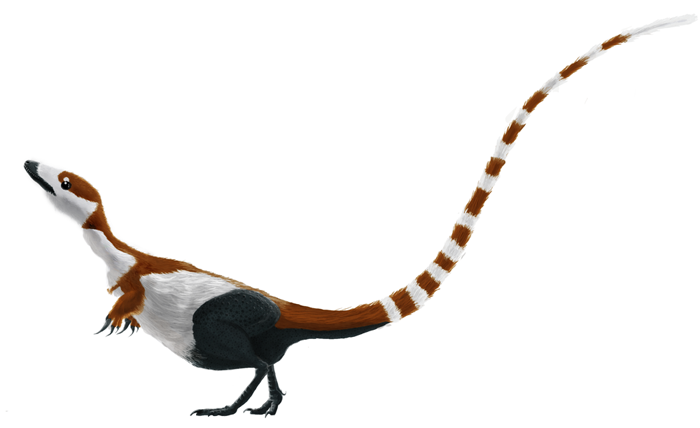
Dinosaurs like Sinosauropteryx might have been covered in a type of "fur".
In this article, Switek mentions this fossil discovery:
“Put feathers on a Velociraptor—we know it had feathers thanks to quill knobs preserved along its arm bones—and you get something disturbingly birdlike, revealing the dinosaur's kinship to the ancestors of Archaeopteryx and other early birds.”
In 2007, scientists published the find of a fossil arm bone of a Velociraptor. Along the forearm are six bumps that they claimed were very similar to those found on the bones of some modern birds. In modern birds the bumps are the quill knobs where feathers were once supposedly rooted. Is this proof of a feathered dinosaur? Perhaps, but sources that talk about this find give no details as to why the quill knobs don't extend further along this bone or if there were other fossils were also examined or how complete the find was. Who's to say this is even the arm bone of a Velociraptor? There are many uncertainties with this fossil. Keep in mind that I'm not doubting the validity of the scientists who studied the fossil, but we should also remember that we should be cautious about such claims based on scant evidence and the claims made by scientists with evolutionary presuppositions.
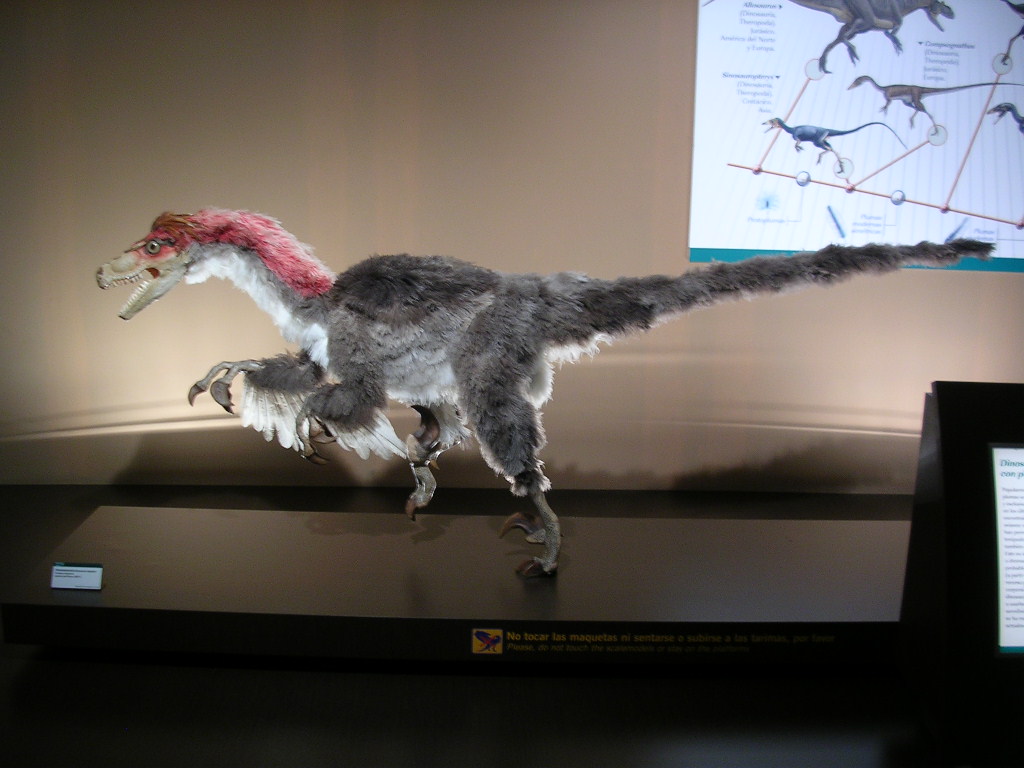
No feathers seem to have been present on Velociraptor, but pcynofiber-like fuzz is still a possibility.
What about “dinosaurs” that actually have fully-functional actual feathers? Archaeopteryx and Microraptor are two such creatures. Both of these animals bear toothy snouts, clawed and feathery wings and bony tails. They also both have a pair of enlarged retractable toe claws like those of raptor dinosaurs, such as Deinonychus and Velociraptor. Surely this is proof that these animals are the missing links between dinosaurs and birds.

Microraptor is a very unique creature with four fully-functional feathered wings.
First of all the feathers on the bodies of Archaeopteryx and Microraptor are actual feathers and not collagen fibers or fur-like structures. They also have the same digits configuration of modern birds (like modern birds they bear the 2nd, 3rd and 4th digits). Undoubtedly, these animals are birds. The fact that they have reptilian features does not make them half reptile/half bird. In fact, there are several actual birds that have reptilian features: ostriches and baby hoatzins also have clawed wings, and no one questions that these animals are birds; the extinct bird Hesperornis possesses teeth in its beak; and the seriema of today even has an enlarged second toe claw, similar to the ones seen in raptors. If you don't need a missing link between dinosaurs and birds (which creationists don't) then there's no need to call Microraptor and Archaeopteryx anything other than 100% birds.

The seriema is a medium-sized bird living today with an enlarged toe claw, similar to the ones found on dromaeosaurs.
If you look in dinosaur books, you've likely seen diagrams similar to the one below:

This is a typical chart showing the evolution of dinosaurs to birds.
This picture suggests that the fossil record wonderfully displays the evolution from dinosaurs to birds; with more dinosaur-like creatures in lower geologic rock layers and more bird-like creatures in higher layers, slowly evolving more complex feathers. Isn't it strange that we creationists reject the plain evidence in the fossil record as Switek states we do?

Unfortunately, this isn't what the fossil record represents at all! Despite this being portrayed in just about every secular dinosaur book, the “clear fossil record” (as Switek puts it) tells a different story. Archaeopteryx, the famed transitional between dinosaurs and birds is believed to have existed 150-148 million years ago, during the Late Jurassic Period. The problem? Most bird-like dinosaurs that are commonly said to be closely related to birds, according to this worldview, lived before Archaeopteryx! Sinosauropteryx, a dinosaur with “proto-feathers” is claimed to have lived 124-122 million years ago! In fact, most dinosaurs with so-called “proto-feathers” are found above rock layers with more bird-like animals! The only dinosaur with "proto-feathers" that evolutionists have that didn't live after Archaeopteryx is Juravenator. But according to evolutionists, Juravenator lived at the same time as Archaeopteryx! In addition to this, we find birds very similar to the ones we see today living with "dino-birds". A Microraptor skeleton described in 2011 was discovered with tree-perching bird fossils (more bird-like than Microraptor) inside of its abdomen! This animal didn't only live with modern-like birds – it ate them! Even Velociraptor, a very bird-like dinosaur, is usually dated to live about 80 million years ago, long after birds has supposedly been flying through the skies for millions of years. These creatures were hardly ancestors to the birds. I for think the fossil record clearly demonstrates that dinosaurs evolved into birds, don't you? (That was sarcastic by the way).

Of course, I am not at all saying we should find all the transitional forms between dinosaurs and birds if this transition really did occur, but we should find a few. Evolution on this scale would take tens of millions of years and millions of generations between dinosaurs and birds. Where are these fossils? Surely some should have popped up if the "clear fossil record" suggests dinosaurs evolved into birds.

And to make matters even worse for evolutionists, extinct birds such as Anchiornis, Xiaotingia, Aurornis and potentially Protoavis are buried in sediment “older” than Archaeopteryx!
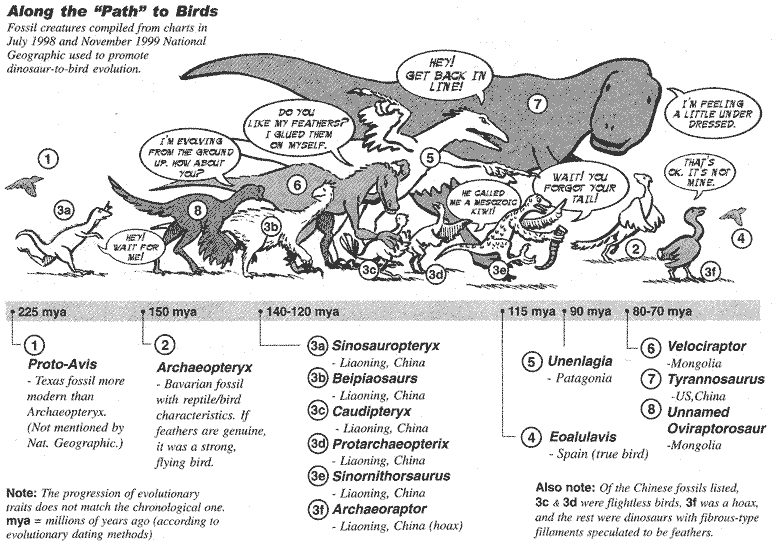
So, Switek, you believe the "clear fossil record" portrays dinosaurs evolving into birds? Hm...

Earlier, I mentioned how Switek claimed creationists don't like feathered dinosaurs. What if a feathered dinosaur with actual feathers were discovered? Would this prove that dinosaurs evolved into birds and that the Bible is untrue? Nope! In fact, nothing in the Bible goes against the idea that dinosaurs might have had feathers. Not only that, but I happen to like the look of feathered dinosaurs; I am not against the notion of feathered dinosaurs in the slightest, just the idea that they evolved into birds. Finding a feathered dinosaur would be no different than finding a mammal that lays eggs. which we actually have! The duck-billed platypus and porcupine-like echidna are monotreme mammals that lay eggs instead of giving birth to live young like all other mammals. Yet they aren't half mammals/half reptiles; they're mammals that lay eggs. We creationists aren't against the idea of feathered dinosaurs at all, it's just that so far, the evidence for feathered dinosaurs is missing in action.

Like Microraptor, the platypus bears characteristics of many different creatures, including the ability to lay eggs, a duck-like bill, a beaver-like tail and webbed feet, a mammal's fur, the ability to use a form of sonar and even a venomous spur. Yet it is not some evolutionary missing link, but a mosaic.
In order to prove that dinosaurs evolved into birds, one would need to find evidence of a transition between the two in the fossil record (like reptile scales evolving into feathers) and the fossil record would need to show dinosaurs and birds evolving in the right order. This is not what we find!

Why haven't evolutionists who love to talk badly about creationists bring up the points I made in this article? An even better question is why would they do such a thing? Never in Switek's article does he even mention these problems with the dino-bird theory (or solutions to them)! Like many other evolutionists out there, he decided to pick on the claim made by creationists rather than the evidence that backs up the claim in order to make creationists sound like unprofessional idiots. What he wrote in this article shows just how utterly and willingly ignorant he is of creationism and what we believe to be true (and more importantly why we believe it to be true).


As I hope to have made clear throughout this article, if one looks at the fossil record from an evolutionary perspective, we don't really learn about the origin of birds. It's really sad how little research Switek did on the truth about creationism, Answers in Genesis, dinosaurs, birds and the fossil record as a whole. I doubt hearing the truth would have actually change his mind, but at least he would have been more informed. Until he decides to learn what creationists actually have to say and only talking about evidence from his own side of the argument, he should avoid talking about creationism altogether. (Unlike him, I used information from both sides).

I do however hope that this article has enlightened you, my readers, and helped you understand that the fossil record doesn't support the belief that birds and dinosaurs didn't share the same lineage, but that they do share the same wonderful Creator God.


You can relax, dinosaur lovers! The turkey you'll have for Thanksgiving this year isn't the descendant of this Velociraptor!

References:
wikipedia.org/wiki/Origin_of_birds
answersingenesis.org/dinosaurs/feathers/did-dinosaurs-turn-into-birds
answersingenesis.org/dinosaurs/feathers/feathered-raptors-not-the-birds
wikipedia.org/wiki/Archaeopteryx
wikipedia.org/wiki/Microraptor
wikipedia.org/wiki/Sinosauropteryx
Feathered Dinosaurs Drive Creationists Crazy

Disclaimer: Many (or in some cases all) of the photographs and images above are not mine. If you own one or more of them and would like them to be removed, politely let me know via one or both of the email addresses above.

Disclaimer 2: I know I've been talking negatively a lot about Brian Switek article, but this isn't because I don't like the guy. I have read much of his other material and admire his writing style; even though I don't agree with everything he believes.