Thursday, June 27, 2013

The Awesome Spinosaurs: pt. 2 - Their Behavior

Welcome back folks! As usual, I'll presume with updates before getting to today's non-fiction article, written by yours truly!

Howdy folks! Welcome back to my website. I've got a lot of cool updates before we get to the main article, so let's get started!

The second episode of my stop-motion series Planet of the Dinosaurs, called The Tropical Poles, is coming along greatly so far! It has reached 75%! I'm not sure it will be finished by the end of this month, but hopefully by the end of the first week next month. Lord willing!

As many of you might already know, the latest Pixar release, Monsters University, just went into theaters on the 21st of this month. I haven't had the opportunity to see it yet, but I'll probably be able to when it comes out on DVD or on Netflix. I can't wait! 

Here's a clip from the movie:


So what is Pixar working on next? Well, their next movie, coming out next summer is called The Good Dinosaur. They haven't released much on an actual plot, but here's a basic overview of the project:

They are kind of cartoony but they are dinosaurs; they are not walking around with clothes on or anything like that, they still are kind of dinosaurs. We focused on mostly the plant-eaters, not the carnivores… Their society becomes more of an agrarian society, meaning farmers. They become farmers. It’s a very funny story about a certain way of life that a young dinosaur has trouble fitting into and he ends up going on this quest. He kind of messes up and he has to put everything right by going on this quest and on that quest he meets this our character that is an outcast from his society too and so the two of them form this bond and it becomes this unique kind of story…

Last week, I mentioned that another movie I'm looking forward is the release of the movie known as Jurassic Park IV. If you've read last week's article, you'll remember that this movie's new release date appears to be 2015 based on a teaser banner at the Licensing Expo 2013. This past week, I've literally crisscrossed the internet to see if this date is correct, and it seems valid, so we'll assume this is the new date. That's not the only piece of news everyone has been talking about concerning this film! We even have a potential plot! (SPOILER ALERT: this “spoiler” you're about to read would reveal about as much information if you were watching a trailer, but if you don't want to know anything about the movie yet, please skip this update) Jobio.com has apparently learned the plot of JPIV through an unknown source. This could be exactly what we fans have been waiting for! Here's what Jobio.com had to say about the possible plot for the upcoming movie:
JURASSIC PARK 4, set in present day Isla Nublar, is now an actual theme park, as originally intended by John Hammond in the first film. It garners 10 million visitors per year and is completely safe - until it's not. The park itself is described as very Sea World-esque and includes an area called the Isla Nublar Lagoon. That means underwater dino's for the first time. No indication of what kind, but there's concept art showing one of the aquatic dino's, as part of a show, jumping out of the lagoon and eating a strung up great white shark like it was a fish for a dolphin at sea world.
As part of a show, you ask? That's right, folks, this will feature "tamed" dino's. In fact, our source indicated that the usually menacing Velociraptors (which will finally be muzzled, along with the T-Rex - until they're not) will actually be used to help fight the threat, which begins in the form of a new dinosaur, not seen in any of the previous films (and not disclosed to us) shows to be much smarter than originally thought and is the main cause of havoc breaking out at the park.
So, to sum it all up, JURASSIC PARK 4 will take place back on Isla Nublar with a fully operational dinosaur theme park (I'm sure no expense was spared) that's both prosperous and safe, until a new dinosaur figures out a way to wreak havoc, causing the use of the now tamed Velociraptors (and T-Rex? Unclear) as a means to fighting the threat.

Well, if you ask me, this plot is a great idea! However, we must keep in mind that this rumor may or may not have any fact behind it. It is believed by some that this plot description appears to be from the script before the “major changes” were made. So perhaps this plot is inaccurate, but we don't know for sure yet. We also don't know what people or dinosaurs will be appearing in the movie for sure, yet (although Velociraptors and T. rex have a 99.99% chance of being present regardless of whether this plot is the real thing). But if the plot Jobio.com has is accurate, we should be seeing, not only raptors, but also the longed for marine reptiles (maybe a gnarly Tylosaurus mosasaur will make an appearence) as well, AND also the “new scary dinosaur” that's been talked about for a long time can be seen coming into play. For now, this assumed plot is all we know, as Universal hasn't told us their plot yet. But I think it's time to officially say, “The exploration back to Isla Nublar is about to begin!”

Now to get to today's non-fiction article:

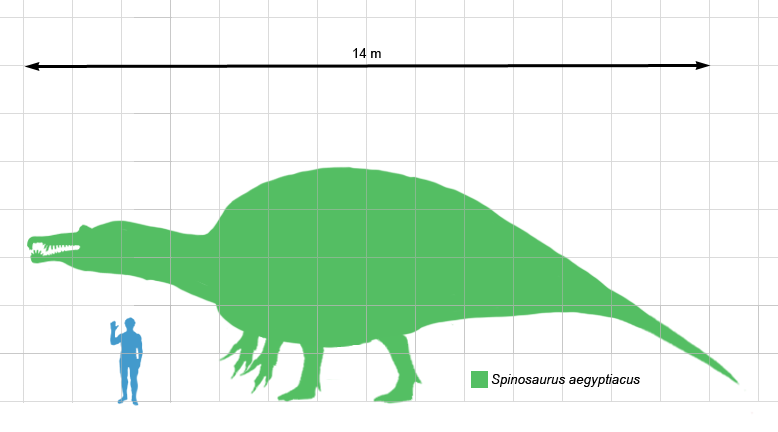
As you might recall from my post two weeks ago, we looked at the history of the discovery of the largest carnivorous dinosaur to ever walk the earth: the 60-foot long, ten-ton Spinosaurus. Last time, we learned that the first Spinosaurus remains ever found were uncovered in Northern Africa and were accidentally destroyed in World War II. A few other Spinosaurus fossils have been found since they were destroyed, but they're far from completion. So paleontologists look to Spinosaurus' relatives – other members of the spinosaur family and modern-day animals for clues. First, let's look at one of the most obvious questions: what did Spinosaurus prey on?
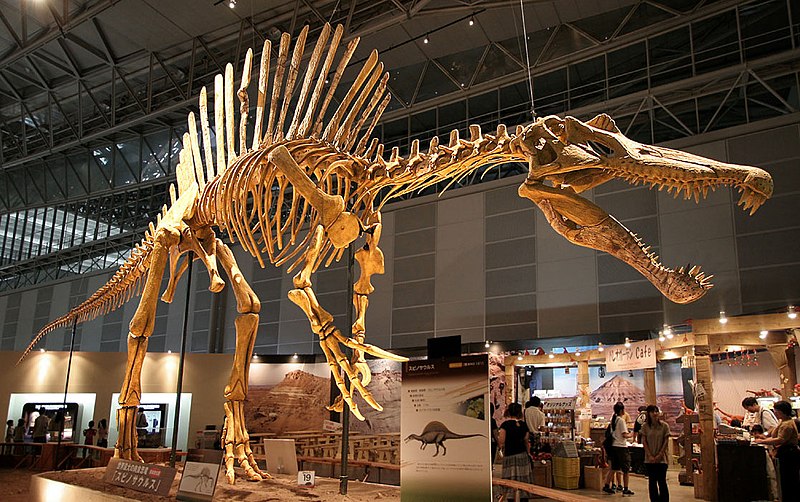
The skeleton of Spinosaurus
We humans are puny compared to this beast!
While we know Spinosaurus ate plants in the world before Man's rebellion against God, which brought death and sin into the world. But what about its diet after the Fall of Man? Well, to find an animal's diet, we must obviously start looking at the mouth and at the teeth. An animal's teeth alone doesn't actually tell you how it behaved or what it ate, but it can give us clues and starting points. The teeth of Spinosaurus are conical-shaped and sharp, somewhat different from your typical theropod dinosaur, which have sharp and serrated teeth. The teeth of spinosaurs resembles not any other dinosaur, but of a different reptile, one still patrolling the waterways of the 21st century: crocodiles! Crocodiles also have sharp and conical-shaped teeth, so by learning how and what crocs mainly eat can give us insight into what dinosaurs, such as Spinosaurus ate. Crocodiles, while antelope and zebra are popular choices, often eat fish, and their conical-shaped teeth are perfect for gripping onto these slippery meals. Does this suggest Spinosaurus ate . . . fish?!? Believe it or not, the 10-ton predator actually probably hunted fish. We have more evidence to back this up. When looking at the teeth of modern-day animals that have similar teeth to prehistoric, we learn that we can guess what prehistoric animals ate. The same often applies with features God “installed” into this creature. The six-foot skull of Spinosaurus is shaped like a crocodile's skull. Perhaps the skull of Spinosaurus is crocodile-like for the exact same reason crocodile skulls are crocodile-like. Like modern crocodiles, Spinosaurus has its eyes and nostrils higher up on the skull. This would help when it was fishing because it could have its jaws half-submerged in the water and still breathe at the same time.
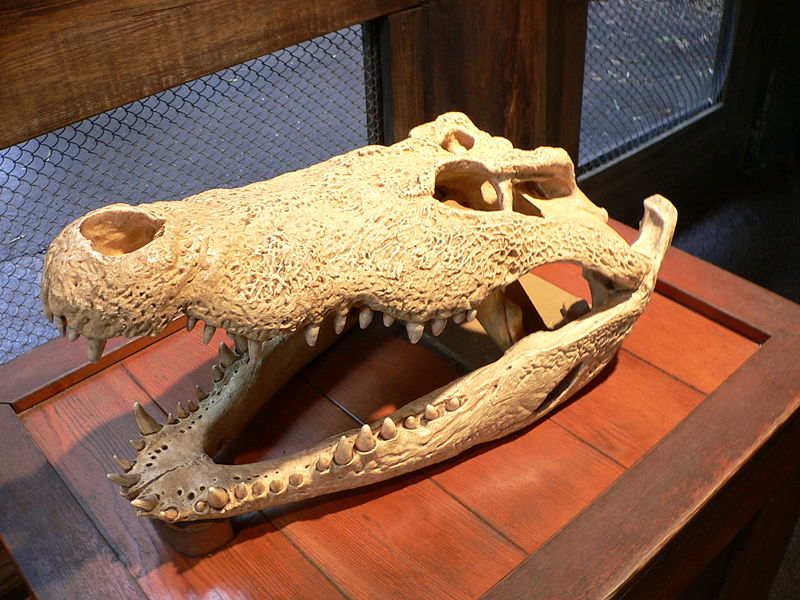
The skull of a crocodile
The skull of Spinosaurus bears great resemblance to that of a crocodile's
When scientists took a close look at the skull of Spinosaurus, they realized that there were a bunch of little pits and holes on the end of the snout. Once again, scientists compared the skull of Spinosaurus with the skull of a modern crocodile and bingo! Crocodiles also have pits and little holes on their snouts. What are they used for? Well, in crocodiles, the pits are attached to sensitive nerve endings. These nerve endings can detect movement in the water so even if a crocodile can't see its prey, it can feel the disturbance in the water and know where the prey is. Perhaps Spinosaurus could stick its snout into the water and feel the water movements of fish below the surface. Does the notion of the 60-foot long Spinosaurus eating mainly fish seem a bit strange to you? After all, how could this huge hyper-carnivore sustain itself on fish? The answer is that many of the fish in pre-Flood Northern Africa (which was much wetter and swampy than today) were huge! Some fish, such as the a type of giant sawfish called Onchopristis, grew over 24 feet in length! That's what I call “catch of the day”! We even have evidence that Spinosaurus hunted Onchopristis in particular: an Onchopristis fossil has been found with Spinosaurus teeth embedded in it.
Onchopristis looked just like this modern sawfish, just a lot bigger!

And Spinosaurus also had a weapon that no crocodile has: arms that were probably over eight-feet in length and ended in nine-inch dagger-like claws! These claws would be useful in helping haul the mighty fish out of the water so Spinosaurus could chow down.
To help you visualize a fishing Spinosaurus, take a look at this clip from the BBC television series called Planet Dinosaur, in which a Spinosaurus catches the big whopper in the river – Onchopristis!
This series is one of my favorites, I hope you enjoy it:


Did you know that Spinosaurus' diet wasn't restricted to giant fish? Fossil remains of the closely related Baryonyx found in Europe, contains the bones of an herbivorous dinosaur called Iguanodon, and a fossil pterosaur, or flying reptile bone in Brazil contains the tooth of a spinosaur. Judging by the position of the tooth, we can tell that the pterosaur was probably attacked by the spinosaur. So spinosaurs including Spinosaurus not only were hunters of water, but they were also ferocious predators on land as well. Scientists estimate that Spinosaurus could run over 20 mph, and that's faster than most of us can run! So if Spinosaurus is coming for you and unless you're an Olympic sprinter, you'd better learn how to hide!

Spinosaurus was a ferocious predator on land AND in the water!
Now it's time to examine the most obvious mystery of Spinosaurus: what exactly put the spine in Spinosaurus? Actually, perhaps I'd better reword that to: what exactly did that sail of Spinosaurus do in life? Unfortunately for us, no animal alive today has a sail quite like Spinosaurus, so we can't really make a comparison. The sail on Spinosaurus' back was about six to seven feet tall and was made up of the creature's backbone. What was it for? Well, many scientists believe that the sail was littered with blood vessels, kind of like the ears of an elephant or a hare. The blood flowing through the sail would have had temperature changes much faster than the rest of the body. If Spinosaurus needed to cool down, cool air would cool the blood in the sail and then this now-cool blood would flow through the rest of the dinosaur's body. Therefore it would cool down the Spinosaurus. The same would work, if the animal wanted to warm up, but instead of air, it would use the heat of the sun. Even if Spinosaurus was a warm-blooded creature, the ability to cool itself down rapidly would have been helpful for the creature. Isn't God ingenious?

Some scientists believe that, instead of trying to stay cool, the sail of Spinosaurus was a way for males to look cool. Perhaps, like many other animals, Spinosaurus had wacky body equipment for display purposes. Many modern insects, mammals, birds and reptiles use weird and wonderful displays to impress potential mates.
Another theory is that Spinosaurus used the sail during fishing. How did it do that? Some species of herons today use their wings to create an umbrella-like shape, casting a shadow on the water. Fish are attracted to the shadow, but little do they know that they're swimming right into range of the heron's beak and SNAP! The heron gulps down a fish. Perhaps the sail of Spinosaurus also attracted fish and could help this dinosaur catch its prey. And who knows? Considering no one around today has seen a living Spinosaurus, who's to say it didn't use its sail in all the ways mentioned? We may never know, but it's a possibility!
What do you think Spinosaurus used its sail for?
Alas, it is time to end our time together for this week. Be sure to come back next week and you can read Joy's latest article. The week after that is when we can delve into the conclusion of my series on spinosaurs, some of the weirdest dinosaurs that ever lived! Hope to see you next week, bye for now and God bless you!

PS: To post a comment (this is highly encouraged), please simply click the post you wish to comment on, scroll to the bottom of the page and put what you wish to say or ask in the comment box. Then in the box below the comment box choose who you’re going to comment as. And then click preview or publish. If you aren’t signed into Google, you’ll be asked to type in a word and a number in the space provided. Type the word, put a space and then put the number. Then your comment is on the blog!

PS 2: Have a puzzling question about animals (including dinosaurs), myself, my latest book, my stop-motion movies, Creation or etc? Please post your question as a comment or send me an email at animaladventures@aol.com.

PS 3: What’s the latest scoop? Check it out at SMILEY’S NEWS.

PS 4: Be sure to comment on the latest stop-motion movies too, this will help me improve them.


Thursday, June 20, 2013

Exploring the Ocean's Less Familiar Inhabitants pt. 3

Hi everyone! This week, I actually have quite a few updates for a change! As you'll recall if you've read the last couple of weeks' posts, I haven't had many updates. So let's get started!

The second episode of my Planet of the Dinosaurs stop-motion series I'm working on called, The Tropical Poles, is reaching the end of its long march to the finish line. I'm not sure I'll be able to finish it this month or not, but definitely (Lord-willing) early in July. I'd say it's about 65% finished. I'll post more updates on this episode as I work to complete it.

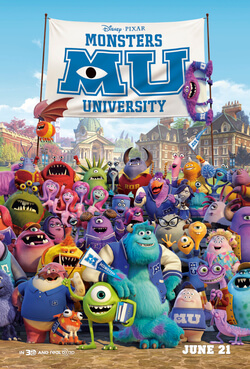
Finally, after much anticipation, the newest film from Pixar Animation Studios: Monsters University is coming into theaters tomorrow! I probably won't see it until it comes out on DVD (and I'll rent it before buying it), but still, it will be nice to finally know that Pixar has released it. I'd expect that this movie will be available on DVD by Christmas (that's normally the case for summer releases) and be available on Netflix by February of 2014. I can't wait to see how the movie turns out. Hopefully they didn't mess it up! Let's hope that this is a great family movie that we've been waiting to see for so long!

The theatrical poster for Monsters University, released tomorrow!
Here's the trailer for Monsters University:


What you can say for Monsters University is much, MUCH more than you can say for another upcoming release I've really been looking forward to called Jurassic Park IV. If you've been looking at my past posts, or have been following the news on this movie, you will recall that originally, JPIV is 1) going to take place on Isla Nublar, the island of the first movie, 2) going to feature a new terrifying dinosaur that will make you want to keep the lights on 3) will feature no feathered dinosaurs (hooray!) and 4) was supposed to be released on June 13th, 2014, but because the film's directors and writers got busy making “minor” edits to the script, the movie is now planned to be more epic than originally planned for and therefore, make the June 13th release date impossible. The latest bit of information on the movie is that a star of the first and third movies, Sam Neil, who plays Dr. Alan Grant believes the fourth movie to be a remake of the first one; it's just as likely however that, since he has not seen the new, revised script, that he could be wrong. This would also make sense considering the movie makers already declared this movie a sequel.
Well, ever since that last bit of news, we Jurassic Park fans have been waiting anxiously for more news on the film, but things at Universal Pictures (the company producing the movie) have been rather hush-hush for the past couple of weeks. So a fan tweeted to the film's director, Colin Trevorrow, on June 2, 2013 concerning the development of the movie and Trevorrow tweeted this response:
"No, [the movie is] very much alive. We're writing and designing [Jurassic Park IV]. More news coming soon."
It was also mentioned that they are in the process of writing and designing. Recently, a teaser banner for Jurassic Park IV has been made and was shown at Licensing Expo this year, best of all, the date shows 2015! It is unknown if this is the actual release date, but it's definitely a possibility. Let's hope we get more updates very soon!

Will Jurassic Park IV be released in 2015 as this teaser poster suggests? We're still eagerly awaiting confirmation from Universal Pictures
Our last update for today is on another dinosaur-flick. But unlike Jurassic Park IV, this movie is presumably already finished and simply waiting for release. The movie I'm speaking of, entitled Walking with Dinosaurs: the 3D Movie, is semi-based on the BBC 1999 series called Walking with Dinosaurs. I already mentioned it a little bit in my earlier posts, but not in great detail, so today, that's what I'm going to do! Thanks to two teaser trailers, we know that this movie stars a dinosaur known as Pachyrhinosaurus, a relative of Triceratops. Unlike the original Walking with Dinosaurs series, this new movie is not a documentary, but rather for entertainment purposes, though it is based on much fossil evidence. Also unlike Walking with Dinosaurs, which is like a traditional wildlife documentary, the new movie is featuring a voice-over of the hero dinosaur (I'm not sure if he has a name in the movie). Walking with Dinosaurs: the 3D Movie is to be released on December , 2013 and is being distributed by 20th Century Fox and is being produced by BBC Earth. For those of you who haven't seen the trailers of the film yet, here they are for your viewing pleasure:


Now to get to today's non-fiction article:

The Barreleyes fish looks like its frozen, but of course it's not. It has glowing eyes and lives in the depths of the sea. This creature lives where there is no light, only deep darkness. You can see straight through their head!!!!! They can even see you in the darkness, like cats do at night. The fish looks frozen but its not.

A Barreleye fish's head is transparent, as you can see from this photograph. This kind of barrelfish is called a Macropinna.
Barreleyes uses a big fin to keep itself almost motionless. The fish seems like its staring straight into nothing. In fact, the white circles that look like eyes are actually nostrils in disguises! The green orbs at the top of the body are its eyes, scanning waters for movement. What  a clever fish God has created! Well that's concludes our fish in the sea chapter for now! This is Joy Hammond and I'm looking forward for the next time we meet! 

Be sure to come back next week when we will learn more about nature and the world around us. See you later! 

PS: To post a comment (this is highly encouraged), please simply click the post you wish to comment on, scroll to the bottom of the page and put what you wish to say or ask in the comment box. Then in the box below the comment box choose who you’re going to comment as. And then click preview or publish. If you aren’t signed into Google, you’ll be asked to type in a word and a number in the space provided. Type the word, put a space and then put the number. Then your comment is on the blog!

PS 2: Have a puzzling question about animals (including dinosaurs), myself, my latest book, my stop-motion movies, Creation or etc? Please post your question as a comment or send me an email at animaladventures@aol.com.

PS 3: What’s the latest scoop? Check it out at SMILEY’S NEWS.


PS 4: Be sure to comment on the latest stop-motion movies too, this will help me improve them.
Thursday, June 13, 2013

The Awesome Spinosaurs pt 1. - History

Hello, everyone! Welcome back! Lately, I'll admit that I haven't been working on the my latest stop-motion series episode, "Planet of the Dinosaurs: The Tropical Poles." But this coming week, I'll be back on it! I still hope to get it complete by the end of this month.

With my one and only update out of the way, here's today's non-fiction article. I hope you learn a lot from it:

When I say “dinosaur”, what comes to mind? Perhaps the horned and frilled Triceratops, or the plated Stegosaurus, or maybe the long-necked sauropods. What about when I say “name me the largest carnivorous dinosaur you can think of”. Most would undoubtedly say, “Tyrannosaurus rex”, and indeed, T. rex is a force to be reckoned with. It's big, bad and has a four-foot long jaw with 13-inch teeth. But there are so many other theropods (a dinosaur of a group whose members are bipedal and range from small and delicately built to very large, most ate meat) that the general public doesn't no about. Henry Fairfield Osborn, the president of the America Museum of Natural History gave T. rex its name, which means “Tyrant Lizard King”, in 1905. Ever since its discovery, it became the most famous dinosaur of all. This 43-foot long menace was thought to be the largest carnivore ever to walk the earth, and it stayed that way until the 1990's. Scientists started finding larger and larger carnivores, but the biggest of all was discovered a fairly long time ago. It's name is – Spinosaurus aegypticus. But this monster went through a lot of “hard times” before it earned the title. Come along for the ride as we learn more about one of the strangest dinosaur you've probably never heard of!

Spinosaurus aegypticus, the largest carnivore ever to walk the earth!
The first fossils of this strange dinosaur were discovered in Bahariya Formation in western Egypt in 1912 by paleontologist and German aristocrat Ernst Stromer – seven years after T. rex was named. The fossils of this dinosaur he found were far from a complete skeleton, but they were enough to tell him that he'd found and completely new species. The only bones he found was a long skull, some teeth and some tall  vertebrae, many up to 165 cm long! Stromer believed, as many of today's scientists, that these supported a large sail that stood six to seven feet tall!
Some vertebrae of Spinosaurus stood over six feet tall!
In 1915, he named the creature Spinosaurus aegypticus, which apply means “Spine Lizard from Egypt,” after those spines on its back. Stromer shipped the bones to a museum in Munich, Germany for a special exhibition. He also argued that Spinosaurus was much larger than T. rex. Unfortunately for Stromer, his fossils didn't have long to be around. Why?

Well, I guess you could say human history collided with prehistory. Something terrible happened to the museum the Spinosaurus was being held in. During World War II, the Nazi headquarters were right in front of the museum with our Spino fossils, so on the tragic day of April 24, 1944, the Nazi headquarters were bombed, along with the first Spinosaurus skeleton ever found. That's not all they blew up either; along with the Spinosaurus remains were the fossils of another creature Stromer discovered, called Carcharodontosaurus. All that remain of the original Spinosaurus remains are Stromer's detailed sketches, descriptions and photographs.

Without a Spinosaurus skeleton, scientists weren't quite sure about this dinosaur. They couldn't make an accurate depiction of this beast. For the next 31 years, Spinosaurus' trail would be as cold as an ice cube in the middle of Antarctica. During this time, Spinosaurus was depicted as a four-legged, quadrupedal carnosaur with a sail on its back and four-fingered hands. Carnosaurs such as the relatively famous Allosaurus are dinosaurs with more roundish skulls. The only way scientists would be able to get a more complete picture of this dinosaur would be to find a “missing link”, not like the fictional missing links in evolutionary dogma, but the missing link that connects us to knowing more about this dinosaur.
Stromer's sketch of Spinosaurus' jawbone.
Finally, in 1983, scientists got a “lucky” break. An amatuer fossil hunter named William Walker discovered the hand claw of a dinosaur later named Baryonyx. Now when scientists uncovered the almost complete specimen of this new dinosaur, they finally realized that they had seen many of the bones in Baryonyx in another dinosaur: Spinosaurus! And indeed, after fully describing the bones, it became clear that Spinosaurus and Baryonyx are closely related. Unlike many of the drawings and pictures of Spinosaurus after the original specimen was destroyed, Baryonyx had a crocodile-like snout with conical-shaped teeth. These two animals were not carnosaurs at all. They are so different that scientists placed them in their own family (or possibly “baramin” in baraminology): the “spinosaurids”, or “spinosaurs.”

The skeleton of Baryonyx bears much resemblance to the skeleton of Spinosaurus
Thanks to Baryonyx, we now can be pretty sure of what Spinosaurus looked like
As if that weren't enough, more spinosaurids were being discovered in Europe and northern Africa. And if THAT weren't enough, in 1996, another Spinosaurus specimen was dug up in the Kem Kem Beds of northern Morocco, Africa by the paleontologist Paul Sereno and his team. By 2002, The Civic Natual History Museum in Milan obtained a skull of Spinosaurus and Cristiano Dal Sasso and his team of colleagues studied the fossils of Spinosaurus extensively. They found out many things about Spinosaurus that scientists never knew about before, but perhaps one of the most astounding things they learned about Spinosaurus was that Stromer was right all those years ago about the size of this animal - it was bigger than T. rex. In fact, as 59 feet long, it was the largest carnivorous dinosaur ever to walk the earth!
A size comparison of the largest carnivorous dinosaurs (PHOTO CREDITS)

I hope you enjoyed learning about the history of Spinosaurus. But we're far from done learning about this beast, there's much, much more! Next week, be sure to come back to this site and read my friend Joy's article and the week after that, we'll learn some more about the largest killer ever to walk the earth.

So long for now!


PS: To post a comment (this is highly encouraged), please simply click the post you wish to comment on, scroll to the bottom of the page and put what you wish to say or ask in the comment box. Then in the box below the comment box choose who you’re going to comment as. And then click preview or publish. If you aren’t signed into Google, you’ll be asked to type in a word and a number in the space provided. Type the word, put a space and then put the number. Then your comment is on the blog!

PS 2: Have a puzzling question about animals (including dinosaurs), myself, my latest book, my stop-motion movies, Creation or etc? Please post your question as a comment or send me an email at animaladventures@aol.com.

PS 3: What’s the latest scoop? Check it out at SMILEY’S NEWS.

PS 4: Be sure to comment on the latest stop-motion movies too, this will help me improve them.

Thursday, June 6, 2013

Exploring the Ocean's Less-Familiar Inhabitants pt. 2

Hello everyone! Welcome back to my website. Unlike most weeks, I don't have many updates today, but an update is an update, so I'll reveal it before we get to today's non-fiction article.

I hope you enjoyed my latest episode of the stop-motion series I'm working on called, "Planet of the Dinosaurs: Out of Africa". The next episode is "Planet of the Dinosaurs: The Tropical Poles". Now as the name suggests, this episode takes place in the polar regions of our world - the Arctic (what will become Alaska to be precise) and Antarctic. You might wonder how dinosaurs could live on these now cold and frozen places, but did you know they didn't used to be that way? Before Noah's Flood, which happened about 4,350 years ago, Antarctica wasn't in the same place it is today, it was closer to the equator and both the Arctic and Antarctic had a tropical climate. During the Ice Age is when these continents turned cold. Anyway, "The Tropical Poles" is about 55% complete. I hope to finish it by the end of this month.

Now it's time for my friend, Joy's latest article. I hope you enjoy it:

Today we will talk about predatory tunicates and the moon jellyfish. Last time, we learned about the transparent sea cucumber, who uses a surprise retreat and a glass squid, who can have no shadow! The moon jellyfish, like most jellyfish, sting with their tentacles to catch it's prey and to protect themselves from predators. Jellyfish are unique though, different most other invertebrates. God made jellyfish, such as the moon jellyfish 98% water! That's right, 98% of this guy is water, that's seems almost unbelievable. It also has no brain, I can't imagine being without one. That jellyfish sure doesn't have any imagination or dreams at night (LOL). The moon jellyfish live together with a smock or family of other another type of jellyfish. There are over 200 different shapes and colors of the moon jellyfish! What color would a water-filled jellyfish be? Why, it would be transparent of course!

A pair of moon jellies
The Predatory Tunicates are almost like Venus Flytraps underwater. It's got the easiest to do list: 1. Open mouth 2: close mouth 3. Repeat process. The tunicates anchor themselves to the ground and then wait for food to center its mouth by current. Pretty smart and a little boring if you know what I mean. Guess what else the steady current that's from top to bottom of the tunicates keep it from having the world's worst head ache (LOL)! Stay tune for Barreleyes, the fish looking frozen in time, in two weeks!

A Predatory Tunicates, the Venus Flytrap of the Sea!
I hope liked Joy's article. Tune in next week when hopefully, I'll have some more updates. By for now!

PS: To post a comment (this is highly encouraged), please simply click the post you wish to comment on, scroll to the bottom of the page and put what you wish to say or ask in the comment box. Then in the box below the comment box choose who you’re going to comment as. And then click preview or publish. If you aren’t signed into Google, you’ll be asked to type in a word and a number in the space provided. Type the word, put a space and then put the number. Then your comment is on the blog!

PS 2: Have a puzzling question about animals (including dinosaurs), myself, my latest book, my stop-motion movies, Creation or etc? Please post your question as a comment or send me an email at animaladventures@aol.com.

PS 3: What’s the latest scoop? Check it out at SMILEY’S NEWS.

PS 4: Be sure to comment on the latest stop-motion movies too, this will help me improve them.

Thursday, May 30, 2013

The Living Dinosaurs? pt. 2

Hello everyone! Once again we will begin our voyage of discovery into the amazing world God made for us. But as usual, let's start with some updates, and believe me, today they're really worth reading!

Recently, 20th Century Fox has released the second trailer for a movie I can't wait to see, "Walking with Dinosaurs: The 3D Movie". Click the video below to watch it:


If you've been reading my recent posts, you'll recall that I have been working on my most recent stop-motion series called, "Planet of the Dinosaurs" for the past five months. I expected to have the first episode released in April, but I greatly underestimated the project. Well, you'll be glad to know that I have made major progress on the first episode of the series: IT'S FINISHED!!! It's finally finished! This episode which I've entitled, "Out of Africa" will take place in Egypt as it was 4,900 years ago, when huge dinosaurs stormed the planet. While this episode will feature a variety of dinosaurs that lived in Northern Africa, it will be staring the largest carnivorous dinosaur God ever assembled: Spinosaurus aegypticus and a slightly smaller carnivorous dinosaur a bit larger than T. rex called Carcharodontosaurus saharicus. This episode is about 30 minutes long, so you may want to read today's article before watching the clip. But whatever you decide to do, I hope you enjoy it:


I'll be releasing the next episode, "The Tropical Poles" next month after it's complete. How did you like the one you just watched? Please leave a comment or two!

Now it's time for this week's non-fiction topic:

Dinosaurs used to roam all over this planet. They lived on every continent, including Antarctica. Yet, their fossils only appear in rock layers underneath the K-T Boundary. This is where evolutionists believe a massive six-mile wide comet or asteroid slammed into the Gulf of Mexico 65 million years ago and killed not only dinosaurs, but most of the marine reptiles, pterosaurs and most of the other terrestrial creatures. That's how to look at things through a secular worldview. But, as Christians, we should instead use God's Word, the Holy Bible, to determine the history of Life on Earth – in other words, we should use our Christian worldview. So, dinosaurs were on the earth, now they're not. What happened to them? Dinosaur extinction is a lengthy topic, but I'd rather not discuss it today. Instead, there's another topic we're going to look at – instead of looking at why the dinosaurs are extinct, we are going to look at if the dinosaurs are really extinct? Yes, you read right! Your typical evolutionist would say no due to their beliefs, but if we follow the Bible's framework, we learn that the Flood of Noah's time described in the Bible was responsible for the many rock layers containing fossils under K-T boundary. The Bible also says that God brought two of every kind of land animal on board (and seven pairs of clean animals), so this would have included a “teenage” or perhaps sub-adult pair of dinosaurs (which were smaller and easier to care for than full grown adults). These dinosaurs came off the ark to reproduce in the post-flood world (even if they weren't as numerous as before). You will recall if you've read the article I wrote a couple of weeks ago called The Living Dinosaurs, that that post was the first of a two part topic (you can click on the link to go to this article). On the first part of this topic, I made a review for a movie that recently came out on DVD called The Dinosaur Project, a film about an ill-fated mission to find a living Mokele-mbembe (in the movie it was a plesiosaur). The topic of dinosaurs that could possibly still be living on the planet is a very extensive topic, and I plan to delve into much of it on a later date. So on this second part of this topic, we'll be looking at an animal that might not have gone extinct at all – maybe the dinosaurs didn't die out, what if they're still among us? Let's learn about Mokele-mbembe!

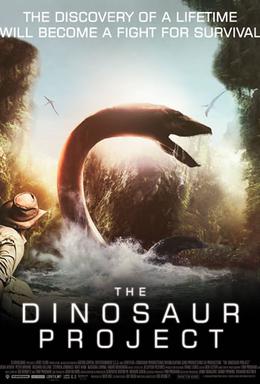
The theatrical poster for this movie
Creatures such as Big Foot, the Abominable Snowman, Loch Ness Monster and Mokele-mbembe are called “cryptids”, creatures that may or may not exist. In The Dinosaur Project, a group of scientists went to the deep jungles of the Congo in Africa to find a living Mokele-mbembe. Now, in the movie, this creature was a plesiosaur, but in reality, if this animal does exist, it is probably a dinosaur. Now let's learn about this animal in more depth.

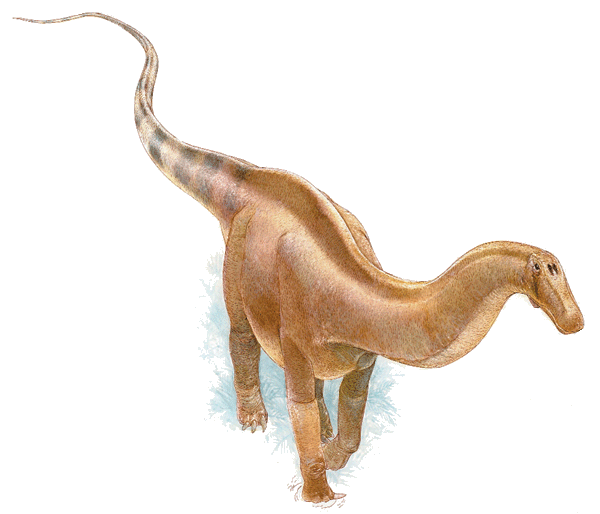
An illustration of Mokele-mbembe
Over the past 100 years, sightings of Mokele-mbembe have been reported. While each of the report does vary some, they all have some similarities. This animal is described as being the size of or larger than an elephant, having a squat body and a long neck and tail. It is said to use its long neck to reach the tree leaves and fruit it eats (sounding familiar?). This beast is believed to spend much of its time in rivers and lakes. In fact, in Lingala language, Mokele-mbembe means “one who stops the flow of rivers”. They also are said to be able to climb out of the water and onto the river banks and they leave clawed footprints behind them. So this appears to rule out most, if not all Mokele-mbembe sightings as plesiosaurs, since most plesiosaurs probably couldn't leave the water and none of them had clawed feet. No, the animal that fits the description of Mokele-mbembe isn't any animal that is known to be living today; some skeptics have claimed this creature to be anything from a crocodile or large snake to the elephant, hippo or rhinoceros. The behemoth-animal is often said to be a gray-brown color. When explorers and scientists go into the Congo and other nearby regions to find evidence of Mokele-mbembe, they will often question the natives and show them pictures of living and extinct animals. They ask the natives to tell them which animal looks most like Mokele-mbembe, the natives often point to an animal only known to modern scientists from the fossil record with a long neck and tail, small head, thick legs and a large body – they point to a member of the sauropod kind of dinosaur. One sauropod that fits the description of Mokele-mbembe is a small Apatosaurus.

A dinosaur similar to a small Apatosaurus might be responsible for the Mokele-mbembe sightings.
The first time that Mokele-mbembe was known to people other than natives was when a French Missionary to the African Congo named Lievain Bonaventure saw the humongous footprints of the creature that were three-feet in diameter in 1776, but he never saw the creature itself. Of course, considering dinosaurs weren't thoroughly described until the early 1800's, if Lievain did see Mokele-mbembe, he probably wouldn't have had a clue what it was.

But between 1910-1911, reports of Mokele-mbembe were finally making worldwide news in the newspapers. Since sauropod fossils had been discovered, many people knew of a possible identification for the beast. Some were skeptical about this animal, while others believed otherwise. But regardless of personal opinions, there was no firm evidence of the creature's existence. There was only one way to prove whether or not this cryptid exists! Explorers and scientists would have to go out themselves and find the proof!

Scientists and explorers started going out in droves to find proof of Mokele-mbembe's existence. But most came back with the same results – failure. The only “proof” they brought back was either tales, stories and descriptions of Mokele-mbembe from the locals and/or sometimes sightings of large footprints. Here are just a few of the expeditions that took place:

1919-1920 – Smithsonian Institute: Failed
1927 – Alfred Aloysius Smith: Failed
1938 – von Boxberger – Failed
1939 – von Nolde – Failed
1979 – Mackel-Powell – Failed
1985-1986 – Operation Congo – Failed
1986 – Ronald Botterweg – Failed
2000 – William Gibbons – Failed
2001 – CryptoSafari/BCSCC – Failed
2006 – Vice Guide to Travel – Failed
2009 – Monster Quest – Failed
2011 – Beast Hunter – Failed

So as you can see, no one has yet come forth with affirmative proof for its existence. I mean, even with Big Foot, we have numerous photos and even a video or two of it. But for Mokele-mbembe, not one photograph or video . . . right? Well, for the most part that's true. However, some explorers who have claimed to have seen the animal have tried to either get a photo or film it, but, of course, most of these explorers who supposedly filmed or photographed it claim that their photos either didn't come out, were blurry, not really an animal at all and etc. While it may seem a little suspicious that maybe these photos or film footage never existed to begin with, I don't find it likely that every single one of those “supposed footage” instances were fakes. And actually, we do have a video that might be of Mokele-mbembe.

In 1988, a Japanese expedition went to the Congo. The expedition was led by a wildlife official named Jose Bourges. In the year of 1992, they were filming above Lake Tele (where the natives say Mokele-mbembe is often spotted) in a plane when they noticed something in the water. The cameraman tried to get a better look at the object and he caught 15 seconds of footage of a strange object swimming in the lake. The footage isn't the best, but it does appear that it could be a large, long necked sauropod! Of course, as has been pointed out by skeptics, it might also be anything from some men in a canoe, an elephant swimming or a snake. We may never know, but maybe, just maybe . . .

While we have no current evidence for Mokele-mbembe at this point, there are still many square miles of uncharted land in the Congo and surrounding areas. Perhaps somewhere in the deep jungles remains the last living dinosaurs on the planet (it's often said that in those deep jungles, you can be a few meters from an elephant and never know it!). If a dinosaur is discovered, this isn't the first time an animal previously thought extinct was discovered: a fish called the Coelacanth was thought extinct for 65 million years was rediscovered alive and well off the coast of Africa in the Indian Ocean. The wollemia pine tree supposedly went extinct with the dinosaurs but was discovered living in Australia. A subspecies of whale thought to be extinct (by evolutionists) for the past 2 million years was also rediscovered in oceans in the southern hemisphere. So finding a living dinosaur definitely isn't out of the question.

The fossil skeleton of a large sauropod
Will scientists find a living dinosaur in the Congo? No one really knows, but it isn't out of the realms of  possibility. If they are out there (and there's definitely enough forest to hide in!), I sure hope they find one before the last of its kind vanishes from the face of the earth for good! Don't you?

Thanks for stopping by today! Be sure to come back to next week to read my co-author's - Joy Hammond's - latest article. Bye for now!

PS: To post a comment (this is highly encouraged), please simply click the post you wish to comment on, scroll to the bottom of the page and put what you wish to say or ask in the comment box. Then in the box below the comment box choose who you’re going to comment as. And then click preview or publish. If you aren’t signed into Google, you’ll be asked to type in a word and a number in the space provided. Type the word, put a space and then put the number. Then your comment is on the blog!

PS 2: Have a puzzling question about animals (including dinosaurs), myself, my latest book, my stop-motion movies, Creation or etc? Please post your question as a comment or send me an email at animaladventures@aol.com.

PS 3: What’s the latest scoop? Check it out at SMILEY’S NEWS.

PS 4: Be sure to comment on the latest stop-motion movies too, this will help me improve them.

Thursday, May 23, 2013

Exploring the Ocean's Less-Familiar Inhabitants pt. 1


 Hello everyone! Today things are going to be just a little bit different. Normally, I give you updates on things happening in my life and then I present a non-fiction article, normally dealing with animals or something else in nature. But instead, today we are having a guest writer! But we'll get to that later, first, let's do some updates:

The first episode of my upcoming stop-motion series, "Planet of the Dinosaurs", which as you will recall is entitled, "Out of Africa" is nearing completion! It stands at about 85% finished! I expect to have it completely done by the 30th of this month. I'm so glad that I'm almost finished with this first episode because I will finally be able to see my hard-work completed.

If you've been reading my recent posts, you will note that I am writing about the updates for the upcoming movie known as Jurassic Park IV. Let's recap what we've learned about the movie in the past few months:
  1. It's supposed to be a sequel.
  2. A new scary dinosaur is making an appearence
  3. It's not coming out on June 14, 2014 as originally planned due to major script changes
  4. It's taking place on Isla Nublar, the island of the first movie
  5. Colin Trevorrow is directing (he's directed movies such as Safety Not Guaranteed)
  6. No mutant dinosaurs are in this movie
Did you notice that I underlined "supposed" in the first fact? This is because in earlier interviews with people working on the movie, it was stated that Jurassic Park IV (JP4) was supposed to be a sequel. But now this is put into question based on a recent interview with one of the main actors in the first Jurassic movie, Sam Neil. He portrayed the paleontologist Dr. Alan Grant. In the interview Sam stated that:
"I'm told it's [JP4] a big reboot, a total rejig."

He also said that since he believes its a reboot, he probably won't get a part in the movie because the movie-makers will want a fresh start with new actors. Now it's believed that if this is a reboot, the movie will still follow the same storyline as the original so that its sequels are not obsolete. However, Sam also admitted that he hasn't seen the final script that the director and a few of the film's writers revised. So Sam could have gotten some of the wrong information. I don't know for sure, but it's possible (and hopefully it's true) that the older script was the reboot, and the newer script is an actual sequel. I was kind of looking forward to a sequel considering we've already been waiting 11 years for it. Only time will tell whether Jurassic Park IV is a remake or not. Hopefully not though! Here is more information about the interview:


Now, my friends, it is time for today's nonfiction article by a guest writer! Today's guest writer is Joy Hammond, a friend from the church I attend, and she wrote about some of the lesser-known inhabitants of the ocean world. Here is her article:

Have you ever noticed the beautiful chirping sound a cricket makes late in the night or watched as an ant picked up a huge crumb of bread to bring it back home? Have you taken time to stop and watch nature around you?  Well guess what, the most amazing things are all in your backyard if you stop and look around! I'm sure most of you all have been to the beach. You've all had your time, building sand castles, tanning on a beach chair, or suffering on the waves. I'm sure you she all collected seashells every once and awhile. Have you ever wondered about what creatures lie within the sea? There are millions of miles of ocean to explore and the waters get deeper as you go in. 

Did you know that there are so many different sea creatures living in the sea that scientists have hardly just begun searching for! That's right. Because you see, there are so many unknown creatures near the bottom of the ocean floor! But these animals aren't as boring as they might look at first glance, God created these animals survive in the environment they live in. Those sea creatures that live near the bottom, tend to illuminate themselves, which is amazing for both scientists and the public.

There are five creatures that I'm going to talk about, but I'm only doing two for now: Barreleyes, glass squids, Transparent Sea Cucumbers, moon jellies, and predatory tunicates.

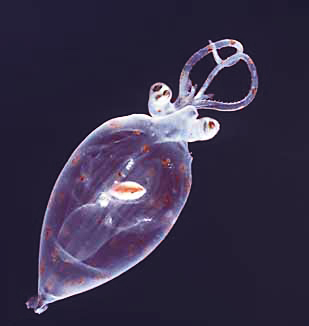
Glass squids are different than the average squid, they do not have the stinging tentacles of some other invertebrates (e.g. jellyfish) so they have to hide for their lives! As a baby squid, they live at the surface of the ocean but their transparent skin camouflaged them from predators, such as birds. As it grows, the glass squid moves deeper into the ocean, where there are larger predators but it still has camouflage. The most amazing  thing about this creature is that it can cancel out its own shadow with the small lights under its eyes, making it undetected in the ocean depths!

This is a little Glass Squid, as you can see, it gets its name from its translucent body. The only thing not transparent in these little guys is the cigar-shaped digestive gland (yes, that's in its stomach!)
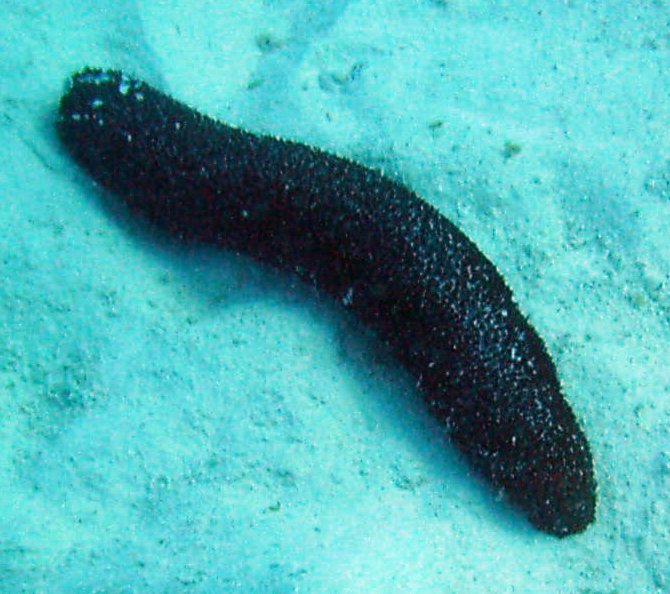
Another sea creature is the Transparent Sea Cucumber! Average sea cucumbers live on the ocean's surface searching for food. They are constantly in danger as it moves only an inch per minute. Most sea cucumbers use camouflage to protect them from sea predators, the Transparent Sea Cucumber uses a different tactic...SURPRISE! This species of sea cucumbers was found in the Gulf of Mexico. When they sense danger, the Transparent Sea Cucumber, flips its tentacles out of its tail and over itself, looking like its wearing a cape. Then the tentacles propel the sea cucumber to a different location where they start digging again.

A sea cucumber, keep in mind that these animals aren't nearly as tasty as the food cucumber!
         These creatures are just a few of thousands that live here on earth. All you have to do to meet some is stop, look around, and be patient.

What did you think of Joy's article? Please leave comments to voice your opinion!

I hope you enjoyed this article. I can't wait till next week so that, not only can we learn more about the wonderful world God made for us to enjoy, but we can also look at the first episode of "Planet of the Dinosaurs"! See you then!

PS: To post a comment (this is highly encouraged), please simply click the post you wish to comment on, scroll to the bottom of the page and put what you wish to say or ask in the comment box. Then in the box below the comment box choose who you’re going to comment as. And then click preview or publish. If you aren’t signed into Google, you’ll be asked to type in a word and a number in the space provided. Type the word, put a space and then put the number. Then your comment is on the blog!

PS 2: Have a puzzling question about animals (including dinosaurs), myself, my latest book, my stop-motion movies, Creation or etc? Please post your question as a comment or send me an email at animaladventures@aol.com.

PS 3: What’s the latest scoop? Check it out at SMILEY’S NEWS.

PS 4: Be sure to comment on the latest stop-motion movies too, this will help me improve them.